
Africans urged to invest in mineral exploration to promote value addition
“If we don’t invest in African exploration, we risk losing control over where our resources end up,” Edochie emphasized.
Marble factory managed by Sun Zhan Zhong under the Sunbelt Mining Group where marble has had value addition for export. (Credit: Wilfred Sanya)
African leaders are being urged to invest in mineral exploration to expand the continent’s mineral reserves, boost local production and promote value addition.
The Africa Finance Corporation (AFC), a pan-African financial institution, is supporting the development of an investment vehicle dedicated to financing mineral exploration and helping close the continent’s widening exploration funding gap.
Speaking at African Mining Week in Cape Town, South Africa, on October 17, 2026, Franklin Edochie, the Deputy Director and Head of the Metals and Mining Desk at AFC, said the investment vehicle is designed to expand Africa’s mineral reserves, boost domestic production and strengthen the continent’s control over its mineral resources.
This was contained in a statement issued by the African Energy Chamber.
“If we don’t invest in African exploration, we risk losing control over where our resources end up,” Edochie emphasized.
Edochie noted that Africa-led exploration financing remained insufficient, leaving the sector vulnerable to global geopolitical pressures that often determine which projects receive funding instead of prioritising minerals critical to the continent’s long-term economic development.
The AFC also plans to scale up its infrastructure investments along key trade corridors to support industrial development.
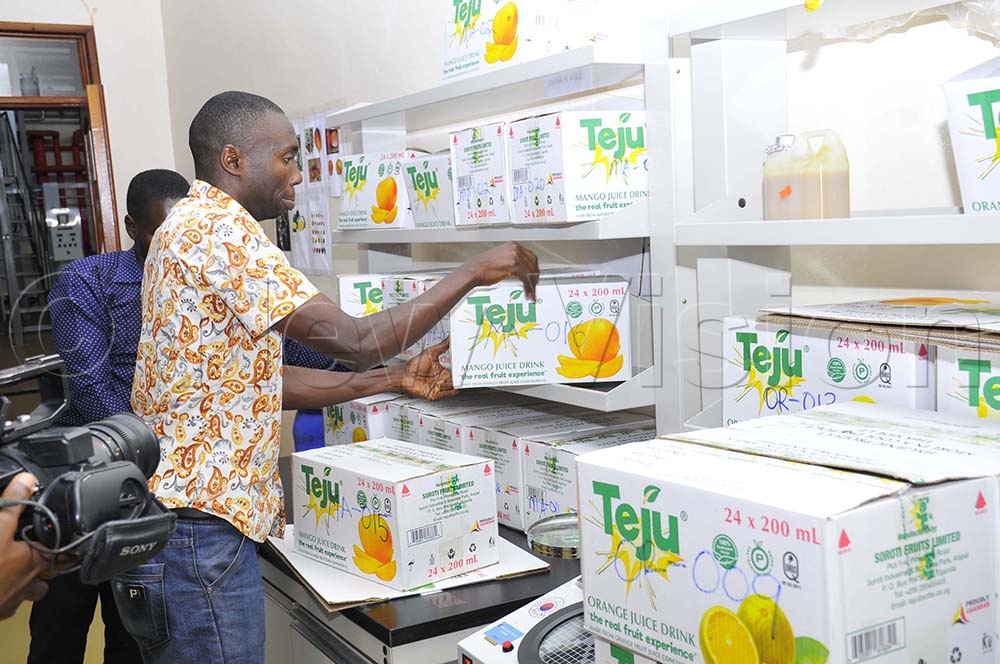
A Worker arranges boxes of finished products made out of mangoes and oranges ready for the market in Soroti City. (Credit: Wilfred Sanya)
“We want to expand our investments in regional ports and power corridors to ensure major industrial areas, such as the Copperbelt, are fully powered,” he added.
Uganda has also been pursuing policies aimed at increasing domestic processing of its natural resources rather than exporting them in raw form.
In 2025, President Yoweri Museveni announced restrictions on the export of unprocessed minerals, including iron ore, gold and tin. The Ministry of Energy and Mineral Development was to withhold export permits from companies that did not engage in local smelting and value addition.
Uganda is also preparing to develop its oil industry, with plans to process crude oil locally. Last month, Museveni launched the name “Sweat Pearl” for Uganda’s crude oil and presided over the groundbreaking ceremony for the Kampala Storage Terminal (KST) in Mpigi District.
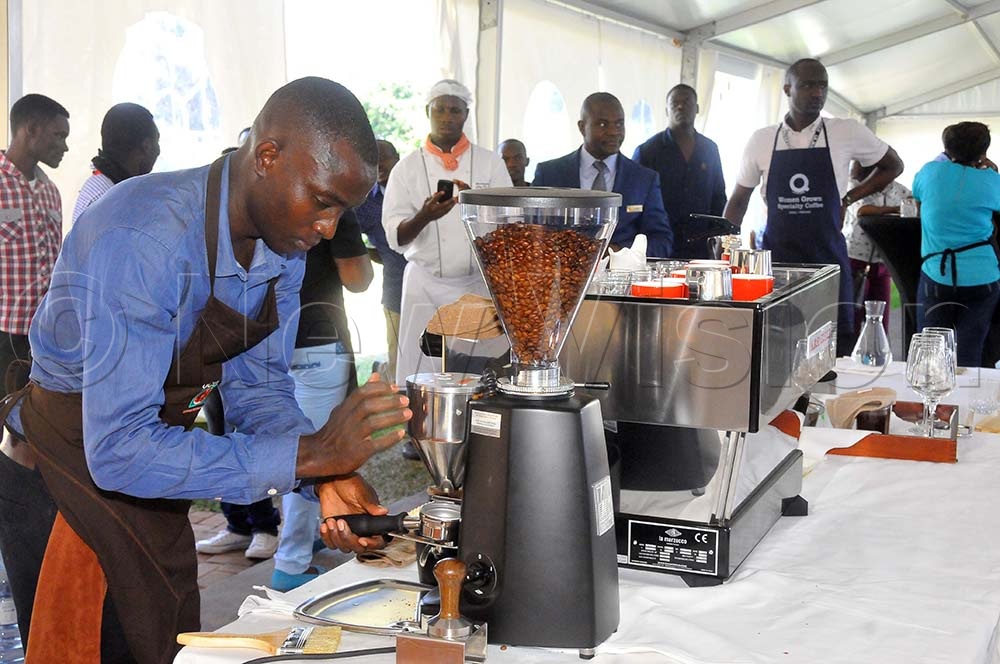
Trained to make instant coffee than having it exported outside the country without value addition. (Credit: Wilfred Sanya)
Meanwhile, Freddy Mwamba Kanyinku, Director General of the Democratic Republic of the Congo’s (DRC) Centre for Expertise, Evaluation and Certification of Precious and Semi-Precious Mineral Substances (CEEC), highlighted the country’s ongoing national geological mapping programme as a major entry point for international investors.
Kanyinku said the DRC had completed high-precision geological mapping for only 19% of its territory, but modernising geological evaluation mechanisms had already changed how foreign investors access the country’s mineral sector.
"Previously, to invest in the DRC, you had to go through Belgium first. That is no longer the case today, investors can now come directly to us," Kanyinku stated, pointing out that advanced survey equipment being procured by CEEC is giving stakeholders a clearer view of the country's resource value.
"Eighty percent of our land remains unexplored. While we have secured partnerships with countries like the US, we still have immense opportunity for international investors across these uncharted mineral regions," Kanyinku said.