
Uganda braces for first coffee training centre
Uganda and Italy have partnered to establish a coffee training centre at Kyambogo University to promote value addition, technology transfer and skills development, enabling Uganda to retain more value from its coffee exports and create employment opportunities for young people.
Prime Minister Robinah Nabbanja (centre) and Italy’s Director-General for Development Cooperation at the Ministry of Foreign Affairs and International Cooperation, Ambassador Stefano Gatti (Right), during the groundbreaking ceremony for the Uganda-Italy Coffee Training Centre at Kyambogo University on Friday, Nov. 6, 2026. (Credit: Mpalanyi Ssentongo)
________________ Prime Minister Robinah Nabbanja and Italy’s Director-General for Development Cooperation at the Ministry of Foreign Affairs and International Cooperation, Ambassador Stefano Gatti, cut the ribbon during the groundbreaking ceremony for the Uganda-Italy Coffee Training Centre at Kyambogo University. (Credit: Mpalanyi Ssentongo)
Uganda and Italy have enhanced their strategic partnership to transform Uganda’s coffee sector through value addition, technology transfer and skills development.
To achieve the objectives, on Friday, November 6, 2026, Prime Minister Robinah Nabbanja and Italy’s director-general for Development Cooperation at the Ministry of Foreign Affairs and International Cooperation, Ambassador Stefano Gatti, witnessed the groundbreaking ceremony to establish the Uganda-Italy Coffee Training Centre at Kyambogo University.
Dignitaries at the ceremony included: ministers, permanent secretaries, heads of departments and agencies, and business personalities from both Uganda and Italy.
Conveying President Yoweri Museveni’s support for the project, Nabbanja said Uganda must move beyond producing coffee to developing the expertise, infrastructure and industries needed to process and market finished products.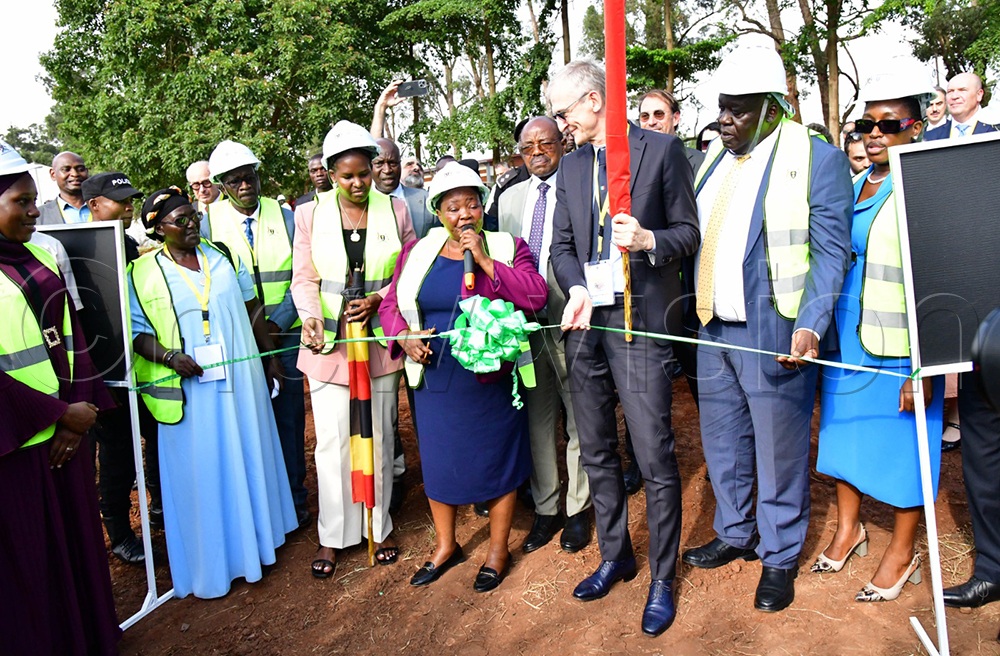
“While we grow coffee, we do not capture its full value. Much of that value is captured elsewhere,” she said.
She described the initiative as a major step towards ensuring that Uganda retains more economic benefits from its coffee instead of relying predominantly on exports of unprocessed beans.
The Prime Minister added that the facility would serve Uganda and the wider East African market, estimated at approximately 360 million people, while creating opportunities for collaboration across Africa.
Nabajja said that whereas Uganda’s exports had reached a record 8.4 million bags, valued at approximately $2.4b (sh9.7 trillion), more than 98% of the coffee leaves the country as green beans, while domestic consumption accounts for only about 8% of production. She is confident that the centre will address these gaps through professional training in coffee quality assessment, grading, roasting, processing and preparation, while strengthening the domestic market.
Noting that coffee supports more than three million smallholder farming households, Nabbanja said the initiative was particularly important for young people, given that approximately 70% of Uganda’s population is below 35 years.
“Our young people need to be equipped with the skills to test, assess and improve coffee quality, as well as prepare and serve high-standard coffee in our cafes, hotels and homes,” Nabajja said.
She revealed that said the project emerged from engagements with Italian officials, including Deputy Prime Minister and Foreign Affairs Minister Antonio Tajani, following discussions on Uganda’s ambitions to expand coffee value addition.
Nabbanja acknowledged that she initially wanted a fully-fledged coffee factory rather than a training facility but later appreciated that technical knowledge and professional skills were essential foundations for developing a competitive coffee industry.
The planned coffee hub will comprise a training centre, quality laboratory, roastery, coffee shop and coffee bar, providing practical learning and opportunities for Ugandans to experience locally produced coffee prepared by trained professionals.
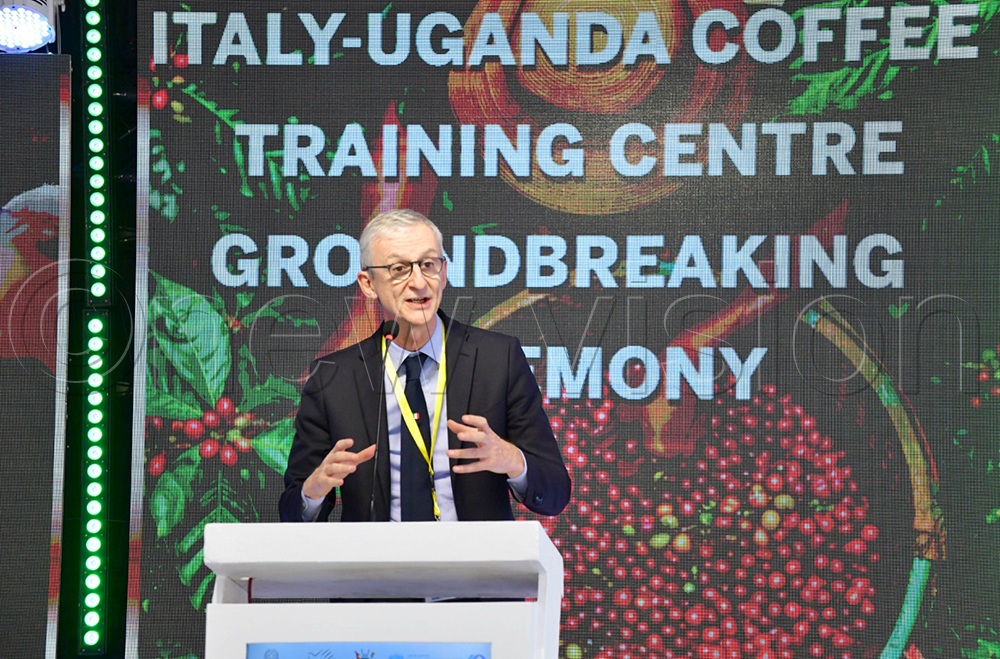
Ambassador Stefano Gatti, Director-General for Development Cooperation at Italy’s Ministry of Foreign Affairs and International Cooperation. (Credit: Mapalanyi Ssentongo)
Italy’s director-general for Development Cooperation at the Ministry of Foreign Affairs and International Cooperation, Ambassador Stefano Gatti, reaffirmed his country's commitment to supporting Uganda's coffee transformation through technology transfer, investment and skills development.
Gatti said Italy wanted to share its experience in developing coffee into a product associated with quality, culture and economic value.
“Our common challenge is to retain as much of the value of coffee as possible within this country,” he said.
He explained that Italy had successfully established a similar training facility in Addis Ababa, Ethiopia, where all young people who completed the programme reportedly secured employment.
Uganda initiative, he added, falls under Italy’s Mattei Plan for Africa and the Advancing Climate Resilience and Transformation in African Coffee (ACT Coffee) programme, with alignment to the European Union’s Global Gateway initiative. Gatti emphasised that transforming Uganda’s coffee industry required investment in farmers, machinery, irrigation, modern technology and technical education.
“The first and most important challenge is people. It is about investing in people, investing in education, knowledge and technological and technical skills,” he said.
He expressed confidence that construction would be completed within eight months, promising to return to inaugurate the facility.
Gatti is leading a delegation of over 80 Italian business personalities who are in Uganda seeking investment opportunities not limited to the coffee value chain.
The delegation is scheduled to meet President Yoweri Museveni at State House, Entebbe, on Saturday, November 7, 2026, to discuss investment and business prospects between Uganda and Italy.
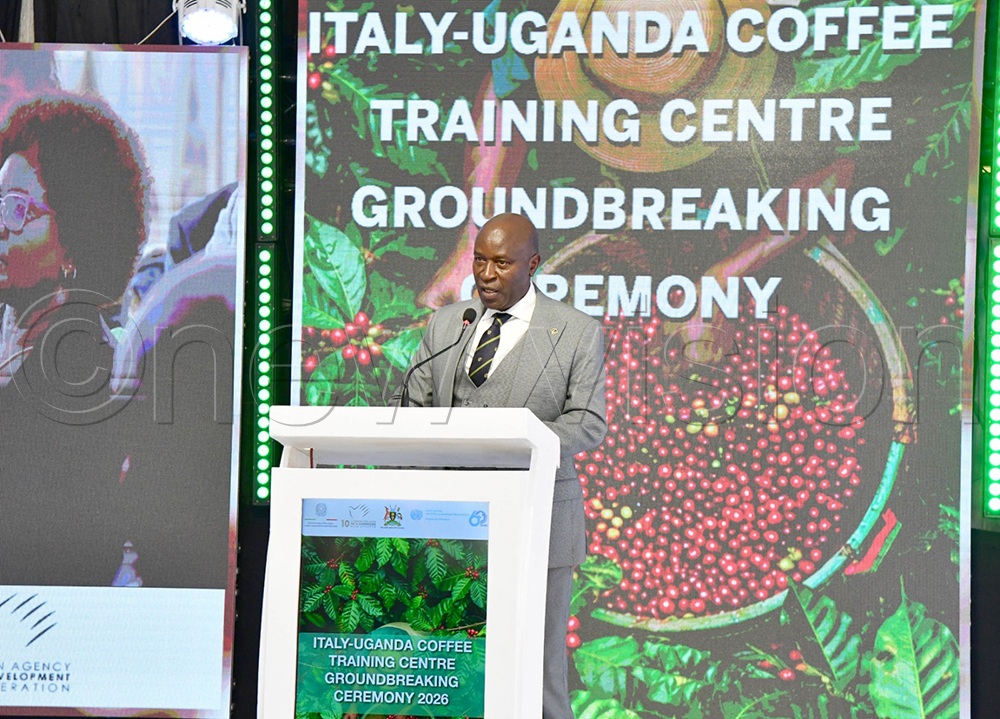
Prof. Eli Katunguka, Vice-Chancellor of Kyambogo University. (Credit: Mpalanyi Ssentongo)
Kyambogo University Vice-Chancellor Prof. Elly Katunguka welcomed the partnership, describing the centre as a milestone in the development of Uganda’s coffee industry.
Katunguka said the centre would strengthen the university’s contribution to research, innovation and entrepreneurship while positioning Uganda as a regional centre of excellence in coffee training.
“We believe that once completed and operationalised, it will make a significant contribution to strengthening Uganda’s coffee industry,” he said.
He reaffirmed the university’s commitment to providing institutional support and working with government and international partners to ensure the project achieves its objectives.
Katunguka also credited President Museveni’s emphasis on value addition for inspiring institutions to invest in processing and industrial development.