
Six million Ugandans carry sickle cell gene, health ministry warns
"The sickle cell trait affects about 15% of the population. This translates to about six million healthy people living with the trait. One in every seven Ugandans may be a carrier, and that is why we need a national call to action," Olaro said at the sickle cell press briefing on June 18, 2026.
Ministry of Health officials with other stakeholders that are fighting sickle cell disease in the country. (Credit: John Musenze)
KAMPALA - The Ministry of Health has raised concern over the growing sickle cell burden, revealing that an estimated six million Ugandans carry the sickle cell gene and could unknowingly pass it on to their children.
Speaking ahead of World Sickle Cell Day, commemorated on June 19, the director general of health services, Prof. Charles Olaro, said between 13 and 15 per cent of Uganda’s population carries the sickle cell trait, meaning roughly one in every seven Ugandans is a healthy carrier.
"The sickle cell trait affects about 15% of the population. This translates to about six million healthy people living with the trait. One in every seven Ugandans may be a carrier, and that is why we need a national call to action," Olaro said at the sickle cell press briefing on June 18, 2026.
Uganda is ranked fifth globally and fourth in Africa among countries with the highest burden of sickle cell disease, according to health officials.
The Ministry of Health estimates that 25,000 babies are born with sickle cell disease in Uganda every year, while about 9,000 children die before their fifth birthday, many without ever receiving a formal diagnosis.
Olaro said these deaths account for about 16 per cent of Uganda’s under-five mortality burden and could be significantly reduced through early testing and treatment.
Olaro highlighted the growing use of hydroxyurea, a drug that reduces the severity of sickle cell disease, citing the experience of Kayunga Regional Referral Hospital, where admissions of children with sickle cell complications have reportedly fallen following wider use of the medication.
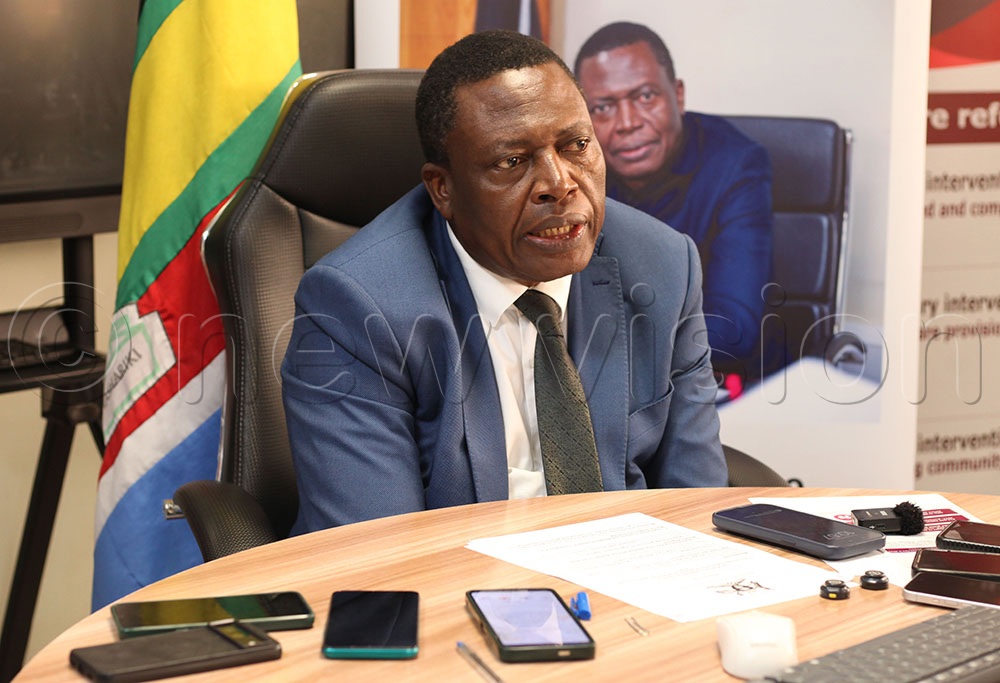
Olaro highlighted the growing use of hydroxyurea, a drug that reduces the severity of sickle cell disease, citing the experience of Kayunga Regional Referral Hospital, where admissions of children with sickle cell complications have reportedly fallen following wider use of the medication. (Credit: John Musenze)
"Previously, more than half of the children's ward was occupied by children with sickle cell disease. With hydroxyurea, admissions have dropped significantly," he said.
The ministry also announced that Uganda is transitioning from targeted sickle cell screening to a nationwide newborn screening programme, supported by locally manufactured testing kits that have already been distributed to regional referral hospitals. District laboratory teams have also been trained to use them.
"Every child who tests positive should be linked to care before complications develop. Early diagnosis and early treatment dramatically improve outcomes," Olaro said.
Dr Miriam Ajambo, the national coordinator for sickle cell disease, said prevention remains the most effective long-term strategy.
"The best way to fight this disease is to prevent it. Everyone should know their status before they decide to have a child so that carriers do not have children with fellow carriers," Ajambo said.
She described the government’s approach as “closing the tap while managing the water already overflowing,” meaning Uganda is simultaneously working to prevent new cases while improving care for those already living with the disease.
Chairperson of the National Sickle Cell Task Force, Prof. Sarah Kiguli, said Uganda already has proven interventions, including newborn screening, penicillin prophylaxis, malaria prevention, immunisation and hydroxyurea treatment.
She said the challenge now is ensuring these services reach every district and community.
"We have the evidence and the interventions. What remains is to make them available to every family affected by sickle cell disease and to increase awareness, so people know their status," Kiguli said.
World Sickle Cell Day will be commemorated today, Friday, June 19, in Jinja, a region identified as having a high burden of the sickle cell trait.