
Spike in sickle cell disease cases among children worries medics
A consultant paediatrician and haematologist at the Sickle Cell Clinic at Mulago Hospital, Dr Deogracias Munube, said the number of patients battling the disease has increased significantly over the past five years.
Dr Deogratias Munube addressing officials at Golden Tulip Hotel in Kampala ahead of the World Sickle cell day celebrations. (Photo by Simon Peter Tumwine)
__________________
An increase in the number of children diagnosed with sickle cell disease at Mulago National Referral Hospital is raising concern among health experts.
A consultant paediatrician and haematologist at the Sickle Cell Clinic at Mulago Hospital, Dr Deogracias Munube, said the number of patients battling the disease has increased significantly over the past five years.
Records at the sickle cell clinic at Mulago National Referral Hospital show that about five years ago, the facility had approximately 15,000 registered patients with sickle cell disease. That number has since risen to about 22,000. The patients come from all parts of the country.
On average, the clinic registers nearly 20 newly diagnosed sickle cell disease patients every week.
Dr Munube said the growing number of patients has created space constraints at the facility.
He added that many patients are presenting with severe complications associated with the disease.
"We are seeing a lot of children with pain, while others are developing strokes and others are developing end-organ damage," he noted.
The executive director of the Joint Clinical Research Centre (JCRC), Dr Cissy Kityo Mutuluuza, attributed the severe complications to persistent myths surrounding sickle cell disease, with some communities still associating the condition with witchcraft.
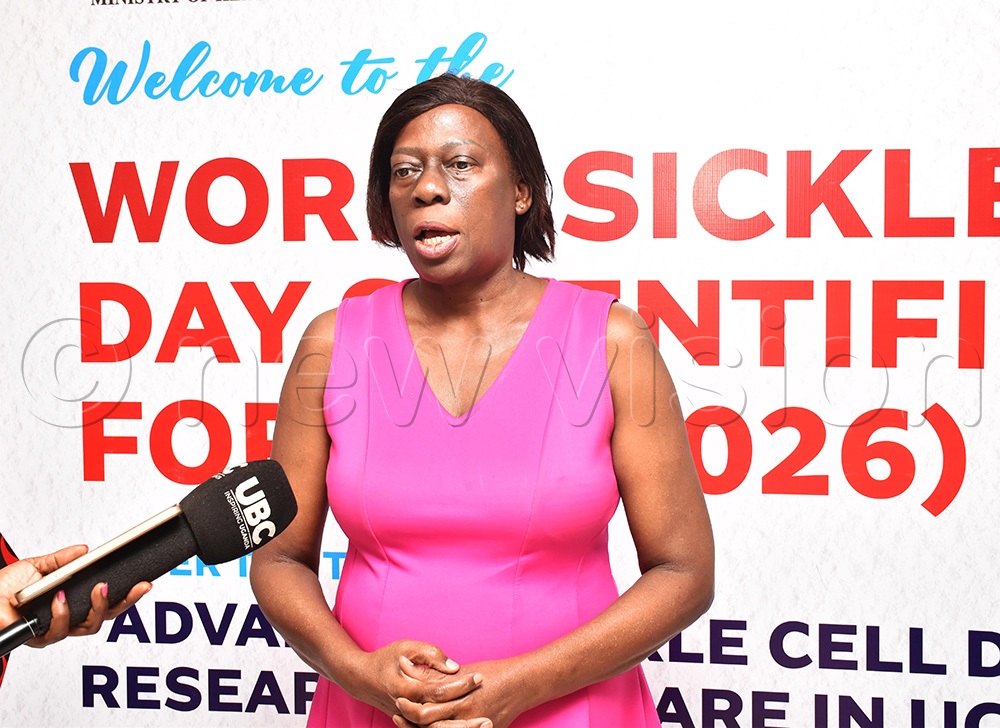
Dr Cissy Kityo Mutuluuza, the executive director of the Joint Clinical Research Centre (JCRC) addressing the media during an interview. (Photo by Simon Peter Tumwine)
As a result, children born with sickle cell disease are often taken to health facilities only after complications have already developed, Dr Kityo said.
She called for urgent public education on sickle cell disease and encouraged couples planning to marry to undergo screening so they can make informed decisions.
The remarks were made during a symposium held ahead of World Sickle Cell Day, which will be marked on June 19, 2026, in Jinja City.
Held under the theme, "Advances in Sickle Cell Disease Research and Care in Uganda", the symposium aimed to raise awareness among scientists and healthcare stakeholders.
The event was organised by the Ministry of Health in partnership with the Joint Clinical Research Centre (JCRC) and Terumo Blood and Cell Technologies. It was held at Golden Tulip Hotel in Kampala on Tuesday, June 16, 2026.
Disease burden
Sickle cell disease (SCD) remains a major public health challenge in Uganda. It is a lifelong inherited blood disorder that causes red blood cells to become rigid, sticky and crescent-shaped rather than round and flexible. These abnormal cells can block blood flow, leading to severe pain and tissue damage.
Without comprehensive care, between 70% and 80% of affected children die before the age of five.
Treatment available
Dr Munube said the Government of Uganda has made hydroxyurea, an oral medication used to manage severe sickle cell anaemia, available to patients.
He noted that hydroxyurea is now being produced locally, significantly reducing its cost.
Dr Munube said previously, the hydroxyurea drug cost as much as sh2500 (especially in rural areas).
"To date, the cost of hydroxyurea capsules has reduced to sh1,000 in the urban area pharmacies. The good news is with Quality Chemicals Industries Limited having embarked on the manufacturing of the drug about three weeks ago, the cost of hydroxyurea is expected to drop significantly to about sh500," Dr Munube noted.
According to Dr Munube, the availability of the drug has helped improve outcomes for both children and adults living with sickle cell anaemia.
“We are seeing fewer children come in with painful crises,” he noted.
However, he said, delayed diagnosis remains a major challenge, with many children only being identified after complications have developed.