
Parliament: Why Tumwebaze wants Kaunda suits, Madiba shirts legalised
“Kaunda suits, safari suits and the Madiba shirt are generally lighter than western suits, hence better suited to the climates most African legislatures like Uganda sit in. They also represent a culture of being free and accessible,” Tumwebaze summed.
Fortunately for Tumwebaze, despite putting up a strong defence, he was saved by Speaker Jacob Oboth, who said plans were in the offing to review the Rules for efficiency.
KAMPALA - For the longest time, a handful of lawmakers have taken issue with some ministers' dress codes.
Notably, that of water and environment minister Maj. Gen. (Rtd) Kahinda Otafiire and agriculture, animal industry and fisheries minister Frank Tumwebaze, who are known to don the ‘Madiba’ and ‘Kaunda suit’.
For context, the Madiba shirt is a loose-fitting silk shirt named after former South African President, the late Nelson Mandela.
The Kaunda suit, a collarless suit, was named after former Zambian President, the late Kenneth Kaunda.
The attires have repeatedly come under fire from purists on the pretext that they do not fit the prescribed description of attire meant to be worn when the House is in session.
So much so that former Kiira Municipality MP Ibrahim Semujju Nganda once admonished a minister for dressing as though he was “going to milk cows.”
Such was the case on August 20 this year, when Kilak South MP Gilbert Olanya (FDC) lunged into Tumwebaze, who was dressed in a blue, short-sleeved Kaunda shirt with white stripes, accusing him of breaching Rule 88 of the Rules of Procedure.
Under Sub-rule 4 of the provision, a presiding officer can order a member who is indecently dressed out of the Chamber or committee and allow them to return only when they are in order.
Fortunately for Tumwebaze, despite putting up a strong defence, he was saved by Speaker Jacob Oboth, who said plans were in the offing to review the Rules for efficiency.
Legal Committee, Tumwebaze meet
However, an unrelenting Tumwebaze took the fight to the streets of X (formerly Twitter), denouncing what he appeared to view as compradorism.
Luckily, on Tuesday (September 1), he was given an opportunity to make his case before the Legal and Parliamentary Affairs Committee, which was chaired by Fred Ruhindi (Nakawa East, NRM).
He made a strong case, arguing that even in the Parliament of Uganda's former colonial master, the United Kingdom (UK), there is no specific rule outlining a dress code.
Rather, the Speaker can exercise discretion where they deem a member to be informally dressed.
He added that the same applies to other Commonwealth countries to which Uganda belongs, such as Australia, where MPs are free to wear tailored “safari suits” without a tie.
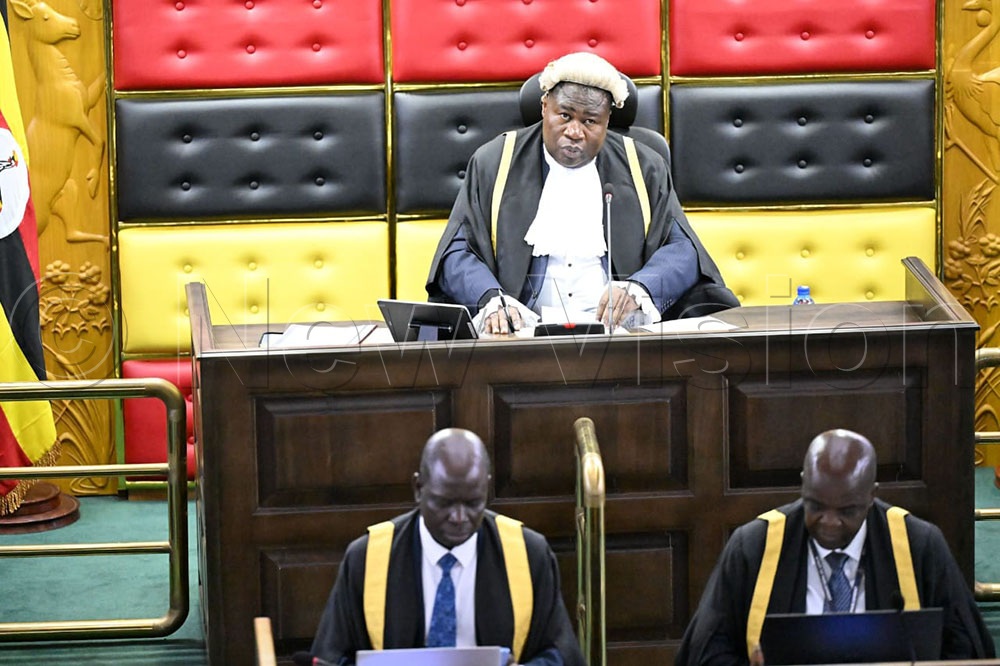
Fortunately for Tumwebaze, despite putting up a strong defence, he was saved by Speaker Jacob Oboth, who said plans were in the offing to review the Rules for efficiency. (Credit: Maria Wamala)
He also said they could wear a cap when the House is in session, provided they are not on the floor.
The Kibaale East lawmaker also said the same applies in the Caribbean, where the “Kariba suit” is permitted.
“In India, the formal wear known as the “Nehru collar shirt” is the preferred dress for male members of Parliament,” Tumwebaze contended.
Furthermore, he retorted that several indigenous communities had successfully challenged provisions similar to those in Uganda.
“In New Zealand in 2021, the Maori party co-lead Hon. Rawini Waititi was removed from the Chamber for wearing a traditional pendant. The next day, the Speaker allowed him to speak without a tie,” Tumwebaze stated.
Fast-forward, he said the above shows that there is no one-size-fits-all approach, as some would want to believe. Rather, Uganda should follow the lead of other continental parliaments, which have adopted traditional attire.
“The western business suit inherited from the colonial administration has largely dominated the dress code for members of parliament for many years. Retaining that standard decades after independence means the Parliament of Uganda would be signalling, symbolically, that other African forms of dress are inferior and less legitimated in spaces of power,” he retorted.
“Kaunda suits, safari suits and the Madiba shirt are generally lighter than western suits, hence better suited to the climates most African legislatures like Uganda sit in. They also represent a culture of being free and accessible,” Tumwebaze summed.
MPs respond
The Minister's arguments were backed by several lawmakers, including Richard Ongorok (Usuk County, NRM).
He reasoned that allowing such suits would give leverage to designers of traditional attire to make a killing.
“Economically, I have seen many people fly out of this country just to buy suits, and they are spending dollars. Which dollars we could use to develop our economy locally here and probably to give an opportunity to the young people who are in the textile industry, the tailors and the rest to prosper,” Ongorok intimated.
Committee chairperson
Fred Ruhindi (Nakawa East, NRM) observed, “Many of the Eastern Countries why they survived the severe consequences of colonialism because they kept their culture. The Indians, you know. Those eastern countries, Malaysia.”
“At one point, I was even actually toying with the idea that we could even have a committee in Parliament to follow up on our customary practices. The reason being, I will give you an example. Our land in Uganda, about 20% is titled; 80% is not; it is communally owned. But it is strange to go to the Ministry of Lands, and you don’t even find a dedicated department of customary practices,” Ruhindi opined.