
News
Land disputes, domestic violence, poverty blamed for rising crime
A security report presented to Parliament by Internal Affairs Minister Prof Ephraim Kamuntu on November 4, 2026, identifies six major drivers of criminality: land and property disputes, domestic and family conflicts, economic hardship, substance abuse, organised criminal gangs and mob justice.
Internal Affairs Minister Prof. Ephraim Kamuntu presenting a security report to Parliament. (Photo by Maria Wamala)
By: Nelson Mandela Muhoozi and Dedan Kimathi, Journalists @New Vision
________________
Land disputes, domestic violence and poverty are among the major factors driving violent crime and killings in the country, according to the Ministry of Internal Affairs.
A security report presented to Parliament by Internal Affairs Minister Prof Ephraim Kamuntu on November 4, 2026, identifies six major drivers of criminality: land and property disputes, domestic and family conflicts, economic hardship, substance abuse, organised criminal gangs and mob justice.
The report comes amid growing concerns over violent incidents in districts including Ibanda, Kazo, Mubende, Kyegegwa, Mitooma, Bukwo, Sheema, Kagadi, Ntungamo and Masaka.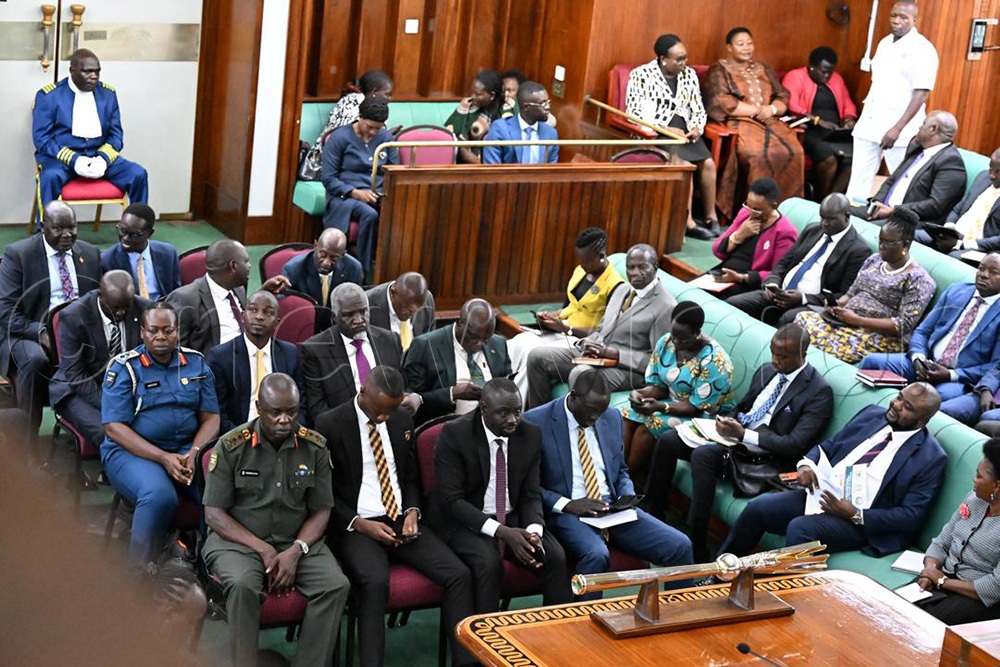
Some of the Members of Parliament attending plenary. (Photo by Maria Wamala)
Police recorded 3,192 homicide cases between January and September 2026, of which 2,302 were still under investigation, 818 had been forwarded to court, and 72 had been dropped.
Land, inheritance disputes turning deadly
Land and property disagreements are among the leading triggers of violent incidents identified by police.
The report notes that the conflicts often involve family members fighting over inherited property, ownership, boundaries and control of land.
In some cases, disagreements that could be resolved through established legal processes escalate into physical confrontations and killings.
The report identifies inheritance disputes and disagreements among relatives as recurring factors behind murders in several affected districts.
In Kyegegwa, for instance, police recorded a land-related murder at Kyarujumba on October 9, 2026, following other violent incidents in the district.
The Government has also acknowledged the wider security implications of land disputes. In August 2026, the Ministry of Lands issued new guidelines to improve the handling of land conflicts, citing violence, property loss and insecurity associated with poorly managed disputes.
Domestic violence
The report also points to domestic violence, marital breakdowns, infidelity, divorce and suspicions of witchcraft as factors contributing to violent crime.
Police investigations in Ibanda established that family wrangles, domestic violence and social disputes were behind several killings.
Between June and September 2026, the district registered 18 murder cases involving 23 victims.
Kazo recorded 13 murder cases involving 17 victims between July and September, with police linking several incidents to family disputes and brutal attacks on households.
Among the cases were the killings of three children and a mother with her two sons. These incidents highlight the danger posed by unresolved conflicts within families, where disputes can escalate into attacks against spouses, children and other relatives.
Poverty, unemployment and debt
Economic hardship is another factor police identified as contributing to criminality.
According to the report, unemployment, gambling, debts and financial competition are among the pressures associated with criminal behaviour.
Police say financial difficulties can fuel disagreements, theft, robberies and other criminal activities as individuals struggle to meet their financial obligations or seek quick money.
The report also identifies poverty as a factor that can expose communities to criminal networks and increase vulnerability to property-related offences.
Alcohol and drug abuse
Substance abuse is another major concern, with police warning that excessive alcohol consumption and drug use can impair judgement and turn ordinary disagreements into violent confrontations.
The report links substance abuse to domestic disputes and other personal conflicts that have resulted in killings.
The concern is particularly significant because substance abuse can aggravate existing tensions within households and communities, increasing the likelihood of physical attacks.
Criminal gangs and repeat offenders
Beyond domestic and family-related violence, organised criminal gangs are also contributing to insecurity in some districts.
In Bukwo, police identified a group known as B13, operating around Amanang Centre, Kapkoros sub-county, Suam and Bukwo town council.
Between April and September 2026, the gang was linked to eight murders, six robberies, 10 break-ins, 10 cases of animal theft and two produce thefts.
Police also reported criminal networks operating across districts, with investigations linking a rape-murder case in Kazo to a criminal gang associated with Ibanda.
Kazo MP Dan Kimosho further raised concern over what he described as similarities in the methods used in killings across Ibanda, Kazo, Sembabule and Mubende.
He said the attacks appeared coordinated and sophisticated, with victims being killed without attracting the attention of neighbours.
Kimosho called on security agencies to investigate possible links between the incidents and establish whether criminal networks were sharing methods or operating across district boundaries.
Mob justice undermining law enforcement
The report also identifies mob justice as a contributor to insecurity, attributing it partly to limited public understanding of formal judicial processes.
Police say strengthening community policing and improving public awareness of lawful dispute-resolution mechanisms are necessary to address the problem.
Police capacity and crime prevention
The report outlines several interventions intended to address the identified causes, including intelligence-led operations, increased patrols, forensic investigations, CCTV surveillance and stronger community policing.
The government also plans to accelerate the subcounty policing model, under which each sub-county is expected to have 18 police officers, three motorcycles and other operational facilities.
However, MPs questioned whether the programme had sufficient funding and personnel to deliver the intended results.
Katikamu County North MP Denis Sekabira said the government had allocated sh50b towards the programme, against a projected requirement of sh249b.
Kazo MP Dan Kimosho also raised concerns about inadequate fuel and grounded police motorcycles, saying some subcounty police commanders received only sh50,000 a month for fuel.
Presenting the report, Kamuntu maintained that Uganda's overall security situation remained stable and under control, describing the reported incidents as largely isolated.