
Land grabbing, cattle rustling and insecurity still undermine Karamoja's recovery — EOC
The concerns were raised on Friday during a high-level stakeholders' dialogue on gender and equity issues affecting Karamoja sub-region held at the EOC headquarters in Kampala.
The chairperson of Equal Opportunities Commission (EOC), Hajjat Safia Nalule Juuko, speaks during a meeting with the Member of Parliament from Karamoja Region at EOC offices, Kampala, on 10 July 2026. (Photos by Ronnie Kijjambu)
________________
Persistent land grabbing, cattle rustling and insecurity continue to undermine livelihoods, food security and economic recovery in Karamoja sub-region, the Equal Opportunities Commission (EOC) has warned.
The concerns were raised on Friday during a high-level stakeholders' dialogue on gender and equity issues affecting Karamoja sub-region held at the EOC headquarters in Kampala.
Presenting findings from recent engagements with district councils in Karamoja, EOC Senior Compliance Officer Irene Nafungo said communities in the sub-region continue to grapple with land disputes, human-wildlife conflicts and male-dominated land ownership patterns that disproportionately affect women and vulnerable groups.
"Land grabbing, land disputes, human-wildlife conflict, cattle rustling and male-dominated land ownership continue to threaten livelihoods, food security and women's economic empowerment," Nafungo said.
The Commission's findings further showed that recurrent insecurity has disrupted education, service delivery, agricultural production and broader economic recovery efforts across the sub-region.
According to the report, poverty and food insecurity remain widespread, with 74.2 percent of Karamoja's population living below the poverty line compared to the national average of 16.1 percent.
According to the Uganda Bureau of Statistics (UBOS) 2024 National Population and Housing Census, the population of the Karamoja sub-region is 1,496,117.
Food shortages, livestock losses, limited access to credit and vulnerability to climate and economic shocks were also cited as challenges that continue to constrain livelihoods.
The report also highlighted the plight of minority and marginalised communities, particularly the Ik community, estimated at about 27,872 people, who continue to face limited access to education, healthcare, infrastructure and economic opportunities due to geographical isolation.
District-specific findings revealed that Kaabong continues to grapple with insecurity, food shortages and the marginalisation of the Ik community, while Karenga faces persistent human-wildlife conflicts, land grabbing, poor internet connectivity and concerns over district-specific resource allocation.
Beyond security concerns, the Commission found that only about 19 percent of children who enrol in Primary One complete Primary Seven due to challenges such as non-coded schools, inadequate secondary and technical education facilities, shortages of Special Needs Education teachers, poor learning infrastructure and seasonal barriers to education.
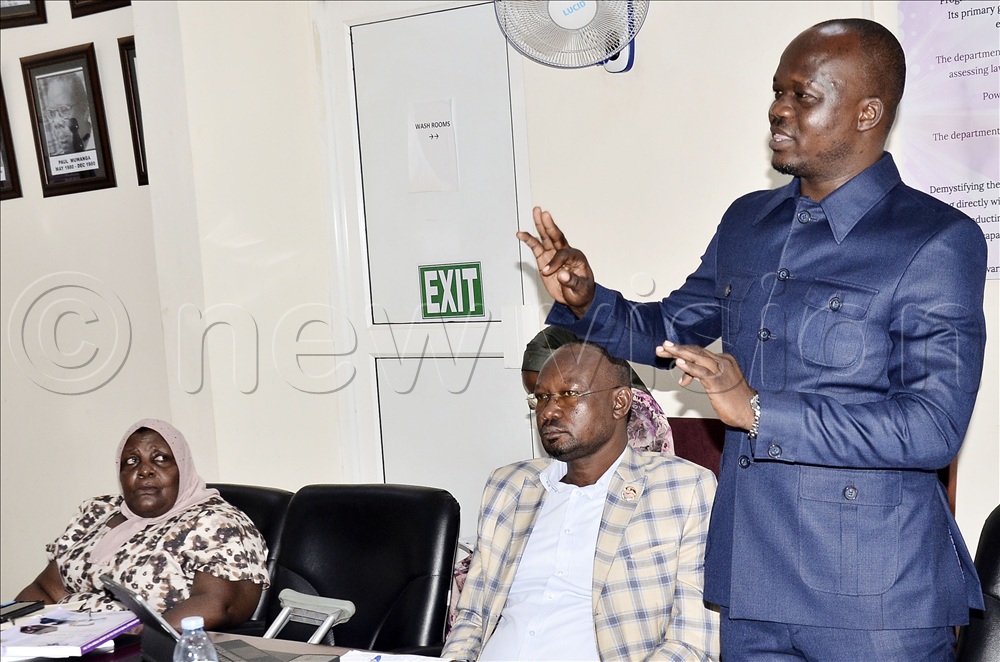
The chairperson of the Equal Opportunities Commission (EOC), Hajjat Safia Nalule Juuko (left) looks on as the member of Parliament for Chekwii East in Nakapiripirit district, Lokoru Stephenson Yoyo (right), speaks during a meeting with the Member of Parliament from Karamoja Region at EOC offices, Kampala, on 10 July 2026. Centre is the MP for Dodoth West and the chairperson of Karamoja Parliamentary Forum, Baatom Ben Koryang.
The Commission also established that approximately 84 percent of youth in Karamoja experience multi-dimensional poverty characterised by high unemployment, limited vocational and technical training opportunities, inadequate access to government livelihood programmes, low financial literacy and migration in search of employment.
Responding to the findings, EOC chairperson Safia Nalule Juuko urged Members of Parliament from Karamoja to move beyond the rhetoric and adopt an evidence-based approach in addressing the region's challenges.
Juuko challenged the legislators to become more proactive in engaging ministries and government agencies before budgets and development plans are finalised.
"You don't wait for people to plan for you. Take your issues first and talk with the agencies concerned so that they include them in their plans and budgets. You are the people who pass the national budget. How do you fail to work with the Speaker and ministers to ensure that a budget cannot be passed until it has issues of Karamoja?" she asked.
Karamoja Parliamentary Group Chairperson and Dodoth West MP Ben Baatom Koryang said the report provides a critical platform for advocacy and engagement with government institutions responsible for service delivery.
"We need to put our feet on the ground to make sure that whatever has come out of here, we take it forward. We need to engage every entity responsible for delivering services in Karamoja and make sure they do their work," he said.
Koryang noted that persistent gaps in education, health, water and agricultural development continue to impede recovery efforts despite existing government commitments, and called for more detailed, data-driven reports to strengthen advocacy.
"If EOC can give us that kind of information with so much detail and statistics, it can help us push so that our voice is heard and whatever needs to be done for Karamoja is brought forward," he said.
Abim District Woman MP Joyce Akamoe Aayoo said years of cattle raids and insecurity have left many families in Karamoja impoverished and struggling to recover economically.
"The cattle raids have left our people orphans, left families with children as heads of households and left us poor. It will take us many years to recover from this poverty, and the only thing that can help us get out of it is when we are restocked," she said.
Aayoo appealed for government support to restore livelihoods and ensure communities affected by cattle raids are compensated and economically empowered.