
Uganda shifts from disaster response to prevention
The multi-hazard integrated early warning system alongside the national anticipatory action roadmap (2026-2031) represents a fundamental shift in Uganda's disaster management: from responding to emergencies after they occur to anticipating hazards through scientific forecasting and taking early coordinated action to reduce their impact on vulnerable communities.
Officials from different government ministries plus those from the UN agencies and Uganda Red Cross after the launch of a multi hazard integrated early warning system alongside the national anticipatory action roadmap on Friday, in Entebbe municipality. (Credit: Julius Luwemba)
As prolonged drought tightens its grip on Karamoja and weather experts warn of El nino rains that could trigger devastating floods and landslides later this year, the government unveiled an ambitious national blueprint intended to stop disasters from becoming humanitarian crises.
The landmark national framework, the first of its kind in Africa, was launched by the Office of the Prime Minister in conjunction with several agencies of the United Nations, at a function held on Friday at Imperial Resort Hotel in Entebbe municipality.
Alex Kakooza, the permanent secretary to the Office of the Prime Minister, said the multi-hazard integrated early warning system alongside the national anticipatory action roadmap (2026-2031) represents a fundamental shift in Uganda's disaster management; from responding to emergencies after they occur, to anticipating hazards through scientific forecasting and taking early coordinated action to reduce their impact on vulnerable communities.
The roadmap seeks to institutionalise anticipatory action by ensuring that early warning information triggers predefined interventions before disasters occur.
"These actions may include distributing drought-resistant seeds ahead of predicted dry spells, relocating vulnerable populations before floods, protecting livestock during disease outbreaks and pre-positioning relief supplies in areas expected to be affected," Kakooza, the permanent secretary, explained.
The launched six-year roadmap aims at shifting from costly emergency response to anticipatory action as climate threats intensify.
The minister for relief, disaster preparedness and refugees, Sam Engola, confirmed that the roadmap comes at a time when Uganda is experiencing increasingly frequent and severe disasters driven by climate change and other emerging risks.
"With the ongoing drought in the Karamoja sub-region, the forecast of a super El Niño later this year, and widespread poverty that heightens vulnerability, it becomes urgent for us to strengthen preparedness and anticipatory action," Engola expressed.
He appealed to the development partners and donors to continue supporting the government-led priorities by investing in sustainable, long-term systems that strengthen national capacity and resilience.
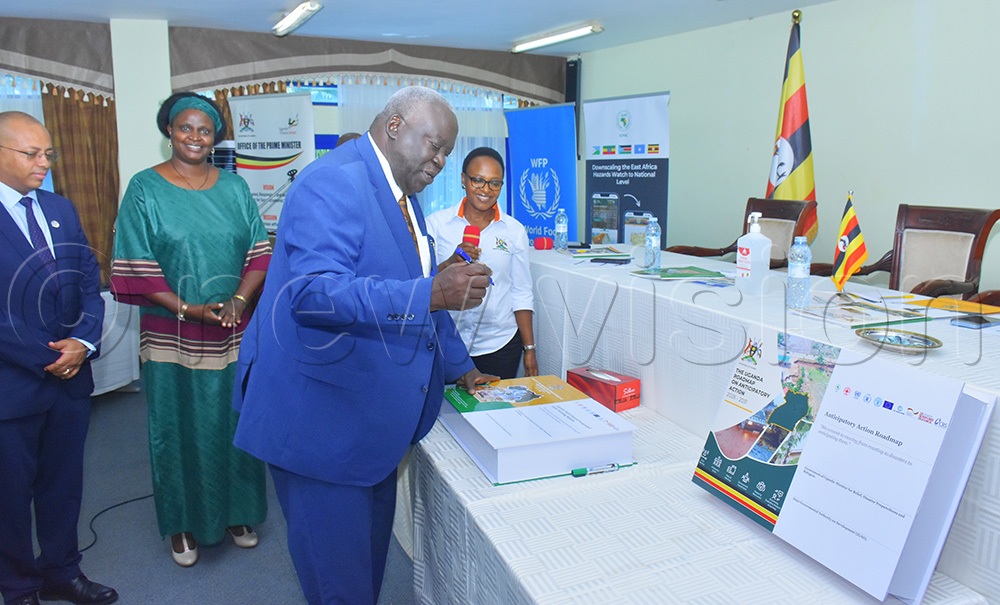
Sam Engola appending signature on the newly launched multi hazard integrated early warning system alongside the national anticipatory action roadmap at Imperial Resort hotel in Entebbe municipality on Friday. (Credit: Julius Luwemba)
Other agencies represented include the Food and Agriculture Organisation (FAO), World Food Programme (WFP), Intergovernmental Authority on Development (IGAD), Uganda Red Cross Society and United Nations Office for Disaster Risk Reduction among other partners.
"Together with the government of Uganda and partners, FAO supported the establishment of four national multi-hazard early warning systems across Karamoja, Teso, Rwenzori and Mt. Elgon that are strengthening local capacities to monitor hazards, analyse risks and disseminate timely warnings," Kassa explained.
Taking note that Uganda is once again facing heightened climate and disaster risks with forecasts indicating above-normal rainfall, the FAO and WFP also launched the global El Niño joint anticipatory action appeal calling for timely investments that enable countries to act before climate shocks escalate into humanitarian crises.
Marcus Prior, the WFP deputy country director, also noted that as climate variability and extreme weather events become more frequent and severe in Uganda, responding after disasters strike is no longer enough. "This is particularly relevant as Uganda prepares for the anticipated impacts of El Niño," Marcus remarked.
The WFP representative said a fully-fledged anticipatory drought action plan was launched in Karamoja last month (June), as well as supporting the development of flood anticipatory action systems that use forecast information and agreed triggers to activate early preparedness measures in South Western Uganda. According to Marcus, such anticipatory action is most effective when it is government-led, science-based, pre-planned and backed by predictable financing.
The government and UN agency officials unanimously believed that Uganda's new roadmap signals a border policy shift towards resilience rather than reaction.
The new roadmap aligns with Uganda's Vision 2040, the National Development Plan IV, among other international frameworks, all signalling that disaster preparedness is becoming part of the mainstream national development plan rather than remaining a humanitarian concern.