
Jinja leaders tipped on comprehensive monitoring to avert govt losses
“Your role is to protect government from losses; this is how we detect ghost learners and teachers. You are very important persons who came to serve your people,” said Okiring.
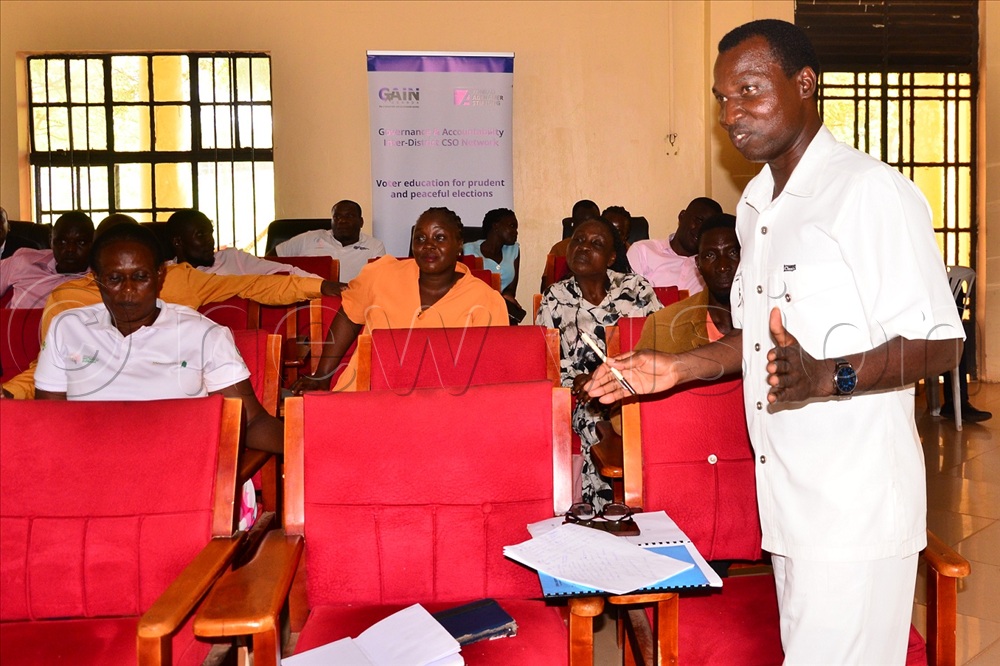
Jackson Okiring, a lead facilitator with the Governance and Accountability Inter-District CSO Network (GAIN), speaking to the leaders at the council hall on Saturday. (Photos by Jackie Nambogga)
________________
Politicians and technical officials in Jinja district have been urged to adopt a comprehensive approach to monitoring government programmes to strengthen accountability and prevent the loss of public resources.
Jackson Okiring, a lead facilitator with the Governance and Accountability Inter-District CSO Network (GAIN), said it was not enough for monitoring teams to inspect a two-stance latrine at a school or health centre and leave without investigating the institution's wider challenges.
Besides inspecting the progress of government projects in communities or commissioning completed ones, Okiring said monitoring teams should use such visits to conduct impromptu headcounts of learners in schools.
“Your role is to protect government from losses; this is how we detect ghost learners and teachers. You are very important persons who came to serve your people,” he said.
He was speaking during a one-day induction for Jinja district councillors organised by GAIN, with support from Konrad Adenauer Stiftung, at the district council hall on November 7, 2026.
Simon Kibombo, the Jinja district speaker remarking
Okiring maintained that comprehensive monitoring of government programmes in specific areas would help communities experience improved service delivery.
Majid Dhikusooka, the Pallisa resident district commissioner, said the current approach to implementing government projects resembled tourism, creating room for corruption.
He said project launch and commissioning events provided opportunities to sensitise communities about projects being undertaken in their areas, their costs, completion timelines and the different responsibilities of stakeholders in ensuring their implementation.
“Avoid tourism implementation of government projects, mobilise the communities and sensitise them on what is being brought for them to create a sense of ownership and appreciate government impacts,” he urged.
Okiring also questioned the practice of using convoys to monitor small projects such as two-stance pit latrines, saying a van would be sufficient where the facilities met the required standards.
“Why do you move in a convoy just to monitor a pit latrine, avoid isolated projects, get a list of them in a subcounty and do impromptu visits to ascertain the number of teachers on payroll? This is how you also come across inflation of learners in schools,” he urged.
He said schools continued to complain about understaffing because some teachers were not implementing their lesson plans as required.
While a teacher was expected to conduct more than 20 lessons a week, some were teaching only 10, he said.
“Our teachers are not being utilised well; if they were following their lesson plans, we would not be yearning for more, but there is that gap,” he said.
Councillors also outlined challenges they had encountered since assuming office. John Kizito, representing older persons, cited delayed procurement, lack of respect, arrogance and selfishness.
District speaker Simon Kibombo said ignorance of the law had divided the council, with the LC5 chairperson, Moses Batwala, the executive and councillors failing to understand their respective powers and responsibilities.
He attributed this to the lack of reference materials, such as the Local Government Act, to guide council business.
Allan Kakuku, the Buyengo town council councillor and deputy speaker, said unnecessary conflicts had arisen because some senior leaders were prioritising their future political ambitions.
“Some leaders want to be seen as stars in public by causing unnecessary divisions in council to assume that they are working, we are progressing,” Kakuku noted.
Of the 24 councillors, 15 were first-time members who needed the induction to address gaps in their understanding of council business, according to Moses Lwokyaza, the workers' councillor.
Batwala, who has been involved in local politics since 2001 and is serving his second term as LC5 chairperson, said the induction and civic learning booklets provided would guide councillors in carrying out their legislative duties in accordance with the law.
Samson Okurut, GAIN's programmes manager, said the organisation had intervened following a request from Lwokyaza, who cited overlapping responsibilities and persistent conflicts within the council.
Okurut expressed optimism that the knowledge acquired would help councillors strengthen their representative, legislative, budgetary and oversight roles, as well as their monitoring of the Parish Development Model (PDM), while working together to serve Jinja district.