
Govt to reintroduce express penalty scheme to curb road accidents
Lord Mayor Eng. Ronald Balimwezo (centre left), Asst. Commissioner, works ministry Apollo Kashanku, with officials from KCCA, Police and ROSACU. (Photo by Jovita Mirembe)
_______________
For Farooq Muwanga, a 36-year-old taxi driver, a road accident in 2020 changed his life in ways he never imagined. What began as an ordinary day ended with a fractured leg, years of limited mobility and medical expenses he is still struggling to meet.
“I spent two years in a wheelchair, two years using crutches and two years now with metals in my leg. I can no longer do some of the things I used to do before I got involved in an accident, like playing football, which I loved so much,” Muwanga says.
Doctors initially advised him to get an artificial limb after the operation, but the procedure would have cost him sh70m, money he could not afford. Instead, they inserted metal plates and steel in his leg to enable him to walk again.
“However, I now need sh20m to remove the metals because their time has expired, but I don't have the money,” he says.
Muwanga is appealing to well-wishers to help him raise the money needed for the operation. He also has a message for fellow taxi drivers: listen to their stage chairpersons when they advise them to repair their vehicles or replace worn-out tyres.
He believes that maintaining vehicles in good condition is one of the ways road accidents can be prevented.
Muwanga is among the many Ugandans whose lives have been disrupted by road crashes, a problem that continues to claim lives and leave survivors with permanent injuries and disabilities.
For Rose Tumwine, the consequences of a road accident were made even more difficult by the fact that she was pregnant at the time.
Tumwine says she was knocked down by a speeding bodaboda in April 2025 as she attempted to cross the road along the Entebbe Expressway. A taxi conductor had grabbed her hand, trying to persuade her to enter his vehicle, leaving her unaware of the approaching motorcycle.
“In April last year, I was involved in a road accident when I was trying to cross the road along the Entebbe Expressway when a taxi conductor grabbed my hand to enter his taxi. Little did I know that there was a speeding boda boda coming towards me,” she says.
The motorcycle knocked her down, leaving her unconscious. When she regained consciousness, she found herself in a hospital bed with her broken leg placed in plaster and suspended.
Tumwine gave birth while her leg was still healing. It took six months for the fracture to heal, during which her parents, with whom she was living, had to sell several household items to raise money for her treatment.
Today, Tumwine says she is grateful that her leg recovered and that she can walk again.
Her story, like Muwanga's, highlights the lasting physical, emotional and financial consequences of road accidents, even for those who survive them.
As Uganda approaches the festive season, the Government, through the Uganda Police Force, is preparing to reintroduce the Express Penalty Scheme (EPS) in a renewed effort to curb road accidents and punish traffic offenders.
Apollo Kashanku, the Assistant Commissioner for Road Transport Regulation and Safety at the Ministry of Works and Transport, said the scheme would soon be reinstated as authorities seek to address reckless driving, which often increases during the festive season.
Apollo Kashanku, Asst. Commissioner, Road Transport Regulation and Safety at the works ministry. (Photo by Jovita Mirembe)
“As a matter of fact, we are reintroducing the Express Penalty Scheme soon. We have put this law in order, and we want to penalise bad behaviour on our roads. If you drive poorly and carelessly, pay for it because you know how to avoid it,” Kashanku said.
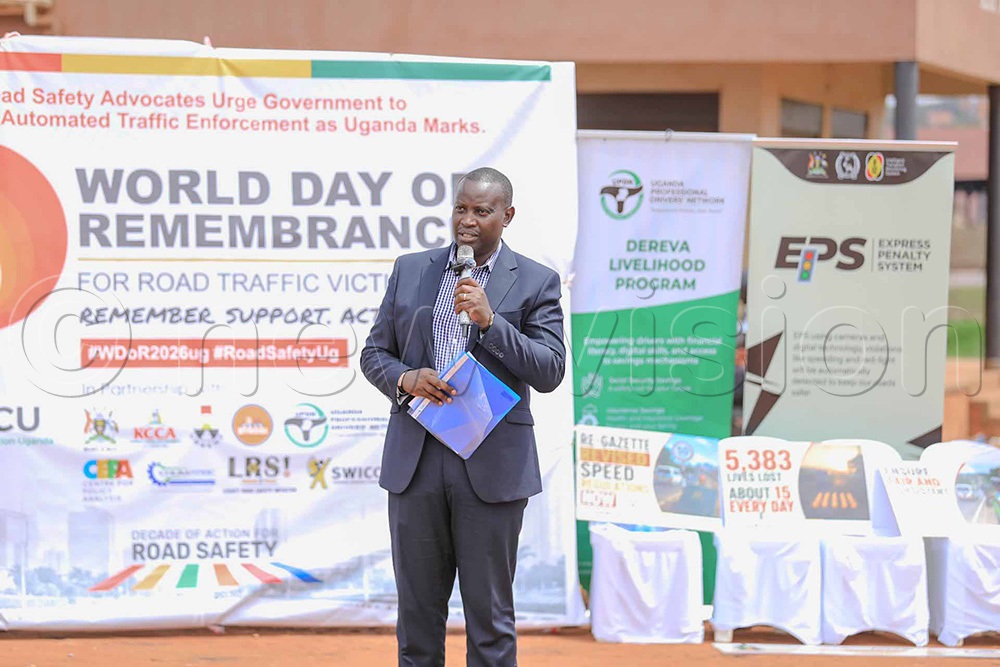
He was speaking at the commemoration of the Remembrance for Road Traffic Victims and National Road Safety Week 2026, held under the theme Remember, Support and Act.
The event, organised by the Road Safety Advocacy Coalition Uganda (ROSACU) in partnership with the Uganda Professional Drivers' Network (UPDN), took place at Bwaise Transport Terminal on November 15. Kashanku represented the Minister of Works and Transport, Fred Byamukama.
He said the growing number of road accidents was partly driven by the increase in the number of vehicles and the country's population, while road infrastructure had not expanded at the same pace.
Kampala Lord Mayor Ronald Balimwezo Nsubuga, who is also a road accident survivor, said his own experience had shaped his decision to join politics.
Balimwezo lost his leg in a road accident in 2000 after his vehicle encountered a pothole along Jinja Road. He said he entered politics partly to fight corruption in road construction, arguing that some roads built with a projected lifespan of 20 years begin developing potholes within seven years.
He also called on the Government to waive taxes on mobility aids, including crutches, wheelchairs and artificial limbs, to make them more affordable for people who lose limbs in road accidents.
“I am also appealing to the government to waive taxes on crutches, wheelchairs and artificial limbs, which is a good support for those who have lost their limbs during accidents to buy them cheaply,” Balimwezo said.
He noted that crutches currently cost between sh50,000 and sh350,000, depending on their quality, while wheelchairs range from sh250,000 to sh5m. Artificial limbs, he said, cost between sh1m and more than sh20m.
The high cost of these devices, he argued, places an additional financial burden on accident survivors who are already struggling with medical expenses and the loss of income.
The Public Relations Officer of the Uganda Police Force Directorate of Traffic and Road Safety, Superintendent of Police Michael Kananura, said careful driving could reduce road accidents by as much as 50%.
“There is no reason a driver should stay on WhatsApp, drink-drive or fail to respect traffic signs while on the road. Over-speeding and overtaking where you are not supposed to overtake have registered a high number of traffic accidents,” Kananura said.
He said Uganda's road safety situation remained worrying, citing figures from the Uganda Police Force Annual Crime Report 2025, which recorded 5,383 road traffic deaths in 2025, up from 5,144 in 2024 — an increase of approximately 4.6%.
The Executive Director of ROSACU, Sam Bambanza, urged Ugandans to take collective responsibility for improving road safety.
He appealed to the public to join the national effort to make roads safer for all users and reduce preventable deaths and disabilities arising from road traffic crashes.
For survivors such as Muwanga, Tumwine and Balimwezo, road safety is not merely a matter of statistics or traffic regulations. It is about lives interrupted, families forced to sell their belongings to pay medical bills, and people left struggling to regain their independence.