
Rotary, KCCA join forces to tackle Kampala’s rising road crashes
Obai said the visit was intended to help Rotarians understand the challenges affecting road safety in Kampala and explore practical ways of working with the authority to address them.
Lord Mayor Ronald Balimwezo speaking during an engagement on Thursday (November 19) between Rotary District 9213 Governor Gerald Obai and KCCA officials at City Hall. (Photos by Nicholas O’Neal)
________________
The Rotary Club of Kampala North fraternity has pledged to work with Kampala Capital City Authority (KCCA) to improve road safety and reduce crashes in Kampala, with a renewed focus on sensitising motorists, pedestrians and other road users about responsible road use.
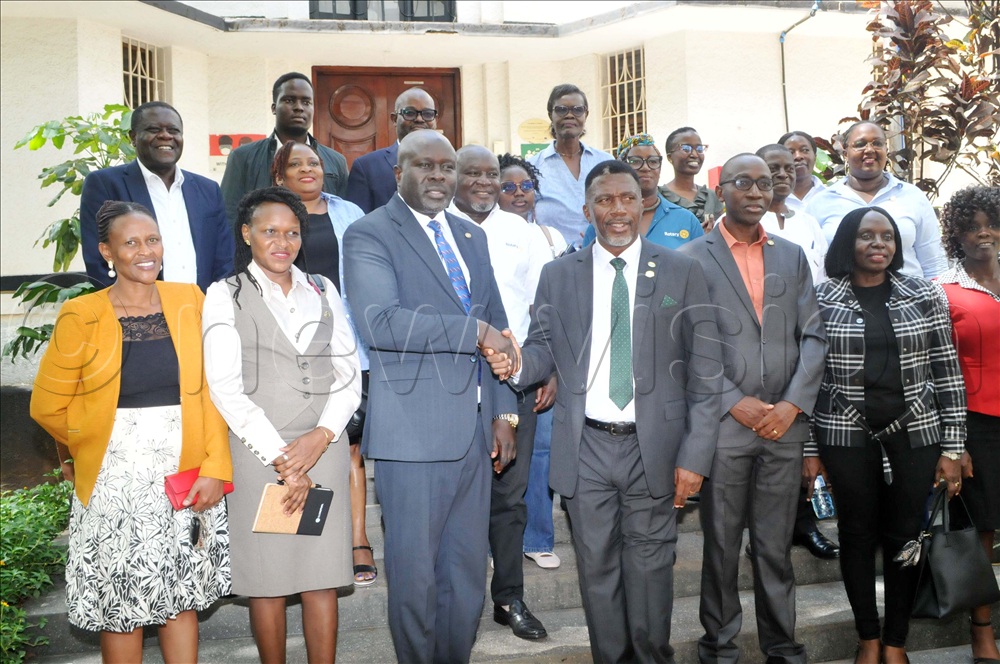
The commitment follows an engagement on Thursday (November 19) between Rotary District 9213 Governor Gerald Obai and KCCA officials at City Hall, where the delegation toured the city’s Traffic Control Centre to understand how traffic is managed and identify areas where Rotary could support road safety interventions.
Obai said the visit was intended to help Rotarians understand the challenges affecting road safety in Kampala and explore practical ways of working with the authority to address them.
He noted that many road users still lack adequate knowledge of how to navigate junctions, roundabouts and traffic-controlled intersections, contributing to unnecessary accidents and congestion.
"There's a need for sensitisation of road users, whether they are pedestrians, cyclists, or motorists," Obai said.
He also commended KCCA for modernising traffic management at major intersections but observed that impatience among motorists and a failure to understand traffic control interventions continued to undermine the system.
KCCA head of transportation, Eng. Jacob Byamukama, welcomed the proposed partnership, saying public education remained an important gap in the authority's road safety efforts.
Byamukama said KCCA was strengthening road infrastructure through improved signage, road markings and engineering interventions aimed at eliminating accident black spots.
However, he acknowledged that the authority needed to do more to communicate road safety messages to the public. He suggested that sensitisation materials be translated into different languages to reach Kampala's diverse population.
He said collaboration with Rotary could help extend road safety education to communities and schools, equipping young people with knowledge about safe road crossing, traffic signals and responsible road use.
Byamukama revealed that KCCA's traffic control system was already improving movement in parts of the city. Using the Spear Motors-to-city centre route as an example, he said travel time had reduced from approximately eight minutes to between four and five minutes following traffic management improvements.
However, he identified indiscipline among motorists, particularly boda boda riders who disregard lane discipline and traffic rules, as a major challenge affecting the system's effectiveness.
The engagement also heard a personal account from Ronald Balimwezo, who recounted losing his leg in a road accident in 2000 after a speeding vehicle struck him while he was riding a motorcycle near Jinja Road bypass.
He said the accident was triggered by a pothole in the middle of the road, which another motorist attempted to avoid before hitting him.
After spending time on crutches and undergoing rehabilitation, Balimwezo received an artificial leg through a Rotary-supported programme, enabling him to walk again and regain his independence.
He thanked Rotary for its contribution, urging the organisation to continue investing in road safety education and interventions that prevent accidents.
Balimwezo also called for better road designs, including clearly marked pedestrian crossings, visible road humps and appropriate signage at junctions.
Citing KCCA's 2025 Kampala Road Safety Report, he highlighted that 407 people lost their lives in road crashes in the city in 2025, with motorcyclists accounting for approximately half of the fatalities.
He called for greater sensitisation of boda boda riders, particularly on helmet use and adherence to traffic regulations.