
Half a million S4 candidates start exams as UNEB warns against fake papers
Uganda National Examinations Board (UNEB) has warned candidates, teachers and the public against examination malpractice as security teams intensify surveillance against fraudsters selling fake examination papers.
Students being checked before entering the exam room on Monday, Oct. 12, 2026. (Credit: Edward Luyimbazi)
_________________ Head teachers from various schools in Kampala collecting Uganda Certificate of Education (UCE) examination papers from the Jinja Road Police Distribution Centre. (Credit: Edward Luyimbazi) Students in Aringa SS getting ready to sit their examination room waiting for the papers. (Credit: Adam Gule) Students being checked before entering the exam room. (Credit: Edward Luyimbazi)
A total of 503,055 candidates started their Uganda Certificate of Education (UCE) examinations across the country on Monday.
As the finalists write their papers, the Uganda National Examinations Board (UNEB) has warned candidates, teachers and the public against examination malpractice as security teams intensify surveillance against fraudsters selling fake examination papers.
The candidates began with Mathematics in the morning, followed by Chemistry Papers 1 and 2 in the afternoon, marking the start of the national examinations for the fourth cohort assessed under the Competency-Based Curriculum at the UCE level.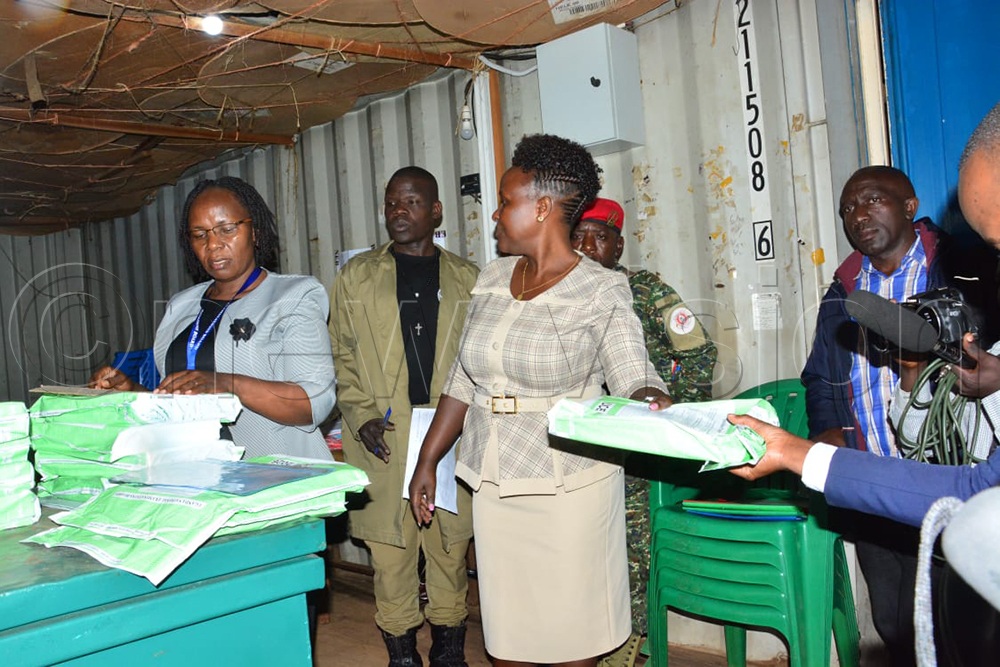
UNEB principal public relations officer Jennifer Kalule-Musamba said the first batch of examination papers had been delivered to all examination stations in time despite heavy rains that flooded roads in some parts of the country.
“We are glad to report that the first phase of papers were successfully delivered to all our stations in good time," she said.
"We got some challenges with the flooding of the roads in some parts of the country due to the heavy rains. Nonetheless, our teams were able to deliver, and we salute them for the resilience."
Kalule-Musamba said preliminary reports indicated that examinations had started smoothly across the country despite weather-related disruptions in some areas.
This year’s candidature represents a 16.4% increase from the 432,165 candidates who registered for the examinations last year, reflecting a growing number of learners sitting the national assessment.
Of the 503,055 candidates, 264,722, representing 52.7%, are female, while 238,333 are male (47.3%). They are sitting their examinations at 4,514 centres countrywide.
Kalule-Musamba said 187,918 candidates, representing 37.3% of the total candidature, were sponsored by the Government under the Universal Secondary Education (USE) programme, up from 154,642 last year.
The remaining 315,132 candidates are privately sponsored and fall outside the USE programme.
She said UNEB had also made arrangements to accommodate 906 candidates with special educational needs, ensuring they received appropriate support during the examinations.
The arrangements include braille answer sheets for blind candidates, large-print question papers for learners with low vision and sign-language interpreters for deaf candidates.
Kalule-Musamba said the arrangements were intended to ensure that all candidates had a fair opportunity to demonstrate their abilities.
This year’s examinations are being conducted under the theme, “Advancing Excellence in Assessment and Certification through Secure, Credible, Inclusive, and Innovative Processes.”
The theme is seen as underscoring the importance of examination security, credible assessment procedures, inclusiveness and innovation in the administration of examinations and the award of certificates.
Six remanded
UNEB has warned members of the public against fraudsters circulating and selling fake examination papers on social media platforms, saying security agencies are already pursuing suspected offenders.
Kalule-Musamba said the board was working with security agencies and contracted professionals to protect the examinations against malpractice.
More than 2,000 scouts have been deployed countrywide alongside nearly 600 security personnel to help secure examination materials and monitor the conduct of the examinations.
“While high levels of integrity are expected from those we are working with, UNEB strongly warns against involvement in any form of examination malpractice, or facilitating the same in any way,” she said.
The security teams have already apprehended some people suspected of selling fake examination papers through social media platforms.
The Kampala Capital City Authority (KCCA) Magistrate’s Court last week remanded six suspected scammers to prison until October 19, 2026, over the alleged sale of fake examination papers.
Kalule-Musamba warned that the board would pursue anyone attempting to disrupt the examinations by obtaining, circulating or facilitating access to purported examination papers.
“The public is hereby cautioned against dealing with fraudsters who are out there trying to trick unsuspecting members of the public,” she said.
She also cautioned members of social media groups used to trade fake papers to leave the groups immediately, warning that participation in such platforms could expose members to legal consequences depending on their conduct.
“The Board therefore sends out a strong warning to anyone with intentions to disrupt this year’s examinations by aiding and abetting malpractice, that our security teams are on high alert and will catch up with you,” she said.
Up to 10 years in jail for examination malpractice
UNEB said offenders would be prosecuted under the Uganda National Examinations Board Act, Cap 259, which provides penalties for people who unlawfully obtain, attempt to obtain or facilitate access to examination papers and related materials.
Section 25(1) provides that a person who gains or attempts to gain possession of an examination paper, any part of an examination paper, examination material or information purporting to relate to the contents of an examination paper commits an offence.
Section 25(2) also criminalises wilfully or negligently assisting a candidate to obtain unauthorised possession of examination papers, materials or related information.
The same penalties apply whether the examination paper or information involved is genuine or fake.
Under Section 26, teachers, invigilators, scouts and other people who assist candidates to cheat, negligently allow cheating or fail to stop unauthorised assistance face a fine of up to 1,000 currency points, equivalent to sh20m, imprisonment for up to five years, or both.
Kalule-Musamba encouraged members of the public with information about suspected examination malpractice to report it to the board through its toll-free line, 0800-211-077.
She said whistleblowers would be protected under UNEB’s whistleblower policy and compensated where the information provided was found useful.
Fees issue
With examinations already underway, UNEB has appealed to head teachers not to block candidates from accessing examination rooms or withdraw them from examinations over outstanding school fees balances.
Kalule-Musamba said parents and school administrators had previously been advised to address fees issues before the examinations began.
However, she urged schools to allow candidates to sit their examinations and pursue recovery of outstanding fees through other arrangements, including measures taken when results are released.
She warned that preventing candidates from accessing examination rooms could threaten the security and smooth administration of the examinations.
UNEB also cautioned candidates against indiscipline, reminding them that being registered for national examinations did not exempt them from complying with school regulations.
Kalule-Musamba said the board would not intervene on behalf of candidates subjected to disciplinary measures by their schools because of misconduct.
Candidates urged to remain confident
As the examinations continue, UNEB has encouraged candidates to remain confident, saying the preparations and work they have put in should help them perform well.
Kalule-Musamba said the examinations should be viewed as a step towards the next stage of education and the candidates’ chosen career paths rather than an end in themselves.
She reaffirmed the board’s commitment to providing valid, reliable, equitable and quality assessments and awarding internationally recognised certificates.
The examinations began amid increased security measures aimed at protecting examination materials, preventing malpractice and ensuring that candidates are assessed fairly.