
Neonatal nurses receive advanced skills in comprehensive newborn care
Dr Twinamatsiko noted that annually, Uganda loses 45,000 babies.
Victoria Nakibuuka, St Francis Hospital Nsambya neonatologist consultant, and Geoffrey Martin Kitakule, District Governor 9213, pose for a photo with health care workers and other Rotarians during the graduation ceremony of the first cohort of Health Workers in Comprehensive Inservice Newborn Care Training at St Francis Hospital in Nsambya on June 5, 2026. (Photo by Juliet Kasirye)
_________________
A total of 270 healthcare workers have received advanced hands-on training in comprehensive newborn care as part of efforts to strengthen maternal and newborn healthcare services across Uganda.
According to healthcare workers, the training is designed not only to build their capacity but also to ensure continuous mentorship at health facilities.
Dr Andrew Twinamatsiko, a programme manager at SEED Global Health, said newborn mortality remains a major challenge despite many of the deaths being preventable.
“Annually, Uganda loses 45,000 babies. If you compare us with countries such as Japan, Sweden, South Korea, that have a peri-neonatal mortality rate of 1 to 2 per 10,000 live births, this means all these deaths are preventable,” he said.
According to Twinamatsiko, common causes of neonatal mortality include infections, birth asphyxia and complications associated with preterm birth.
He noted that a significant number of babies die within the first 24 hours of life, underscoring the need for a skilled health workforce to improve newborn survival.
He said the mentorship programme is intended to help healthcare workers establish functional newborn units and reduce unnecessary referrals.
With funding from the Rotary Foundation and other partners, Twinamatsiko said, “We will ensure these facilities have equipment and infrastructure. Once we do that, we anticipate to see a reduction in mortality.”
He made the remarks during the graduation ceremony of the first cohort of health workers under the Comprehensive In-Service Newborn Care Training programme held at St Francis Hospital Nsambya on June 5, 2026.
The training, which will be rolled out in 14 districts, is being implemented by the Ministry of Health in partnership with Bulamu Healthcare. Working alongside the Mama Toto Programme, Bulamu Healthcare has trained more than 2,000 health workers, including midwives, doctors and nurses.
The Comprehensive In-Service Training in Newborn Care is a month-long Ministry of Health-certified capacity-building programme. It equips frontline health workers with advanced practical skills in newborn care, with a focus on premature, low-birthweight and critically ill newborns.
“Today, we are graduating fourteen health care workers from Nsambya, but they are part of the large cohort. For this particular cohort, we have trained about 104 health care workers across other training facilities including Kiwoko, Kawempe, Mbarara, Moroto, Mbale among others. Since this is the third cohort of the Comprehensive Inservice training, we have already trained about 270 health care workers,” explained Twinamatsiko.
Additionally, Twinamatsiko advised nurses that, “Although Nsambya has a high-level Neonatal Intensive Care Unit (NICU), when you go to your health centre IV, health centre III, general hospital, things might be a little bit different. To minimise referrals, design your existing unit to provide the same level of care for your facility.”
“We are losing 2.8% of our babies. This implies that, if we have 100 babies, only two of the babies can die. Since nurses feed the babies, go to the theatres, give the drugs and resuscitate the babies, training nurses is a vital intervention that we can use to reduce neonatal mortality,” explained Nakibuuka.
Harriet Nakyeyune, the human resource manager at St Francis Hospital Nsambya, said limiting exposure to infections remains critical for the survival and growth of premature babies.
“I gave birth to a premature baby in 1991, and it was 900 grammes. At that time, there was no NICU. However, today, since most people in villages are very inquisitive, to save your baby from infections, be selfish.” Nakyeyune advised mothers.
Dr Richard Kalungi, programme manager of Mama Toto Care Uganda, said the training will help ensure newborns survive beyond the most vulnerable stages of life.
“When a child is five years of age, the chances of death are nearly halved. But before the child makes a five-year milestone, they must first survive the critical first hour, one day, one week, one month.” Kalungi told the nurses.
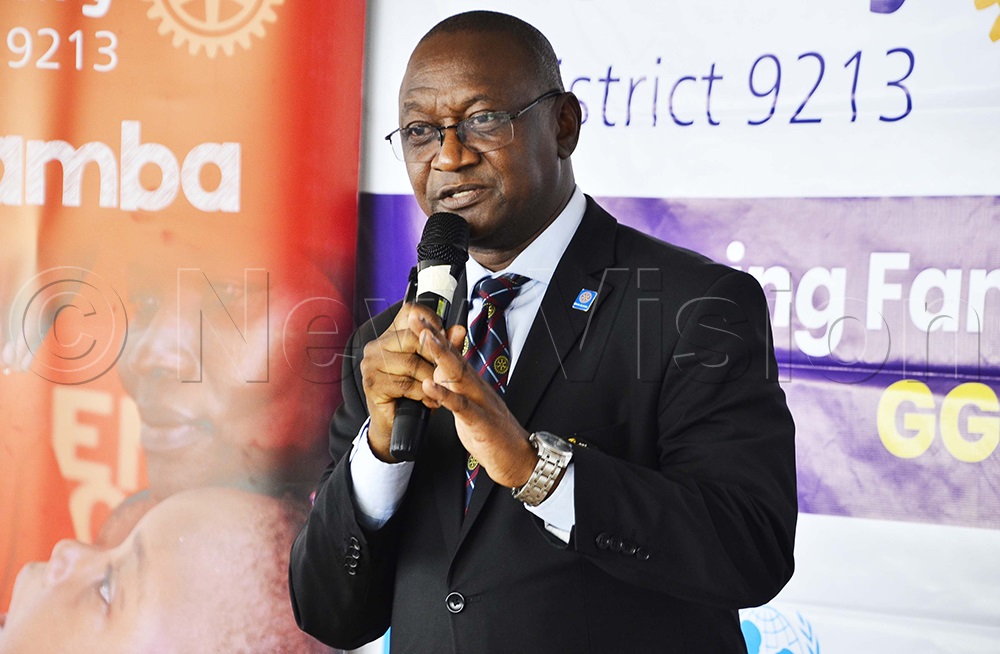
Martin Kitakule, District Governor 9213 addresses health care workers during the graduation ceremony of the first cohort of Health Workers in Comprehensive Inservice Newborn Care Training at St. Francis Hospital in Nsambya on June 5, 2026. (Photo by Juliet Kasirye)
Rotary District governor 9213 Geoffrey Martin Kitakule said he has visited several health facilities and witnessed the effects of weak health systems on children. He said Rotarians would continue supporting Health Centre IIIs with equipment while helping healthcare workers acquire the skills needed to save newborn lives.