
Experts call for more training of health workers in sickle cell care
Dr Ajambo noted that health workers still require support to identify, test and manage patients, adding that this requires significant investment in capacity building.
The National Coordinator for Sickle Cell Disease at the Ministry of Health, Dr Miriam Ajambo. ( Photos by Agnes Kyotalengerire)
________________
The national coordinator for sickle cell disease at the Ministry of Health, Dr Miriam Ajambo, has said the capacity of health workers to diagnose and manage sickle cell disease remains inadequate.
“Recently I was in the Acholi sub-region and Busoga sub-region, and health workers, for example, the nurses, midwives, and clinic officers, do not know the disease very well,” she said.
Speaking to New Vision ahead of the World Sickle Cell Day commemoration, Dr Ajambo noted that health workers still require support to identify, test and manage patients, adding that this requires significant investment in capacity building.
“A lot has been done, and more is still happening, but we are still struggling,” she noted.
According to Dr Ajambo, capacity-building efforts have been undertaken by experts, including haematologists from Mulago National Referral Hospital and Makerere University, through both virtual and physical training sessions. However, she said health workers in high-burden regions still require additional support to effectively manage patients.
She said paediatricians in regional referral hospitals will work closely with specialists at the national referral hospital to disseminate knowledge and improve the care and management of sickle cell patients.
Sickle cell disease (SCD) is an inherited condition and remains a major public health challenge.
A nurse attending to a child battling against sickle cell disease at Atutur hospital in Kumi district.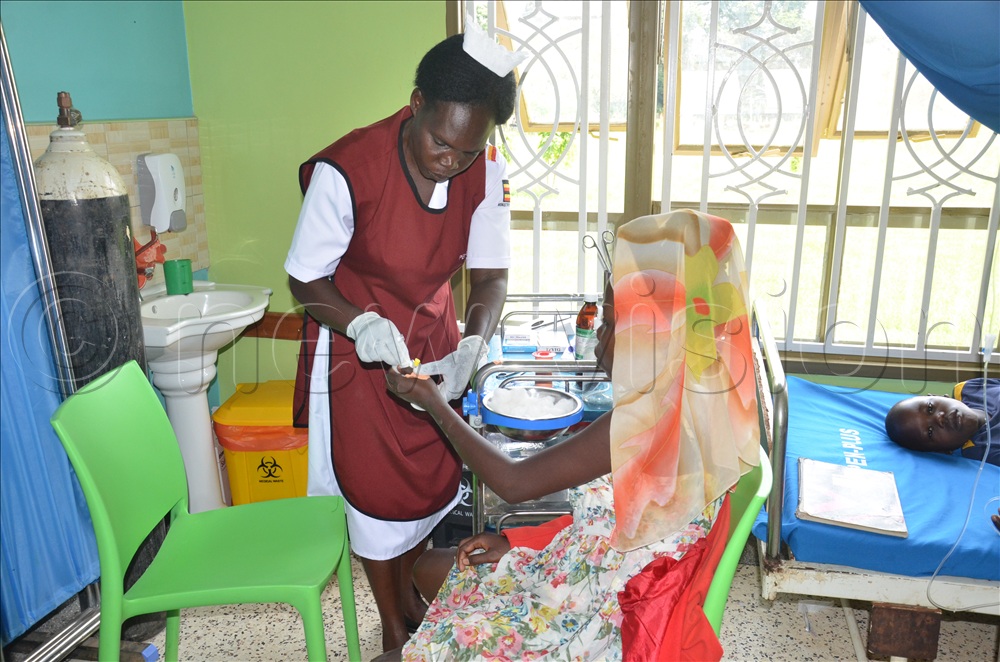
Uganda has the fifth-highest sickle cell disease burden globally and the third-highest in Africa. About 13% to 15% of the population carries the sickle cell trait, meaning approximately 15 out of every 100 people have the trait. Meanwhile, about 0.7% to 0.8% of Uganda’s population lives with sickle cell disease.
An estimated 25,000 babies are born with the disease annually, and about 80% die before their fifth birthday.
According to national health surveys and sickle cell surveillance data, the highest-burden region is Busoga, which has a sickle cell disease prevalence of about 20%.
In some districts, the trait rate reaches between 24% and 25%. Northern and mid-northern Uganda, including districts such as Lira, Kitgum, Dokolo and Oyam, also report high numbers of cases and deaths. Other pockets of high prevalence have been recorded in north-eastern and mid-eastern Uganda.
These kits are easy to use, highly sensitive and can be deployed at the point of care, enabling health workers to diagnose sickle cell disease as early as birth.
“Having testing kits manufactured in Uganda and not going through the bureaucracies of importing them and reagents is a big milestone for us in terms of diagnosis,” she said.
Dr Ajambo said distribution of the kits is ongoing and that most regional referral hospitals have already received supplies. Prior to distribution, laboratory personnel from districts across the country were trained in their use.
She added that as manufacturers continue producing the kits, the government will ensure they remain available at health facilities nationwide.
Uganda today, Friday, June 19, joins the rest of the world in commemorating World Sickle Cell Day.
The national celebrations are being held at Jinja City Square under the theme: "Building and Strengthening Sickle Cell Communities in Uganda through Nationwide Newborn Screening and Knowing Your Sickle Cell Status.”
Jinja was selected to host the national commemoration because the Busoga sub-region carries the highest burden of sickle cell trait and disease in the country.
“We want to go and sensitize the We want to penetrate the entire Busoga sub-region, which has 11 districts and one city. Educate people about sickle cell disease and tests, and link those who are diagnosed to care. But also, advise the carriers on their reproductive choices,” Dr Ajambo said.