
Healing in times of women
At the end, the exhibition doesn’t pretend pain is over. Instead, it shows the work of healing: letting go, resting, and remembering.
Olivia Namala’s Drink with Me at the ‘Healing’ exhibition at the Njabala Foundation art space in Nakwero. (Photo by Kalungi Kabuye)
____________
If any group needs healing, it’s women. History has for long treated them as property, as second-class citizens, and every step toward equality has come with a fight. That’s years of pain to carry. So how does a woman, and an artist, deal with it?
That’s the question behind the Njabala Foundation’s 5th Annual Njabala Exhibition (ANE), ‘Healing’, currently showing at their space in Nakwero, just past Gayaza.
The Njabala Foundation was founded by curator Martha Kazungu with the goal of challenging gender inequality in the art world by using the Njabala myth to put women artists at the centre. The Njabala myth, from Buganda, is about a girl who got married but didn’t know how to ‘take care of her man’; so, she called on the ghost of her mother to help her.
Five exhibitions have since been held, with the inaugural ‘This Is Not How’ in 2022. Others have been ‘Holding Space’ (2023), ‘An Elegy’ (2024), and ‘Obulo Bwaffe’ (2025). In March this year, they hosted the first exhibition at their new home. ‘Karibu’ featured the traditional art of mat making from Busoga.
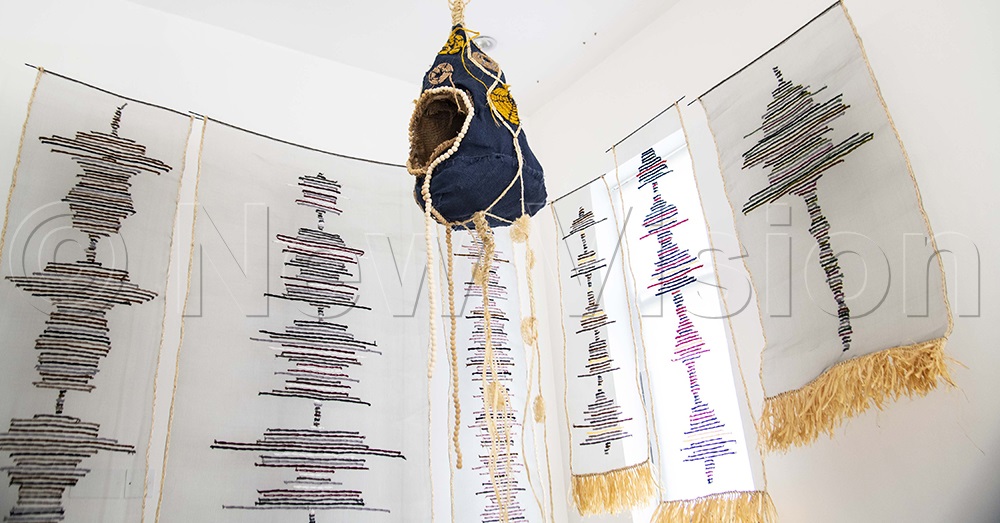
Sarafina ‘Kengi’ Kebirungi’s Bird Song Alert: Kuku-kulu-kuku on display at the ‘Healing’ exhibition at the Njabala Foundation art space in Nakwero. (Photo by Kalungi Kabuye)
‘Healing’, which opened on Saturday, August 1, is the Foundation’s boldest yet, exploring the fact that pain has always been part of being a woman: from monthly periods, to childbirth, to the daily fight for equality.
Walking in on Monday morning, the first thing I felt was the quiet. The space was empty except for Nancy, who offered to walk me around. I kindly declined, and that silence made it even more profound.
Right at the entrance is Esra Rahma’s ‘The Purge’ (acrylic on canvas). You can almost feel the relief in the figure’s wide eyes as she lets go of the parts of herself that caused pain. Rahma and Norah Iyara both paint bald figures, which, by removing hair and detail, seem to strip the body down to its essentials. Perhaps it is a way of saying: this is a body outside of what society expects from it.
But it is the two setups in the next room that really grab you. First is ‘To Heal is to Plant a Seed’, five pieces by Laruni Mary Diana, inspired by the development of the maize plant. Using hand-stitched maize husks, she traces the development of the maize plant from germination to fruition. Only it is in reverse order, with germination the largest of the pieces and fruition the smallest. The catalogue explains that the artist uses the pieces to parallel stages of grief — denial, anger, bargaining, depression, and acceptance. That probably explains the reverse order, because grief arrives full-blown, but gradually shrinks, with one’s spirits lifting, till it breaks out with acceptance.
Olivia Namala’s ‘Drink with Me’ is a sculpture made from metal, banana fibre, bark cloth, and raffia. Its sense of welcoming, service and affection would sit well in a modern-day boardroom.
Sarafina ‘Kengi’ Kebirungi’s ‘Bird song alert: Kuku-kulu-kuku’ literally takes your breath away, and I bet quite a few people had to pick their jaws off the floor on seeing it. She interprets birdsong by hand-stitching milk cotton threads onto panels of wire mesh, converting frequencies into waveforms. Each of the ten pieces represents a different song. Njabala does not put prices on the works (I’m not even sure if they are on sale), but I bet these pieces would fetch a very pretty penny. And rightly so.
There is probably no room to talk about all the other pieces, but they are all quite remarkable. Aida Namukose, Erinah Babirye, Darren Akoragye, Ednah Rebeccah, Mona Okulla Obua and Roselock Namirimo are all your time’s worth.
At the end, the exhibition ( which is in two ‘constellations’, with the second showing from September 5) doesn’t pretend pain is over. Instead, it shows the work of healing: letting go, resting, and remembering.