
How Makerere’s sh96.6b CoBAMS complex will reshape learning, research
“This building is going to relieve the college of business a lot because they have the fastest-growing number of undergraduate students that enrol at the college. I want to thank the department for having such a great vision. Indeed, that’s where the university wants to be,” Nawangwe said.
CoBAMS principal Prof. Edward Bbaale said the design of the building is aligned with Makerere’s ambition of becoming a research-led university.
KAMPALA - Makerere University has handed over a site for the development of a sh96.6b College of Business and Management Sciences (CoBAMS) complex, a major infrastructure investment expected to ease congestion and strengthen teaching, research and graduate training at the university.
The project, fully funded by the Government, will occupy 15,000 square metres and bring together the CoBAMS headquarters, School of Economics, School of Business, and School of Statistics and Planning under one complex.
The project will be implemented over five years in phases, with the first phase expected to be completed within 18 months of the September 4, 2026 site handover.
ROKO Construction Limited is the contractor, while Symbion Uganda Limited is the project consultant.
The site was officially handed over to ROKO by Makerere University Vice Chancellor Prof. Barnabas Nawangwe on September 4, 2026, marking the beginning of construction works.
The complex will comprise lecture rooms, offices, computer laboratories, specialised research spaces and smart classrooms equipped with technology to support digital and online teaching and learning.
For Makerere, the investment comes at a time when CoBAMS is dealing with growing demand for its programmes and pressure on existing infrastructure. The college currently has about 5,500 students enrolled across undergraduate to doctoral programmes.
At the handover ceremony, Nawangwe thanked the Government for its continued investment in Makerere, saying the university had benefited from increased support towards infrastructure development.
“We must thank the Ministry of Finance and President Yoweri Museveni for the vision he has for Makerere. For the last 10 years, the Government has invested heavily in Makerere University, and more is coming. We must appreciate that,” Nawangwe said.
He said the new facility would help address pressure created by the large number of undergraduate students at CoBAMS.
“This building is going to relieve the college of business a lot because they have the fastest-growing number of undergraduate students that enrol at the college. I want to thank the department for having such a great vision. Indeed, that’s where the university wants to be,” Nawangwe said.
“Our strategic plan is placing us to be more of an international research-led university, and the infrastructure should match what we do,” he added.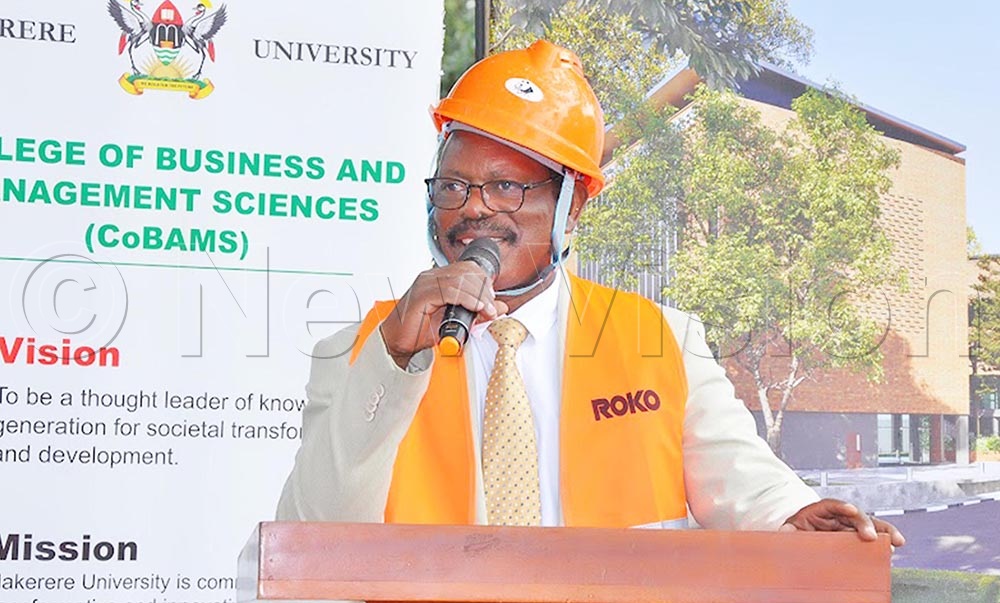
At the handover ceremony, Nawangwe thanked the Government for its continued investment in Makerere, saying the university had benefited from increased support towards infrastructure development.
ROKO commits to quality
ROKO Construction Limited CEO Mark Koehler said the company was committed to delivering the project according to the agreed designs, standards and implementation schedule.
“For this project, our commitment is clear: we want to deliver the quality for which ROKO is known, while also completing the project within the agreed programme,” Koehler said.
He called for close collaboration among all stakeholders to ensure smooth implementation of the project.
“With close cooperation, timely decision-making and good communication between Makerere University, the consultant, ROKO and other stakeholders, together with continued partnership with the Ministry of Finance to ensure the timely availability of funds, I have every confidence that we will fulfil this commitment,” Koehler said.
The five-year implementation period will allow the project to be delivered in phases, with the first phase expected within 18 months.
“We are counting on the contractor, the consultant and our director of estates and works to do a good job, but we shall also be putting serious sanctions if the job is not done to our satisfaction,” Kiranda warned.
Technical quality and sustainability
Symbion Uganda Limited will be responsible for quality assurance on the project.
Its managing director Pius Muli assured Makerere University that the consultancy team was committed to ensuring the project meets the required quality standards.
“When we received the news that we had been selected as consultants for the project, we held a brainstorming session, developed a brief and made a commitment that this project would be one of the best in Makerere. Over the past few weeks, we have had several engagements with the university management to ensure that what is delivered meets their requirements,” Muli said.
Muli further noted that the building was designed to withstand the test of time.
“In developing the design, we made sure to achieve the highest levels of sustainability by ensuring that the building can withstand the test of time and does not become another burden to the university in terms of maintenance over the long term.
“We have applied the best principles of sustainability and incorporated people-friendly spaces. We hope that, once completed, it will provide a welcoming home for the College of Business and Management Sciences,” Muli noted.
The partnership between Makerere, ROKO and Symbion is expected to ensure that construction follows the approved designs and specifications as the project progresses through its different phases.
What it means for students
The immediate impact of the new complex is expected to be felt by students, particularly those currently studying in ageing or congested facilities.
The new lecture rooms and smart classrooms will provide additional teaching space, while the computer laboratories will support practical and technology-based learning.
A lecturer at the college and member of the contracts committee welcomed the development, saying the new infrastructure would provide students with a more conducive learning environment.
The lecturer said the building would provide a “serene environment and world-class learning digital spaces” where students could focus on developing competences critical to their education.
For students, the expansion is expected to address congestion and limitations posed by ageing infrastructure.
“We have been studying in old buildings that do not conform to today’s technology era. We also face a problem of congested lecture halls. A new building will provide an immediate solution,” said a second-year quantitative statistics student who spoke on condition of anonymity.
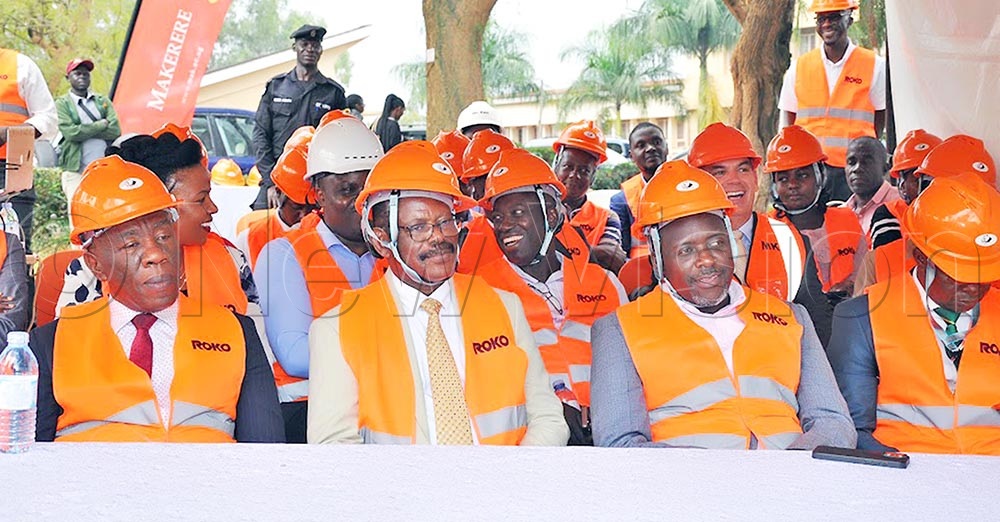
The Vice Chancellor of Makerere University, Prof. Barnabas Nawangwe (second left) and other university staff from the college of business at the institution listening to speeches.
A research-led college
Beyond classrooms, the complex is expected to reshape the way teaching and research are organised within CoBAMS.
CoBAMS principal Prof. Edward Bbaale said the design of the building is aligned with Makerere’s ambition of becoming a research-led university.
The project will provide dedicated spaces for graduate and postgraduate research, computer laboratories, lecturers’ and researchers’ offices, and modern classrooms.
The concentration of the college’s key schools, headquarters and research-related facilities within one complex is expected to create opportunities for greater interaction between students, lecturers and researchers.
It could also strengthen collaboration in areas such as economics, business management, statistics, public policy and national planning.
These disciplines are central to understanding Uganda’s economy and supporting decision-making in both the public and private sectors.
Investment in human capital
The sh96.6b investment also comes against the wider need for Uganda to strengthen human capital as the country pursues industrialisation, entrepreneurship, digital transformation and improved public-sector planning.
For Makerere, the project represents more than an expansion of physical infrastructure.
It is an investment in the university’s ability to provide modern learning spaces, support research and innovation, and train graduates in disciplines that influence economic policy, business and national development.
Founded in 1922, Makerere University is Uganda’s oldest institution of higher learning and has trained generations of professionals who have contributed to the country's development and the wider region.
The CoBAMS complex is therefore expected to help the university respond to growing demand for higher education while improving the environment in which students and academics work.
Betty Mwesigwa, the head teacher of Kololo Secondary School in Kampala, said the development is timely, especially at a time when education is increasingly shifting towards research-based learning.
“In this new pedagogy of research-based teaching, modern lecture halls are essential for promoting innovation and creating an environment that supports effective learning and research,” she said.
She added that Makerere’s infrastructure must be upgraded to match the standards of other modern universities if it is to compete globally and realise its ambition of becoming a research-led institution.
“It is essential to upgrade the university’s infrastructure to meet 21st-century standards if Makerere is to compete globally and fulfil its ambition of becoming a research-led institution,” she said.
Five years, first phase in 18 months
While the entire project will run for five years, the first phase is expected to be delivered within 18 months.
This means students and staff could begin benefiting from parts of the new infrastructure well before the full complex is completed.
Lecturers at the college who spoke to New Vision expressed optimism that the project will enable the university to prioritise high-impact research, expand publication mentorship for students and implement college-level research frameworks.
They said these initiatives align with Makerere University’s 2025-2030 strategic direction, which is also aligned with the UN Sustainable Development Goals (SDGs) and Uganda’s national 10-fold growth strategy.
As construction begins, the success of the project will ultimately be measured not only by the completion of a new building, but by whether it eases congestion, improves the learning environment, strengthens research and enables Makerere to produce graduates with skills relevant to Uganda’s changing economy.
With the site now handed over to ROKO Construction Limited, the complex marks a significant new phase in Makerere’s infrastructure development, with the first phase due within 18 months and the wider project expected to unfold over five years.