
Experts call for increased funding to mitigate climate change
According to Mugagga, "the Government is working with development partners, including GGGI and the European Union, to develop a credible pipeline of bankable projects in sectors like energy, roads, water and environment."
The Head of the Climate Finance Unit in the Ministry of Finance, Planning and Economic Development, Denis Mugaga (left), talking to the EU programme manager for Access to Finance for Small and Medium Enterprises (SMEs), Agribusiness, Land and Climate Finance, Cristina Banuta, during Climate finance conference with European Union and Global green growth institute at Serena Kigo on August 25, 2026. (Photos by Ronnie Kijjambu)
________________
Experts have called for increased investment in climate action, warning that Uganda faces a financing gap of about sh85.8 trillion in implementing projects aimed at mitigating climate change.
The call was made on Tuesday (August 25) during the opening of a three-day climate finance conference organised by the Global Green Growth Institute (GGGI) at Serena Kigo in Wakiso district, where stakeholders discussed ways of mobilising public and private capital for sustainable investments.
Dennis Mugagga, the head of the Climate Finance Unit at the Ministry of Finance, said Uganda had invested about $5.1b (approximately sh19 trillion) towards financing its Nationally Determined Contributions (NDCs), against an estimated requirement of $28.1b (about Sh104.8 trillion).
This leaves a financing gap of nearly $23b (approximately Sh85.8 trillion), making it necessary for Uganda to explore innovative financing mechanisms beyond traditional grants, Mugagga said.
According to Mugagga, "the Government is working with development partners, including GGGI and the European Union, to develop a credible pipeline of bankable projects in sectors like energy, roads, water and environment."
He said there was need to have projects ready before Uganda can raise money through green and other sustainability-linked bonds.
The head of Global Green Growth Institute in Uganda, Pablo Martinez (left), listens to the Head of the Climate Finance Unit in the Ministry of Finance, Planning and Economic Development, Denis Mugaga, during a climate finance conference with the European Union and Global Green Growth Institute at Serena Kigo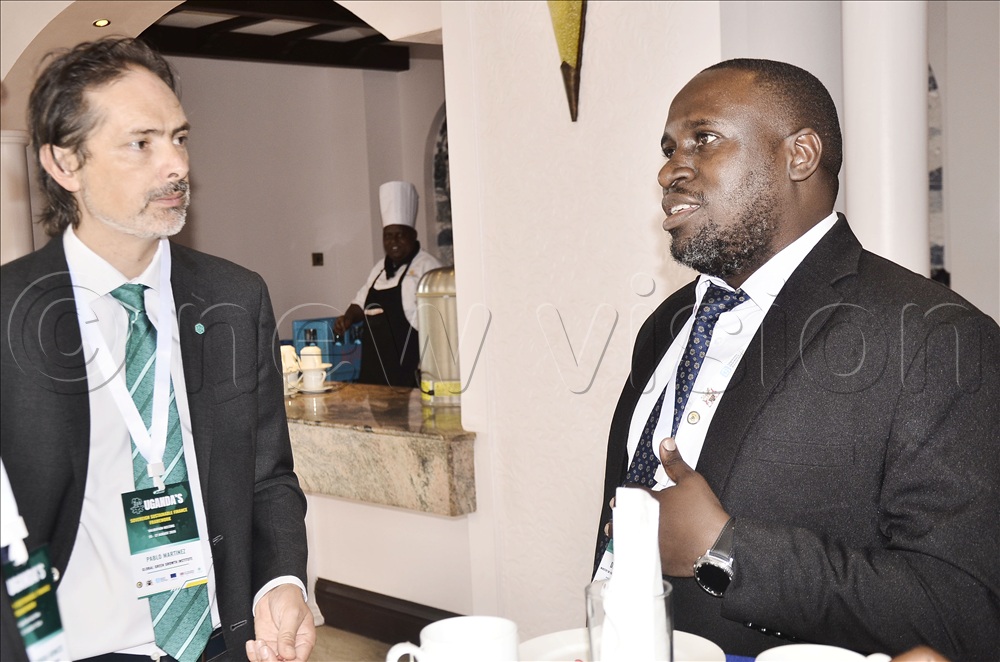
The Government, Mugagga observed, was now targeting the sh104.8 trillion financing from the EU to support environmentally friendly investments, with the funds expected to support commercial banks to finance local climate-related projects.
Mugagga said the Government wanted to attract both local and international investors, including Ugandan banks that already invest in conventional government bonds.
The EU programme manager for Access to Finance for Small and Medium Enterprises (SMEs), Agribusiness, Land and Climate Finance, Cristina Banuta, said they were supporting Uganda’s preparations to issue its first green bond.
She said the development of a Sovereign Sustainability Finance Framework, a national green taxonomy, and a climate finance strategy, had created important foundations for Uganda to access domestic and international green finance markets.
She added that the EU’s Global Green Bond Initiative could purchase part of Uganda’s first green bond once the country is ready to issue it, which would help boost investor confidence.
The GGGI Country Representative for Uganda, Dr Pablo Martinez, said increased private-sector participation would be critical in developing bankable projects and ensuring future bond issuances respond to market demand. Martinez also represents Angola and Zambia.
“We are not trying to issue one bond here. We are trying to support Uganda in terms of integrating sustainability into the normal issuances,” Martinez said.
He said Uganda should consider regular sustainable and thematic bonds, including possible water and forestry bonds, instead of treating green financing as a one-off initiative.
“There is a real opportunity to expand on public-private partnerships with the Government to develop green project pipelines," Martinez said.
Uganda Bankers’ Association (UBA) chief executive officer Wilbrod Owor commended GGGI and the EU for supporting the initiative and the Bank of Uganda for its regulatory oversight.
The conference brought together financial-sector regulators and market players, including the Bank of Uganda, Capital Markets Authority, Uganda Securities Exchange and Uganda Bankers’ Association, to validate Uganda’s Sustainable Financing Framework and explore ways of mobilising private and institutional capital for climate action.