
UWA managers urged to make communities partners in conservation
The two-week training focused on transformative leadership, ideological orientation, management of Government resources, teamwork, methods of work, human-wildlife conflict management, law enforcement and the use of technology in protected areas.
Nakawuki said she was candid during the meeting and expressed confidence in the UWA officers following their leadership training. (Credit: Geofrey Asiimwe)
KYANKWANZI - Senior management officers of the Uganda Wildlife Authority (UWA) have been urged to strengthen community participation in wildlife conservation and ensure communities living around protected areas benefit from tourism, while improving service delivery.
The call was made by tourism state minister Suzan Nakawuki, who was the chief guest at the pass-out ceremony on September 25, 2026, for 36 UWA senior management officers who completed a two-week transformative leadership course at the National Leadership Institute (NALI) in Kyankwanzi.
Nakawuki urged the senior managers to strengthen leadership and ideological orientation among their staff as they return to their respective stations.
She said the managers have a responsibility to guide and motivate their officers while ensuring the tourism sector meets its targets and contributes significantly to Uganda’s economic growth.
Nakawuki also challenged the officers to improve service delivery and ensure that tourists visiting Uganda receive a first-class experience.
“When you go back, I know you have other officers down there. So now it's your job to handle them. Also ideologically orient them. We have our targets we have to meet as a ministry. We are tourism. Our sector is one of the biggest contributors to this country's GDP. So we have to do everything possible to ensure that we give our tourists a first-class experience when they come to Uganda,” Nakawuki said.
The minister said she had earlier met the Parliamentary Committee on Trade and Tourism, where she received reports concerning the performance of the tourism sector.
Nakawuki said she was candid during the meeting and expressed confidence in the UWA officers following their leadership training.
“This morning, when I was in a meeting with the Parliamentary Committee on Trade and Tourism, the stories that were given to me there were inside out. And trust me, I was very candid, and I informed the committee that you're very innocent and not guilty of anything that I was being charged with. I'm very convinced beyond reasonable doubt that from here we are even going to do a much smarter job,” she said.
Senior presidential advisor Lily Ajarova said Uganda must review its traditional conservation approaches in response to changing population trends and development needs.
“We need to review our conservation approaches and strengthen cooperation between wildlife authorities and communities living around protected areas,” Ajarova said.
She said conservation should not depend on enforcement alone, but should also create economic opportunities for communities through tourism.
Ajarova encouraged UWA to promote community tourism by linking visitors to national parks with surrounding communities where they can experience local cultures and ways of life.
She also called for the diversification of Uganda’s tourism products beyond traditional game drives.
“We need to diversify our tourism products to include hiking, cycling, research tourism and other outdoor experiences,” Ajarova said.
On human-wildlife conflict, Ajarova called for approaches that enable communities and wildlife to coexist safely.
She said some conflicts arise when people settle or cultivate along wildlife migration routes and animal pathways.
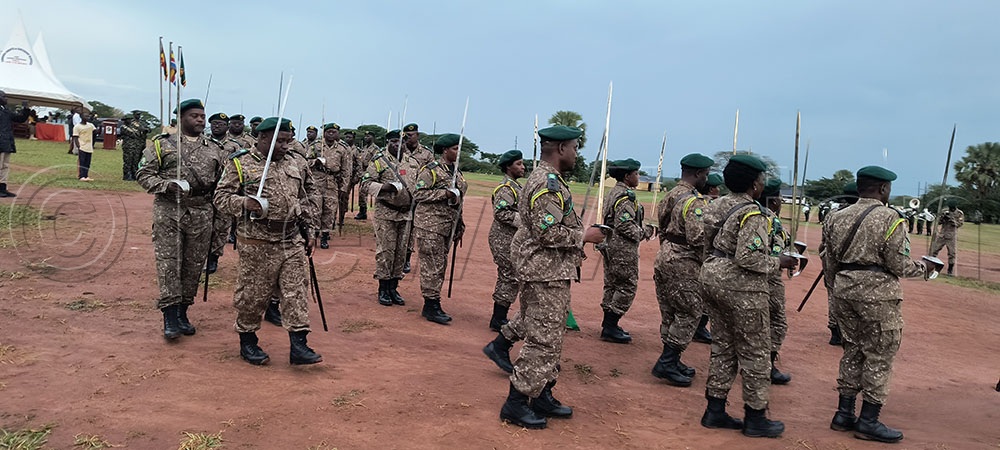
The two-week training focused on transformative leadership, ideological orientation, management of Government resources, teamwork, methods of work, human-wildlife conflict management, law enforcement and the use of technology in protected areas. (Credit: Geofrey Asiimwe)
“We must address the root causes of human-wildlife conflict by protecting and restoring wildlife corridors,” she said.
The two-week training focused on transformative leadership, ideological orientation, management of Government resources, teamwork, methods of work, human-wildlife conflict management, law enforcement and the use of technology in protected areas.
NALI director Col Okei Lukogota commended the UWA senior management team for successfully completing the training, describing them as patriotic and disciplined cadres.
“These are some of the most patriotic and disciplined cadres we have,” Lukogota said.
He said the course equipped the officers with knowledge in political education, ideological orientation, leadership and military skills.
Lukogota said NALI was interested in strengthening cooperation with UWA through possible joint ventures and operations in areas of mutual interest, particularly security and military-related skills.
Meanwhile, UWA executive director Dr James Musinguzi said the training had equipped the senior management team with knowledge and skills to improve leadership, teamwork and management of Government resources.
“This training has strengthened our team and equipped us with knowledge and skills that will improve our leadership, teamwork and management of government resources,” Musinguzi said.
He said the training had prepared the officers to implement UWA’s strategic priorities in line with the National Development Plan Four and Vision 2040.
Musinguzi said the course came at a critical time as UWA prepares its Budget Framework Paper for the 2027/2028 financial year.
“We are at a critical stage as we prepare our Budget Framework Paper for the 2027/2028 financial year. This will outline our priorities and be supported by an action plan derived from our strategic plan,” he said.
Musinguzi said UWA would focus on transforming conservation into what he described as “conservation for prosperity” by working closely with communities and ensuring they benefit from wildlife and tourism.
“Our focus is to transform conservation into conservation for prosperity, where communities are able to benefit from wildlife and tourism,” he said.
He added that the management team had acquired skills in human-wildlife conflict management, law enforcement, firearms management and the use of technology to protect wildlife and combat poaching.
Musinguzi thanked the NALI leadership for conducting the training and commended the UWA management team for their resilience, noting that the programme involved early morning drills and activities that continued until late in the evening.
“The training was demanding, with early morning drills and activities that continued until late in the evening, but the team demonstrated resilience throughout the programme,” he said.
He said the officers were returning to their duties with renewed determination to implement the lessons acquired during the training and contribute to Uganda’s transformation and development.
After the training, the participants were awarded certificates.