
Witonze challenges Africa to invest in crime prevention, not prisons
Internal Affairs State Minister Juma Witonze Kisekka urged partners to strengthen criminal justice systems across Africa to promote lasting peace and security on the continent.
From L-R: State Minister for Internal Affairs Juma Witonze Kisekka, Dean of the African Group Col. Joseph Rutabana of Rwanda, and Acting Director General of the United Nations African Institute for the Prevention of Crime and the Treatment of Offenders (UNAFRI), Andrew Karokora Munanura, sign the membership board during the institute’s 37th anniversary celebrations in Nakawa Division, Kampala, on Wednesday, November 25, 2026. (Photo by Isaac Nuwagaba)
______________________ From L-R: State Minister for Internal Affairs Juma Witonze Kisekka, Acting Director General of the United Nations African Institute for the Prevention of Crime and the Treatment of Offenders (UNAFRI), Andrew Karokora Munanura, and UNAFRI founding Deputy Director, Prof. Eric Paul Kibuuka, during the institute’s 37th anniversary celebrations in Nakawa Division, Kampala, on Wednesday, November 25, 2026. (Photo by Isaac Nuwagaba)
A fresh call has been made for the remaining African countries to join the United Nations African Institute for the Prevention of Crime and Treatment of Offenders (UNAFRI) and become part of collective efforts to build a crime-free Africa.
Addressing heads of diplomatic missions, East African Community member states and African countries' honorary consuls during UNAFRI's 37th anniversary celebrations at its headquarters in Nakawa on November 25, 2026, internal affairs state minister Juma Witonze Kisekka urged partners to strengthen criminal justice systems across Africa to promote lasting peace and security on the continent.
“To keep the vision running, we should all advocate for a crime-free Africa and Uganda without advocating for higher budgets to build prisons. Prisons for what?” he said.
Witonze said Africa should invest more in preventing crime than in punishing it, and in rehabilitating offenders rather than building bigger prisons.
Changing nature of crime
Witonze said the changing nature of crime and the impact of technology had made it necessary to strengthen approaches to fighting crime in the 21st century.
He said cybercrime, human trafficking, terrorism, environmental crimes, drug trafficking and trafficking in cultural property were now crossing borders faster than police could respond, requiring a collective African response.
“We need to emulate countries like Denmark, Norway and Switzerland which have empty prisons because there is no crime committed in those countries and we should borrow a leaf from there,” Witonze suggested.
He said those countries had low prison populations not because they lacked police, but because they had strong social systems, good education, jobs and justice systems that prevented crime before it happened.
“Africa can do the same. If we invest in our youth, in jobs, in education, in justice, we will not need to build more prisons,” he said.
Witonze said Uganda was working with the United Nations Office on Drugs and Crime (UNODC) and that he had recently led the country into a trilateral planning cell under the UNODC, alongside Tanzania, South Africa, Mozambique and Angola.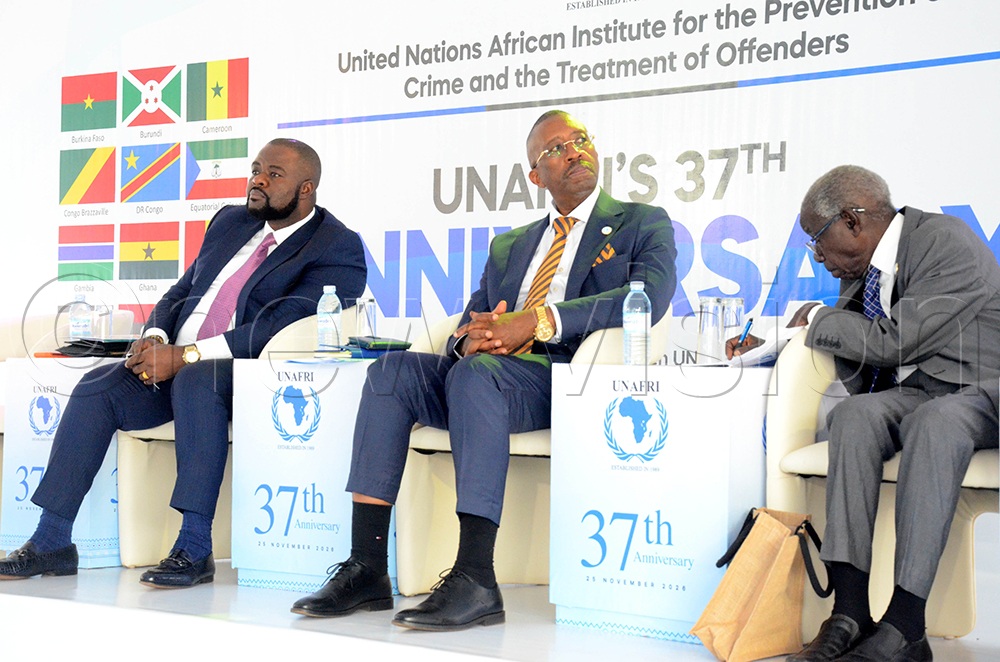
“Uganda is working with UNODC, and recently, I led Uganda to a trilateral planning cell under the UNODC so Uganda is now part of Tanzania, South Africa, Mozambique and Angola,” Witonze emphasised.
He said the planning cell would help Uganda and its partners share intelligence, coordinate operations against organised crime, and build the capacity of investigators and prosecutors.
37 years of UNAFRI
Over the past 37 years, UNAFRI has grown into an institution that trains professionals, supports policy development and brings together governments, diplomats and partners to address shared challenges.
“We are mandated to undertake policy-oriented research, study regional crime trends, generate evidence to support decision-making and promote the exchange of knowledge, expertise and experience,” Munanura noted.
“We promote innovative approaches to crime prevention and criminal justice reforms in accordance with UN norms and guidelines, drawing upon African traditions and orientations,” he added.
Munanura said UNAFRI's work was rooted in African values of community, reconciliation and restoration, rather than punishment alone.
“In Africa, when a person offends, the community does not just throw him away. It tries to bring him back. That is the African tradition we are promoting,” he said.
UNAFRI to establish African Crime Data Centre
Munanura said fighting crime required partner states to support the establishment of an African Crime Data Centre (ACDC), where reliable crime data could be accessed.
“We are soliciting equipment to support teams as we shape operations to kick-start the centre. We have a strong working relationship with the International Criminal Court, with an emphasis on training, the International Scientific and Professional Advisory Council in Milan and others,” he said.
He said Africa currently lacked reliable, comparable crime data, making it difficult to plan, budget and measure the effectiveness of crime prevention programmes.
“The African Crime Data Centre will be a one-stop centre where a minister in Kampala, a researcher in Accra, a police officer in Nairobi can get reliable data on crime trends in Africa,” Munanura said.
He said UNAFRI was already working with partners to collect data on organised crime, terrorism, human trafficking and environmental crimes.
“Our training focuses on fighting organised crime, terrorism, human trafficking, environmental crimes and trafficking in cultural property,” Munanura emphasised.
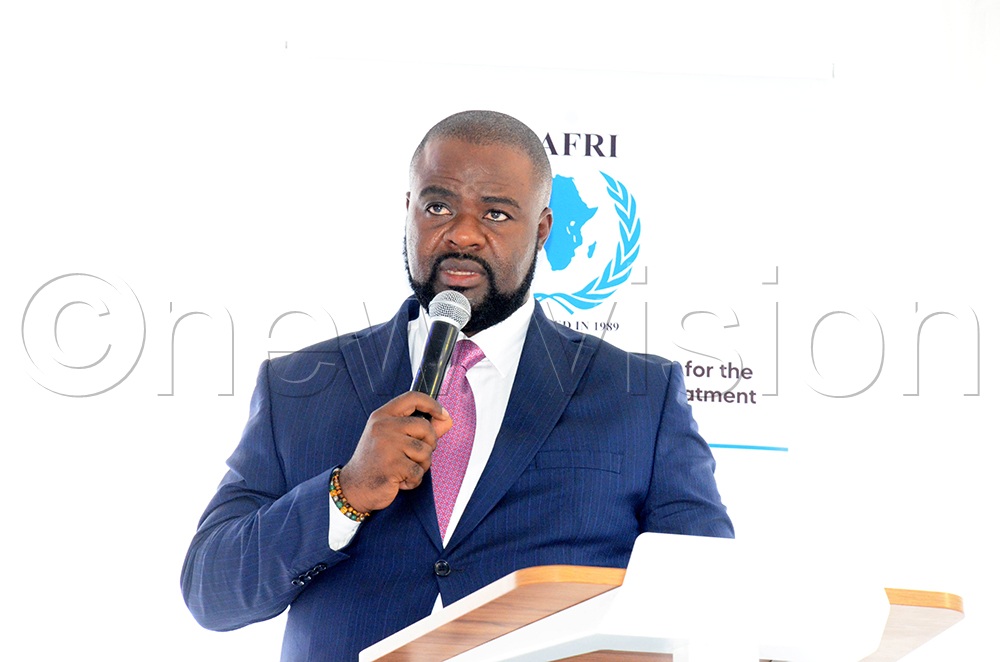
The State Minister for Internal Affairs, Juma Witonze Kisekka, speaks during the United Nations African Institute for the Prevention of Crime and the Treatment of Offenders (UNAFRI) 37th anniversary celebrations at the institute’s headquarters in Nakawa Division, Kampala, on Wednesday, November 25, 2026. (Photo by Isaac Nuwagaba)
Technology and youth
Munanura said UNAFRI was using technology to track young people involved in crime.
“Africa has more than 400 million people aged between 15 and 35 years, and of these, 60% are under 25 years and around 70% under 30 in sub-Saharan Africa,” he said.
“We are now using technology to follow errant youth to their hiding places,” he said, adding that UNAFRI was training police and investigators to use digital forensics, social media analysis and data to track criminals.
With support from the Ghana Police Criminal Investigations Department and other stakeholders in the Ugandan government, UNAFRI partnered with the Uganda Police Force to establish the CID's Anti-Human Trafficking Unit.
“We have also partnered with the Police Forensic Services Directorate to train first responders. We started with Kampala Metropolitan East and will roll out the same exercise to all policing regions in Uganda until we achieve our objective of protecting crime scenes,” he explained.
He said protecting crime scenes was critical because many cases in Uganda and across Africa failed in court due to contaminated or destroyed evidence.
Membership now at 28 countries
UNAFRI's membership now stands at 28 countries, providing a platform for knowledge-sharing and cooperation in addressing crime across the continent and beyond.
Article 1 of the institute's statute provides that membership is open to member states of the United Nations Economic Commission for Africa that have acceded to its statute.
Witonze urged the remaining African countries to join UNAFRI, saying no country could fight crime alone in the 21st century.
“Crime has no borders. A trafficker in Kampala can be in Nairobi in the morning, in Dar es Salaam in the evening. A cyber-criminal in Lagos can steal from a bank in Kampala without leaving his room. We must work together,” he said.
Historic foundation
UNAFRI's director of training and programmes, Dr Gift Kweka, from Tanzania, said its foundation was rooted in United Nations Economic and Social Council Resolution 1979/20, which called for the establishment of an African institute dedicated to crime prevention and the treatment of offenders.
Kweka said UNAFRI was established as Africa's own institute, by Africans and for Africans, to find African solutions to African crime problems.
“For 37 years, UNAFRI has trained thousands of police officers, prosecutors, judges, prison officers and social workers from across Africa. That is a legacy we must protect and expand,” he said.
He said UNAFRI's training programmes now focus on emerging crimes, including cybercrime, environmental crimes and crimes against cultural property, which are robbing Africa of its heritage.
The anniversary celebrations were attended by diplomats from across Africa, representatives of the East African Community, honorary consuls, officials from the Ministry of Internal Affairs, Uganda Police Force, Uganda Prisons Service, and partners from UNODC, the International Criminal Court and other institutions.
Witonze concluded by urging partners to continue supporting UNAFRI with funding, equipment and expertise to make the vision of a crime-free Africa a reality.
“Let us not build more prisons. Let us build a crime-free Africa,” he said.