
NGOS discuss alternative sources of funds to retain 500,000 jobs
The conference, themed “Transforming Regulatory Challenges into Opportunities for Growth and Impact”, was organised by Onyango and Company Advocates in partnership with the National Bureau for NGOs, Civic Advisory Hub and Personal Data Protection Office.
Front row: Internal Affairs Minister Prof. Ephraim Kamuntu (fourth left), State Minister Juma Witonze Kisekka (third left), Denmark’s Ambassador Signe Winding Albherg (fourth right) and NGO Bureau Secretary Dr Stephen Okello (third right) pose for a group photograph with NGO representatives after a stakeholders’ meeting at Kampala Serena Hotel on Tuesday, November 10, 2026. PHOTO BY FRANCIS EMORUT
____________________ Internal Affairs Minister Prof. Ephraim Kamuntu (left) with NGO representatives during a stakeholders’ meeting at Kampala Serena Hotel on Tuesday, November 10, 2026. PHOTO BY FRANCIS EMORUT
The Non-Governmental Organisations (NGOs) have been urged to develop alternative sources of funding if they are to retain 500,000 staff employment rather than depending on donors, whose support is declining due to priority shifts and global economic shocks.
The call was made by experts on donor funding and the NGO Bureau under the Ministry of International Affairs, the regulator.
The experts made remarks recently during the NGO risk, compliance and resilience conference 2026, at Kabira Country Club in Kampala.
The conference, themed “Transforming Regulatory Challenges into Opportunities for Growth and Impact”, was organised by Onyango and Company Advocates in partnership with the National Bureau for NGOs, Civic Advisory Hub and Personal Data Protection Office.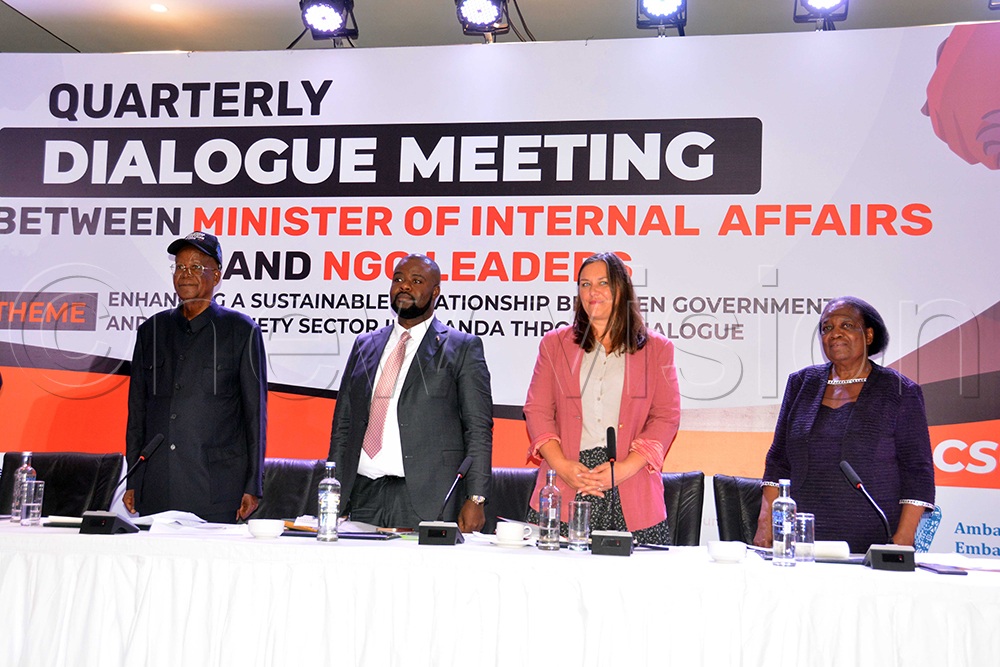
The stakeholders observed that NGOs can have a high bargaining power with development partners if they are able to generate funds internally and retain the employment of staff and avoid the collapse of organisations, which has happened to some after the US President, Donald Trump, stopped the United States Agency for International Development (USAID) programme, the major donor to developing countries, coupled with the exit of the Democratic Governance Facility (DGF).
Currently, there are 7,000 NGOs operating in the country, a significant reduction from 14,000 NGOs in 2019. Experts said Global dynamics including COVID-19, declining support from donors, and a stringent government regulation including the closure of DGF and closure of some NGOs led to loss of thousands of jobs. It is estimated that more than 600,000 jobs in the civil society were lost due to the above factors.
According to Julius Mukunda, the Executive Director of Civil Society Budget Advocacy Group (CSBAG), about 40% of NGOs closed shop while 30% are there in name but not operational.
He explained that they can meet in the office but don't have any activities in the field because of limited funding.
"A half of the NGOs closed due to lack of funding, and that is how dire the situation is in Uganda," Mukunda said. He added that those in operation are 30%, with reduced work and staff.
The NGO sector currently employs more than 500,000 people in project management, health, education, research, administration, human rights, water and sanitation and community outreaches.
Mulindwa told participants that there are abundant institutions and businesses willing to give and therefore NGOs must learn to take advantage of this while being willing to change how they operate, budget and account for resources.
“NGOs must refrain from laxity spending, as this will not be welcomed in the local community giving,” Mulindwa said.
Jacqueline Asiimwe, the founder and chief executive officer, CivSource Africa, implored NGOs to identify services and capabilities for which there is genuine demand and price them to generate internal income while donor funds cover the shortfall.
Asiimwe noted that organisations are permitted under the NGO Act to sell goods and services as long as they can prove that what was earned was ploughed back and not consumed for other purposes by the board.
The civil society experts were supported by Dr Stephen Okello, the secretary for the NGO Bureau, who pointed out that it was critical for NGOs to explore ways of generating internal revenue to sustain their activities as key players supplementing the government’s programmes and not entirely depending on donors.
“Uganda’s NGOs play a significant role in bridging gaps in healthcare, education and humanitarian relief, particularly in rural and underserved communities. Their contribution to improving lives deserves our recognition and appreciation,” Dr Okello suggested.
He noted that weak governance and inadequate financial controls can undermine public confidence, particularly when organisations cannot demonstrate how donor funds are spent.
The NGO Bureau boss revealed that the Bureau is in the process of developing the NGO report, which will be submitted to the Cabinet and to Parliament. He advised participants to get on board when consultations start to contribute views to the ongoing review of the regulatory environment and to promote dialogue that reduces mistrust.
Dr Okello and the experts made remarks during a recent NGO risk, compliance and resilience conference 2026 at Kabira Country Club in Kampala.
The conference, themed: “Transforming Regulatory Challenges into Opportunities for Growth and Impact”, was organised by Onyango and Company Advocates in partnership with the National Bureau for NGOs, Civic Advisory Hub and the Personal Data Protection Office.
Yona Wanjala, executive director of Civic Advisory Hub, informed participants that the suspensions of some NGOs had created uncertainty across the sector, causing some organisations to halt operations and terminate staff as they await decisions on their cases.
The government has suspended the activities of some NGOs and frozen their accounts over allegations of conducting activities considered prejudicial to national security.
Wanjala appealed to the authorities for fair hearings, transparent investigations and clear timelines for resolving cases involving suspended organisations.
Annet Bada, managing partner Onyango and Company Advocates, told participants that true compliance is the bedrock of trust in the NGO sector.
“It is what protects staff, safeguards resources, and ensures that promises to the people you serve are kept,” Bada stated.
Govt to lift ban on suspended NGOS in two weeks
Meanwhile, the Minister of Internal Affairs, Prof Ephraim Kamuntu, on Tuesday, November 10, informed the NGOs leaders and representatives that the government will lift the ban on the suspected NGOs within two weeks.
He made remarks during the quarterly dialogue with meetings between NGO leaders and the minister of internal affairs at Kampala Serena Hotel.
“We are going to study case by case and lift the ban of suspended NGOs within two weeks,” Prof Kamuntu said, drawing applause from the participants.
This was after the Uganda National NGO Forum board chairperson Barbara Babweteera pressed the minister to pronounce himself on the specific days the suspended NGOs should start operating.
The dialogue meeting was attended by development partners, civil society representatives and the government officials from different ministries, departments and agencies.
The secretary of NGO Bureau, Dr Stephen Okello, told participants that his office is in the process of producing annual reports of status on NGOs in Uganda to guide in policy direction.
Magaret Sekaggya, the executive director of Human Rights Defenders Uganda, welcomed the government’s move of lifting ban on suspended NGOs, saying it is in the right step of direction and appealed to civil society organisations to work together as a team to serve humanity and abide by the government regulations.
The ambassador of Denmark, Signe Winding Albjerg, assured the government that development partners are not interested in imposing their own agenda to Ugandans but to provide funds for social and economic transformation of its citizenry.