
Uganda spending sh13m to treat a critically injured crash victim — health ministry
The health ministry also says that while Uganda records as many as 160,000 crash-related injuries every year, Police reports indicate a lower figure.
Takuya Sasayama, Ambassador of Japan to Uganda, flags off the ambulances with Jane Ruth Aceng, Minister of Health, at the event in Kampala on Tuesday, May 5, 2026. (Photo by Bridget Ahurira)
___________
Uganda is spending up to shillings 13.6 million to treat a critically injured road crash victim, New Vision Online has heard.
The health ministry also says that while Uganda records as many as 160,000 crash-related injuries every year, Police reports indicate a lower figure.
The figures were disclosed by ministry emergency health services commissioner, Dr John Baptist Waniaye, exposing a widening data gap and a growing national crisis that continues to strain hospitals, drain public finances and leave thousands with life-altering injuries.
“Our health facilities record about 160,000 road cases a year. That is three to four times what the Police report,” Waniaye said, noting that many victims who survive crashes are treated in hospitals but never make it into Police statistics.
While the Police reports indicate about 5,000 road crash deaths annually, the health sector estimates the real toll at between 9,000 and 12,000 deaths each year, nearly double.
“When an accident happens and maybe it’s a bus, and five people have perished, the big number is sent to health centres, some of these die and these deaths are not recorded by the traffic Police because it stops tracking them on the road so treating these victims is costly and, in most cases, these are taken to government facilities where services are free,” Waniaye said.
Uganda’s reported road death rate has dropped from 29 to 16 deaths per 100,000 people, according to the 2023 global road safety report. However, Waniaye said hospital data shows no meaningful decline in actual deaths over the past five years, with fatalities averaging around 10,000 annually.
“What has changed is that more victims are now living through severe crashes due to improved emergency care. But survival often comes at a cost. Many survive with severe disabilities. Someone is not able to work again, not able to support themselves. That level of disability makes someone almost functionless,” he said.
According to the ministry, the Government, treating a single crash victim can cost the government shillings 1.6 million for mild cases, 3.6 million for moderate injuries, and up to 13.6 million for critically injured patients requiring surgery.
He gave an example of Mulago National Referral Hospital alone, where the trauma unit handles about 400 critical cases annually, costing nearly shillings five billion in treatment. Nationally, road traffic injuries are estimated to cost Uganda about 5% of its GDP, according to ministry calculations, though comprehensive national costing is still lacking.
Waniaye noted that estimates show about 90% of critically injured patients are bodaboda-related, often involving collisions with vehicles or high-impact solo crashes because they are non-compliant with safety measures.
“People have helmets, but they are just carrying them, not using them. If helmets are used, they reduce the severity of head injury by about 70%,” he said.
Authorities attribute the continued severity of crashes to a mix of human behaviour, infrastructure gaps, and vehicle safety issues, where high speeds remain the leading cause, with fast-moving vehicles turning crashes into fatal incidents. Many vehicles on Ugandan roads also lack modern safety features like airbags, increasing the likelihood of serious injury.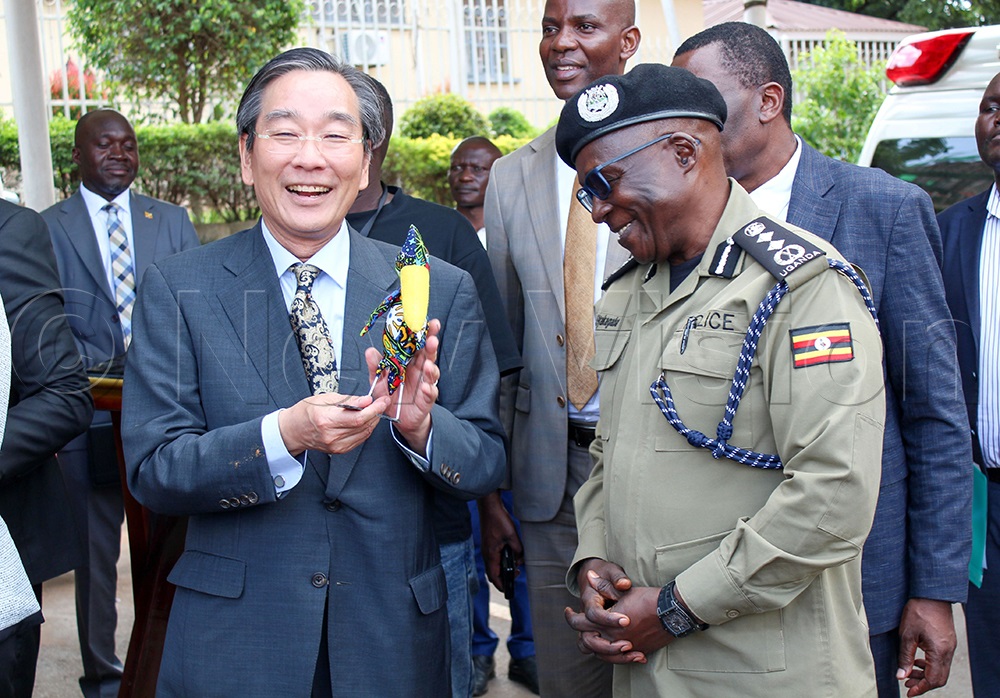
Takuya Sasayama, Ambassador of Japan to Uganda, shares a light moment with Abbas Byakagaba, Inspector General of Uganda Police, at the event in Kampala on Tuesday, May 5, 2026. (Photo by Bridget Ahurira)
Abas Byakagaba, the inspector of Uganda Police, said recent reports show a 31.3% reduction in accidents but cautioned that the intensity and severity of incidents remain high.
“You may see fewer accidents statistically, but the incidents we are dealing with are still very serious,” he said.
He added that frequent reports of fatal crashes and fires across the country continue to shape public perception, often overshadowing the statistical decline.
Japan boosts to emergency response
The revelations came as Uganda received 30 emergency vehicles, including 23 ambulances and seven fire engines from the Government of Japan, aimed at strengthening response capacity. Ambassador Sasayama said the donation is part of Japan’s broader effort to strengthen Uganda’s health and disaster preparedness systems, noting that cooperation between the two countries has steadily expanded beyond infrastructure to include skills transfer and system improvement.
He pointed to ongoing collaboration in hospital management and emergency response training as critical in ensuring that the equipment delivers real impact on the ground.
“These vehicles are only one part of our cooperation. We have also focused on training and management systems so that Uganda can maximise their use and sustain these services for the long term,” he said.
Health minister Dr Jane Ruth Aceng described the donation as timely, noting that Uganda still faces a significant shortage of ambulances despite recent progress.
“With this addition, we now have 296 ambulances countrywide, but we still have a gap of 274. We are grateful to the Government of Japan for consistently supporting us since 2020," she said.
She revealed that ambulance coverage has improved from less than 2% in 2020 to about 54% currently, contributing to reductions in maternal deaths and emergency-related mortality.
“About 61% of ambulance transfers are for emergency obstetric and neonatal cases, which has greatly improved survival,” she said.
According to the Ministry of Health, Uganda requires at least 590 ambulances to meet national demand, based on population needs and administrative structures.