
Healthcare stakeholders tipped on bridging medical education, health needs gap
"I urge all of you not to allow these valuable recommendations to remain on paper—let the policy be disseminated. Do not leave it on the shelves. People have been left behind because they did not know what was in it, but now they must have the tools to implement it," Nakadama stated.
Third Deputy Prime Minister Rt. Hon. Rukia Isanga Nakadama (R) handing over a cash prize to Mebra Mulabiza (left) the Principal of Jinja School of Nursing and Midwifery during the closure of the 4th National Health Professionals Education Training and Healthcare Conference at Source of the Nile hotel in Jinja City. (Credit: Donald Kiirya)
JINJA - Healthcare stakeholders have been urged to move beyond theory and transform policy recommendations into practical actions to bridge the gap between medical education and the country’s actual health needs.
Closing the three-day 4th National Health Professionals Education Training and Healthcare Conference at Source of the Nile hotel in Jinja City, Third Deputy Premier Rukia Isanga Nakadama said the future of Uganda’s healthcare system depends on a seamless synergy between training institutions and service providers.
Nakadama lauded the joint efforts of the education and health ministries in achieving the milestone of launching the National Education for Health Policy, describing it as a spot-on solution for modernising student skills.
"I urge all of you not to allow these valuable recommendations to remain on paper—let the policy be disseminated. Do not leave it on the shelves. People have been left behind because they did not know what was in it, but now they must have the tools to implement it," Nakadama stated.
The conference, themed: Aligning Health Professionals Education and Training with Health System Needs for Sustainable and Responsive Health Service Delivery, tackled the disconnect between classroom learning and the realities of patient care.
Nakadama highlighted several key pillars for success, including praising those who serve in remote areas where others refuse to go; acknowledging that the Government cannot do it alone and requires the expertise and funding of development partners; and commending the Ministry of Education for hosting skills competitions and awarding medals to top-performing students and practitioners.
Nakadama further extended special gratitude to First Lady and Minister of Education and Sports Mrs Janet Museveni, for her leadership in organising the forum.
She noted that the First Lady’s tenure has been marked by visible progress in the professionalisation of health training.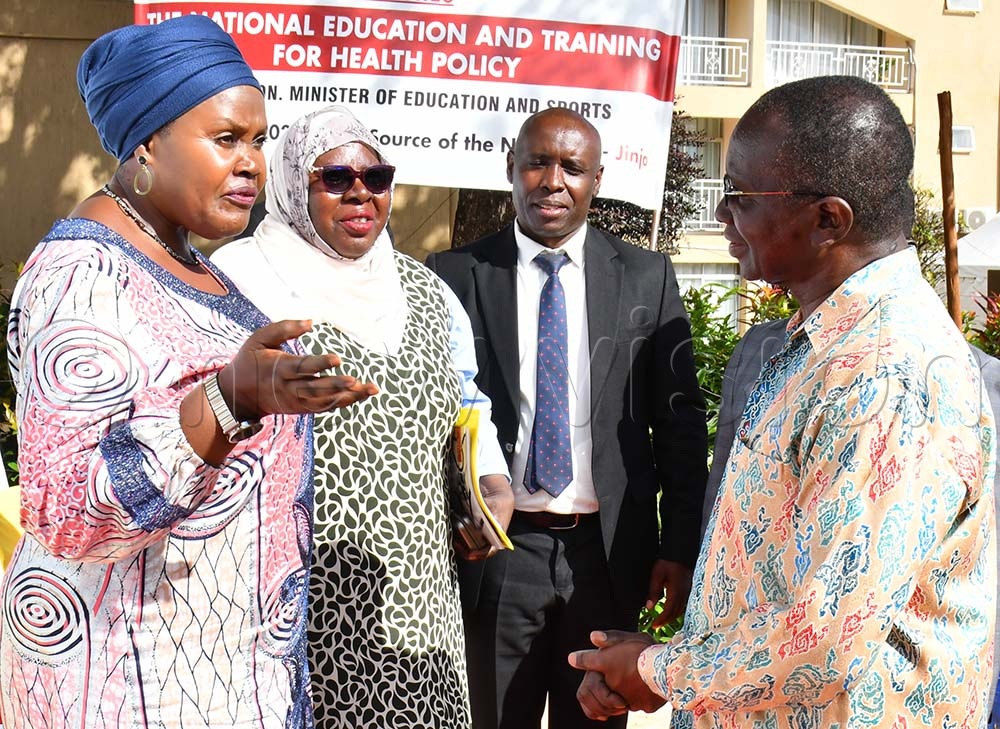
Third Deputy Prime Minister Rt. Hon. Rukia Isanga Nakadama (left) chatting with the chairperson of the Board of Uganda Railways Corporation Daudi Migereko (R) after closing the 4th National Health Professionals Education Training and Healthcare Conference at Source of the Nile hotel in Jinja City. Looking on is the Commissioner of Health Education and Training Hajati Dr. Safina Museene (2nd L). (Credit: Donald Kiirya)
Nakadama emphasised that aligning education and training with health system needs requires collective effort.
“It requires strong partnerships among government ministries, regulatory bodies, training institutions, health facilities, professional councils, development partners, the private sector, and the public at large,” she stated.
“Now that the policy has been approved by the Cabinet, I want to address the words of Hajati Dr Safina Museene that we need to publicise it. Let it be disseminated,” she said, encouraging stakeholders to access the document on relevant websites and familiarise themselves with its guidelines.
Nakadama praised the Ministry of Education and Sports for organising skills competitions and recognising top performers, stressing the importance of teamwork in healthcare delivery.
She congratulated the medalists from the national skills competitions and the best-performing principals and practitioners.
Education ministry commissioner for health education and training Hajati Dr Safina Museene, highlighted key resolutions from the conference, including finalising the policy implementation roadmap, formalising committees outlined in the policy, urgently disseminating the policy (including soft copies on ministry websites), strengthening quality assurance, promoting competency-based education, integrating digital health technologies, and enhancing partnerships between public and private training institutions.
She also called for increased investment in research, innovation, and evidence-based practices in health professional education.
Museene noted the policy provides a comprehensive framework for training across certificate, diploma, degree, and postgraduate levels, with greater emphasis on specialist training to meet needs in both urban and rural areas.
“We noted that specialists were not being given a lot of emphasis,” Museene said.
“This policy is saying: can we train the right number of specialists that we need? Whether it is at the National Referral, Regional Referral, or community hospitals, our training must be responsive to the Ugandan needs,” she added.
It establishes high-level inter-ministerial committees to oversee co-ordination between the ministries of education and health.
A key highlight of the event was the National Skills Competition, where students demonstrated their competencies in a simulated health education and training hospital.
Principals from host institutions, including Moses Ibwala of Medical Laboratory School, Jinja and Mebra Mulabiza of Jinja School of Nursing and Midwifery, expressed gratitude to the Ministry of Education and Sports for entrusting them with hosting duties.
Mulabiza, described the event as a paradigm shift, adding that what amused her most was the commitment the Minister of Health made to work with the Minister of Education.
“The launch of this policy is going to cause a lot of changes in how we produce health workers,” Mulabiza said.
The event concluded with a resounding call for participants to return to their respective institutions and begin the immediate implementation of the new guidelines.