
MPs pledge to promote school gardens, nutrition in rural communities
Okeyo explained that direct interaction with farmers and schools has helped lawmakers better understand nutrition challenges facing communities while also motivating leaders to support local food production initiatives.
Bukholi Island county MP Peter Okeyoh (second left), Mary Apiyo (centre) PELUM advocacy Officer, outgoing Kigulu south MP Milton Muwuwa (left), Agnes Kirabo (right) Food Rights Alliance executive director during the stakeholders nutrition accountability dialogue at Golden Tulip Hotel in Kampala on May 22, 2026. (Credit: Francis Emorut)
KAMPALA - Peter Okeyo, the Member of Parliament representing the island constituencies of Bukooli in Namayingo District, has said lawmakers are increasingly leaving boardrooms and conference halls to directly engage communities on agriculture, nutrition and household feeding practices as part of efforts to fight malnutrition and hunger in Uganda.
Speaking during the launch of the 5th Parliamentary Nutrition Week 2026 at Golden Tulip Hotel in Nakasero, Kampala, on Friday, Okeyo said Members of Parliament have been conducting field outreaches in several districts to encourage school gardening, proper feeding and community-based farming initiatives.
He revealed that his group had conducted outreaches with farmers in Kamwenge and Moroto.
Okeyo explained that direct interaction with farmers and schools has helped lawmakers better understand nutrition challenges facing communities while also motivating leaders to support local food production initiatives.
The MP said the outreach programmes are intended to sensitise communities on balancing household nutrition with commercial agriculture and income generation.
“We are leaving our boardrooms in Kampala. We are leaving hotels to go down to districts and communities to sensitise people and tell them that we can save a lot,” Okeyo added.
According to Okeyo, legislators are using the outreaches to encourage schools to establish demonstration gardens and change negative perceptions that many young people hold towards agriculture.
“We want students to develop a feeling that agriculture is not a punishment,” he said.
The legislator noted that for many years, farming activities in schools were often used as punishment, discouraging young people from appreciating agriculture as a source of livelihood and national development.
Okeyo said school gardens are now being promoted as practical learning spaces where children can acquire farming knowledge, appreciate nutritious foods and develop an interest in agriculture at an early age.
He added that improving household nutrition would significantly reduce healthcare costs and disease burdens among communities.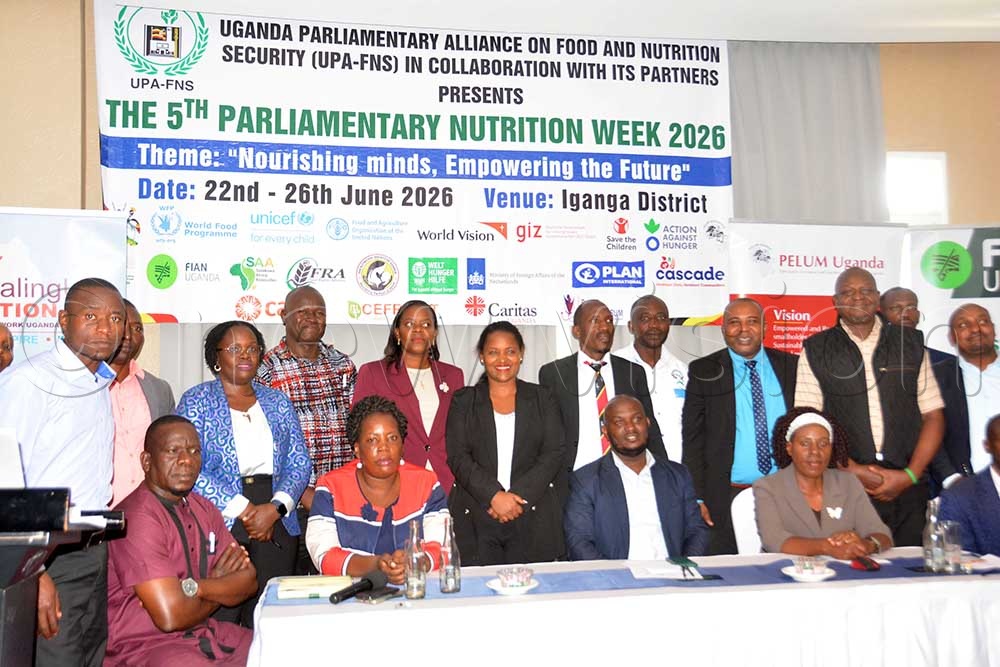
Members of Parliament and participants pose for a group photograph during the stakeholders nutrition accountability dialogue at Golden Tulip Hotel in Kampala on May 22, 2026. (Credit: Francis Emorut)
“If there is good feeding, very few people will be sick. And therefore the money that would be spent on buying drugs and treatment would be saved if people were given nutritious food,” he said.
Okeyo also commended development partners and civil society organisations supporting nutrition programmes across the country, including CARE International, Food and Agriculture Organisation, and Sasakawa Global 2000.
He added that several civil society organisations are already working with communities in districts such as Kamuli and Iganga to improve nutrition and promote sustainable agriculture.
At the same event, Flavia Kabahenda, the outgoing Woman Member of Parliament for Kyegegwa District, urged Ugandans to embrace philanthropy, community savings groups and local support systems to strengthen food security and household resilience.
Kabahenda said Uganda should not rely entirely on government interventions but instead empower communities to develop collective approaches to hunger and nutrition challenges through Village Savings and Loan Associations (VSLAs), food reserves and agricultural insurance schemes.
Meanwhile, Mary Immaculate Apiyo, an Advocacy Officer at PELUM Uganda, said research has proved the link between school feeding and better attendance, concentration and academic performance.
According to PELUM Uganda, about 67% of children in Universal Primary Education schools attend classes without meals, while only about 48,000 out of more than 8.2 million learners benefit from government-supported feeding programmes.
“Children who go to school hungry struggle to concentrate, are more likely to drop out and suffer long-term effects such as stunting and poor cognitive development,” Apiyo said.
She called for increased government financing for home-grown school feeding programmes linked to agroecology and local smallholder farmers, saying the approach would improve nutrition while creating stable markets for farmers.
The 5th Parliamentary Nutrition Week, which will be held in Iganga next month, is expected to focus on strengthening school feeding, food security, climate resilience and sustainable agriculture as Uganda seeks to tackle rising malnutrition and hunger levels across the country.