
Government to standardise ICT indicators, skills certification
Dr Zawedde said the government is creating permanent structures, including standard operating procedures and intellectual property protections, to keep cross-border trade active after the project wraps up.
Aminah Zawedde, the Permanent Secretary Ministry of ICT addressing participants during a meeting on Uganda ICT Industry promotion project at National ICT innovation hub Nakawa on August 25, 2026. (Photos by Nancy Nanyonga)
________________
Government has announced plans to standardise Information and Communication Technology (ICT) indicators and definitions to accurately measure the sector’s contribution to the economy.
The Ministry of ICT and National Guidance is collaborating with key state agencies, including the National Information Technology Authority-Uganda (NITA-U) and the Uganda Bureau of Statistics (UBOS), to establish uniform, globally accepted rules for measuring digital data.
The plans were unveiled during the Uganda-Japan Connect (UJ-Connect) Joint Coordination Committee meeting at the National ICT Innovation Hub in Nakawa on Tuesday, presided over by Permanent Secretary Dr Amina Zawedde.
Amos Mpungu, a principal ICT official, said the absence of standardised definitions has led to the underestimation of ICT’s economic contribution, as Uganda Bureau of Statistics sometimes adopts international definitions that do not fit the local context.
“For the last three years, we have said our contribution is understated because the Bureau has not fully appreciated our perspective,” Mpungu said, adding that a compendium of standardised indicators will be completed within six months.
(centre) Aminah Zawedde the Permanent Secretary Ministry of ICT, Osaki Mitsuhiro Chief Representative JICA Uganda and other officials pose for a group photo after a meeting on Uganda ICT Industry promotion project at National ICT innovation hub Nakawa on August 25, 2026. 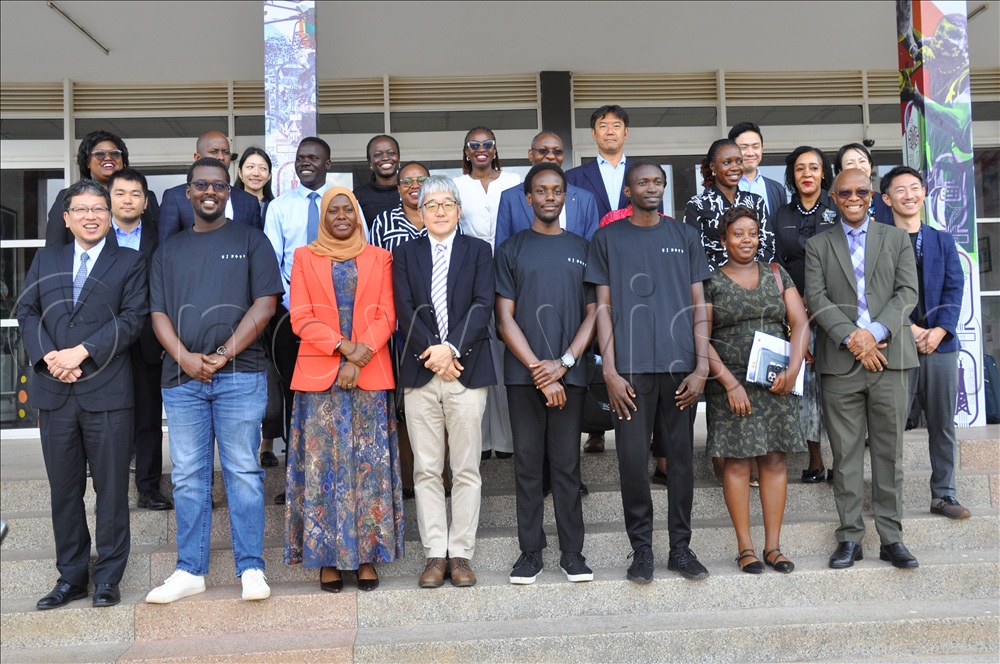
The ministry he added is pushing for the Information Technology Professionals Examination Council (ITPEC) certification to test Ugandan ICT professionals against global standards, opening doors to business process outsourcing (BPO) and labour export opportunities in Japan and allied economies.
“We are not just producing engineers who write code, but professionals who understand business strategy. That is where we usually go wrong: sitting in basements producing things that do not solve actual business problems,” Mpungu noted.
The UJ-Connect initiative is a multi-year collaborative project between the ministry and the Japan International Cooperation Agency (JICA) designed to strengthen Uganda's digital economy.
"While Japan continues to support the government through technical cooperation, it is essential that Uganda develops a clear strategy to sustain and expand the success stories we have already built," Osaki said
The UJ-Connect project is expected to end in February next year, but the government is already preparing documentation for a new phase of financing. Achievements are being integrated into existing structures, particularly the Uganda Institute of Information and Communications Technology (UICT) in Nakawa, to ensure sustainability.
Through the UJ-Connect framework, supported youth founders receive structured mentorship, business acceleration, and proof-of-concept grants of up to $5,000. This allows young innovators to refine their products before pitching at major global gatherings, including Expand North Star and GITEX in Dubai, and Sushi Tech in Japan
Dr Zawedde said the government is creating permanent structures, including standard operating procedures and intellectual property protections, to keep cross-border trade active after the project wraps up.
"We are ensuring that even after the formal project ends, the business pipeline connecting Ugandan innovators with Japanese, Vietnamese, and global investors remains wide open and fully functional," she concluded.
During the event, three students were recognised for their achievements: Barituma Aine from UICT, Tusiime Mark from Makerere University, and Mwijuka Harold from ISBAT University. Their certificates were presented by Osaki and the Permanent Secretary.