
Four in 10 Ugandan media workers face sexual harassment, survey finds
Women continue to be disproportionately affected across nearly all forms of harassment.Among those who experienced harassment, 77% of women reported verbal harassment, compared to 45% of men.
Former Vision Group Editor-in-Chief Barbara Kaija and currently a board member of the WAN-IFRA discussing about sexual harassment in newsrooms during the three-day Editors' Guild Convention at Nile Resort Hotel in Jinja City on August 1st, 2026. (Credit: Donald Kiirya)
JINJA - Four in every 10 media workers in Uganda have experienced sexual harassment, with women bearing the heaviest burden, according to a new global survey.
The findings, released during the Uganda Editors Guild's fourth Annual Editors Convention at Nile Resort Hotel in Jinja city on August 1, 2026, show that 40% of Ugandan respondents, comprising 116 women and 89 men, reported experiencing some form of harassment.
This is eight percentage points higher than the African average of 33%.
The survey, conducted in 2025 by WAN-IFRA Women in News (WIN) in partnership with City St George's, University of London, and BBC Media Action, covered more than 2,800 media workers globally.
Although the Ugandan figure marks a decline from 53% recorded in 2020, researchers say the findings remain troubling, particularly because most cases go unreported.
Women continue to be disproportionately affected across nearly all forms of harassment.
Among those who experienced harassment, 77% of women reported verbal harassment, compared to 45% of men.
Nearly half of the women (47%) experienced physical harassment, compared to 34% of men, while 56% of women reported online harassment, compared to 46% of men.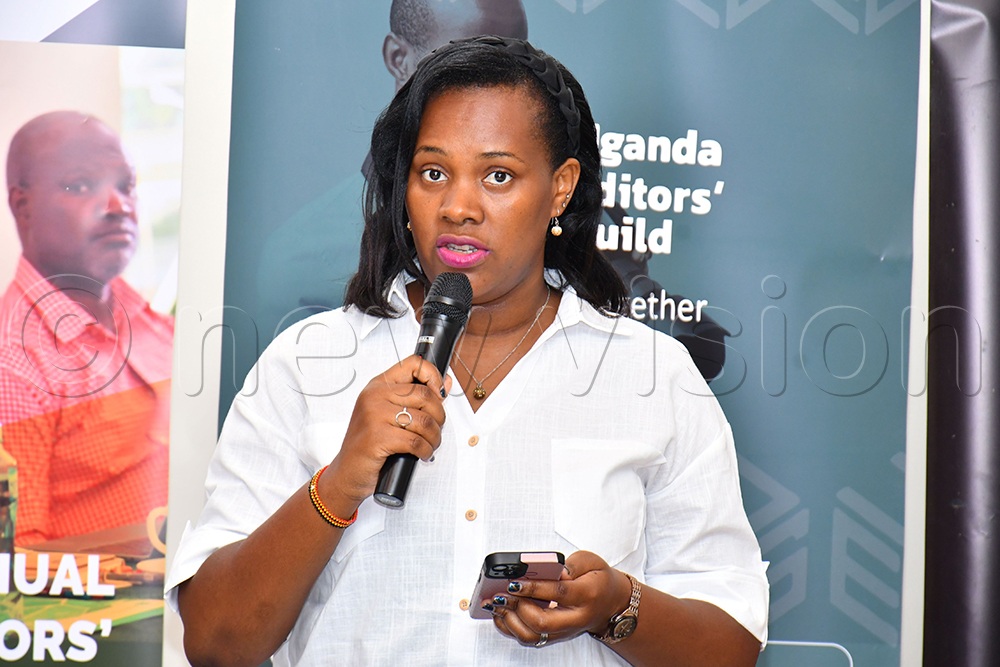
Vivian Kamusiime, WIN Uganda chapter lead addressing Editors and Media House owners during their three-day Editors' Guild Convention at Nile Resort Hotel in Jinja City on August 1st, 2026. (Credit: Donald Kiirya)
The findings were presented to dozens of editors, senior media managers and media owners attending the convention, which ran from July 30 to August 2, 2026.
In a press release, WAN-IFRA Women in News (WIN) managing director Susan Makore urged news organisations to establish clear sexual harassment policies, accessible reporting channels and dedicated response teams to make media workplaces safer for everyone.
Editors and practitioners react
Dick Mivule, deputy news editor and digital team lead at Radio Simba FM, noted that most cases go unreported.
“The report has just shown that almost 80% of the cases that happened were never reported. Many cases happen, they go unreported, and the perpetrators think that they can continue doing it,” he said.
He proposed that flirting be turned into meaningful relationships where two parties should get themselves married, and one of them leave the institution to create a peaceful environment for others.
Irene Abalo, founder and director of Afri Media Training Institute, stressed the importance of leadership accountability.
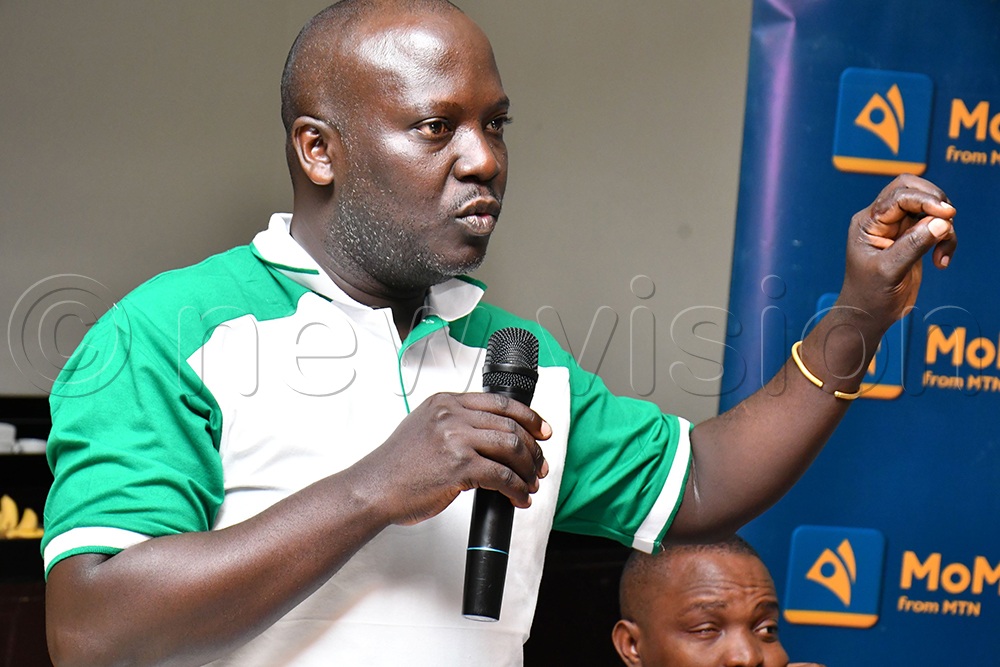
Francis Kagolo, the Senior Producer for News and Current Affairs at Vision Group remarks about Sexual Harassment in the newsrooms during the three-day Editors' Guild Convention at Nile Resort Hotel in Jinja City on August 1st, 2026. (Credit: Donald Kiirya)
“What the leader does, the rest are most likely to do. If you are an accomplice in sexual harassment cases, it is most likely that people in your team are going to do the same. If they see that when the leader hugs in an unexpected way, it will be normal and if someone grips you and tickles you by hand, that is harassment,” Abalo stated.
Esther Nalubega Wamala, chief news editor at Central Broadcasting Services (CBS 89.2 FM), said policies exist on paper but are often undermined in practice, particularly where interns are concerned.
“I think she used sexual harassment as a weapon because she didn’t like me. After the accusation, she has been in a situation that’s really the true definition of harassment. She never reported it—she seemed to enjoy it. Let’s encourage victims to report, but also let’s encourage people to carry themselves in a respectable manner,” he advised.
Flora Aduk of Mama FM, who has researched newsroom culture, questioned why the issue persists after two decades.
“We were being harassed 20 years ago. Why, after 20 years, are we still talking about sexual harassment? We need the involvement of newsroom owners, and let’s give this topic time. This is a serious thing. Let’s have a real campaign…Why can’t we have a championing campaign about something so important?” Aduk questioned.
Joachim Buwembo, a Ugandan author, journalist and newspaper columnist, who is also the chairperson of the board of governors of the Uganda Printing and Publishing Corporation (UPPC), a state-owned printing parastatal mandated to publish and print government documents, pointed to what he described as an emerging form of exploitation.
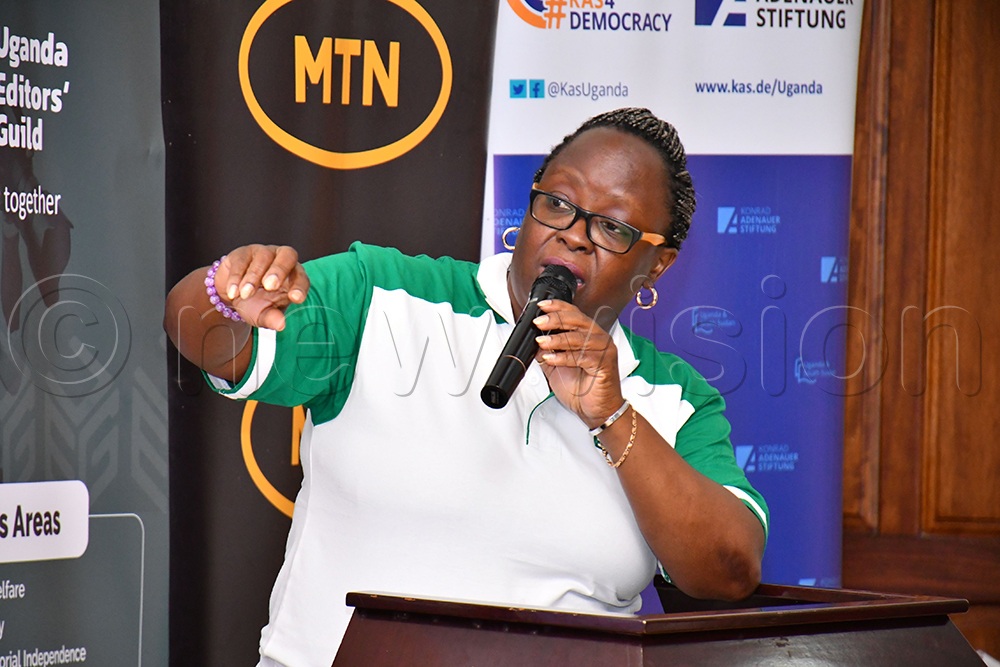
Caroline Nakazibwe, a writer and editor at the Weekly Observer, presenting the WAN-IFRA Women in News sexual harassment report during the 4th Uganda Editors' Guild convention at Nile Resort hotel in Jinja City on August 1st, 2026. (Credit: Donald Kiirya)
“There is a new form of harassment, and it is financial. There was a massive success of affirmative action and female empowerment, which had an adverse effect of bringing young men who set out to look for women to exploit financially by pretending to be in free love—the men are using sex to exploit women financially increasingly in this country,” Buwembo said.
Francis Kagolo, senior producer for news and current affairs at Vision Group, warned against the misuse of sexual harassment allegations by underperforming employees and highlighted the role of workplace power dynamics.
“Most non-performers are using sexual harassment to get away with non-performance. Before you suspend, before you dismiss any person, you need to investigate thoroughly. When you are the woman supervising others, usually the male supervisees tend to fear or respect you, but if you’re the man supervising women, usually the men suffer sexual harassment,” Kagolo said.
He also questioned why women leave newsrooms for public relations roles if harassment is unique to media organisations.
Participants were urged to sign the commitment board, use available reporting resources and return to their newsrooms as ambassadors for change.