
Kiira Motors targets 1,500 electric buses across Uganda in five years
Isaac Musasizi, the chief executive officer of KMC, said the planned fleet would serve more than 12 million Ugandans and be supported by a network of 260 direct-current (DC) charging units.
Kiira Motors Corporation (KMC) plans to deploy more than 1,500 electric buses across 40 urban centres in Uganda over the next three to five years. (Photo by Doreen Musingo)
__________________
Kiira Motors Corporation (KMC) plans to deploy more than 1,500 electric buses across 40 urban centres in Uganda over the next three to five years as it accelerates its electric mobility and battery manufacturing ambitions.
Isaac Musasizi, the chief executive officer of KMC, said the planned fleet would serve more than 12 million Ugandans and be supported by a network of 260 direct-current (DC) charging units.
“We see in the foreseeable future, in the next three to five years, over 1,500 electric buses serving over 12 million Ugandans across 40 urban centres supported with a network of 260 DC charging units,” Musasizi said.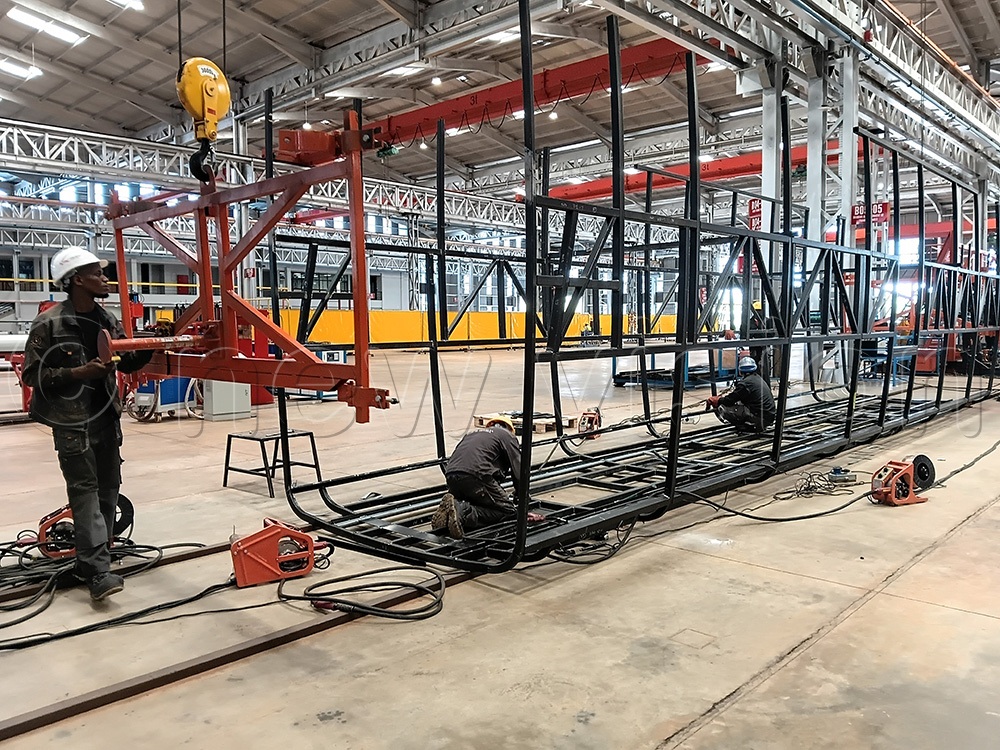
Workers assembling the bus frames at Kiira Motors Corporation (KMC) in Jinja. (Photo by Doreen Musingo)
He said the initiative was part of Kiira Motors' broader strategy to transform public transport while developing Uganda's capacity to manufacture and support electric vehicles locally.
Musasizi said the electric buses were designed to improve commuter comfort through features such as climate control, reclining seats, charging systems, safety features and entertainment.
He said the corporation's vision was to make public transport more comfortable while providing reliable mobility for Ugandans travelling to work and pursuing economic opportunities.
Musasizi made the remarks during the October 2, 2026, launch of a Vivo fuel station at the KMC plant in Mutai, Jinja district, where he outlined the corporation's plans to expand its vehicle production, transport and logistics, electric mobility and battery value chains.
He said Kiira Motors' vehicle plant currently has an installed capacity to produce 2,500 vehicles annually, with room for expansion to 10,000 vehicles.
Musasizi said the success of electric mobility would depend on the availability of reliable charging infrastructure, calling on energy companies to partner with Kiira Motors to establish charging facilities at existing energy stations.
He said the corporation was pursuing what it termed a user electric-vehicle charging system, which would allow charging facilities to be co-located at suitable fuel and energy stations.
“We are inviting fuel companies to partner with us because we believe that at some of your charging stations, where you have sufficient space, we can co-locate some of these facilities,” he said.
Musasizi said the partnership would help ensure that electric vehicle users could access charging facilities as the technology expands across Uganda.
He said the transition to electric mobility should not necessarily mean abandoning existing petroleum-based energy infrastructure, but rather creating an energy mix that accommodates electricity and other emerging technologies.
Joanita Mukasa Menya, the managing director of Vivo Energy, said the proposal to work on setting up charging stations was welcome and that the ideas had already been incorporated into their work plan.
“This is a more brilliant idea that we have embraced, and we have planned and mapped out sites to be used as charging centres to enable your services to be more visible and appreciated,” she said.
Battery value chain
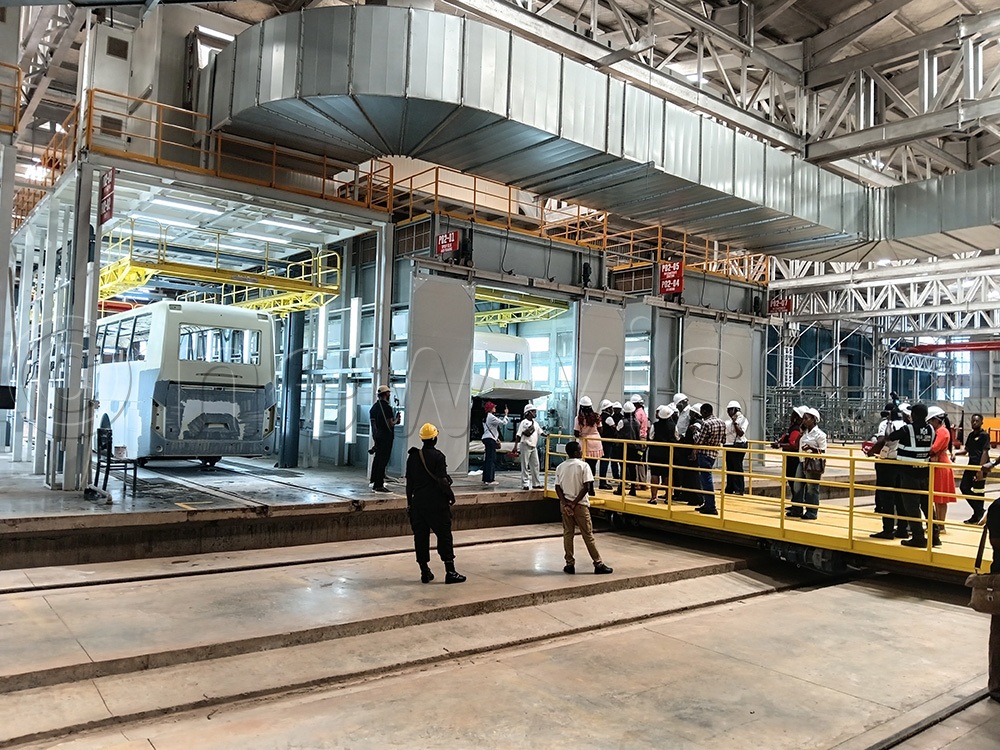
Buses at the paint shop at Kiira Motors Corporation (KMC) Uganda. (Photo by Doreen Musingo)
He said Kiira Motors had started work on localising the battery value chain through its Raddy Energy Systems initiative.
“We are getting into that area of localising the battery value chain, not only to support electromobility but also to see that all the other use cases that require reliable energy can be supported. At KMC, a battery energy storage system is being used to provide business continuity in the paint shop, which is particularly sensitive to power interruptions,” he added.
He said locally produced battery energy storage systems could support industries, hospitals, schools, commercial facilities and data centres that require uninterrupted power because the systems help maintain operations during power disruptions.
He said Uganda and Africa were well positioned to utilise solar energy to charge and store electricity, particularly because of the continent's abundant sunshine.
Growing workforce
Musasizi said Kiira Motors currently employs more than 440 workers and is targeting a workforce of more than 2,000 people as operations expand.
He said the corporation was also focused on nurturing a new generation of technology entrepreneurs and engineers capable of supporting Uganda's industrialisation agenda.
He described the partnership with Vivo Energy as an important step towards strengthening Uganda's mobility and energy ecosystem.
“We are optimistic that partnering with Vivo is going to go a long way in ensuring that we move Africa to its destiny,” Musasizi said.