
News
Dutch Envoy wants refugee women equipped with leadership skills
77% of the refugee community are women and children. Uganda has a population of about 2 million refugees, mostly from neighbouring countries such as Rwanda, South Sudan, Burundi and DR Congo.
Dutch Ambassador to Uganda, Frederieke Quispel poses for a group with other participants at the conference on Wednesday, June 17, 2026. (Credit: Prossy Nadudu)
By: Prossy Nandudu, Journalist @New Vision
___________________
The Dutch Ambassador to Uganda, Frederieke Quispel, has called for funders of refugee livelihood programmes to equip women with leadership skills for peace and economic development in refugee settlements.
Through peaceful co-existence, Quispel noted that women will be in position to champion income-generating activities that will increase self-reliance at a time when refugee funding has reduced.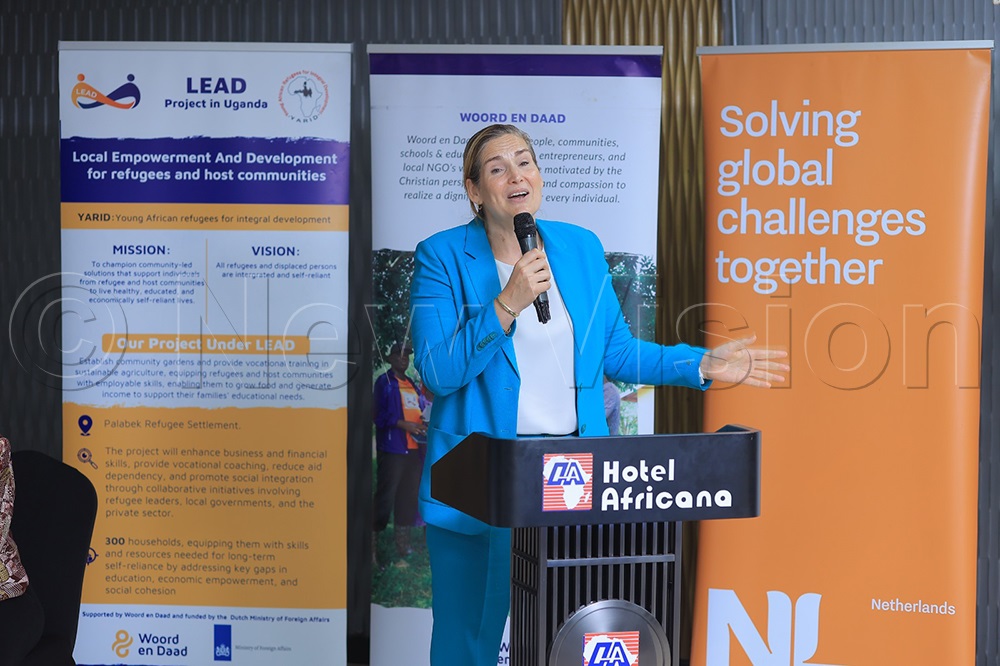
Quispel delivers her presentation during the event. (Credit: Prossy Nandudu)
She made the call on Wednesday (June 17) during the 'SheLeads' conference organised by Woords en Daad under the LEAD project supported by Young African Refugees for Integral Development (YARID), Uganda Community Based Association for Women and Children's Welfare (UCOBAC), Community Empowerment for Rural Development (CEFORD) at Hotel Africana.
The LEAD Project empowers refugees and host communities in Uganda through local development and sustainable livelihoods. Under this project, individuals are equipped with skills and resources to thrive independently. This is done through targeted education and vocational training.
The conference was aimed at celebrating Refugee women, host community leaders and all women at the forefront of humanitarian action whose leadership, resilience and commitment continue to drive positive change in their communities.
Under the “Celebrating Women Leading Change in Refuge and Resilience”, the conference was aimed at honouring, amplifying and standing in solidarity with refugee and host community women who are leading change in the most challenging of circumstances.
Situation in refugee camps
According to her, 77% of the refugee community are women and children. Uganda has a population of about 2 million refugees, mostly from neighbouring countries such as Rwanda, South Sudan, Burundi and DR Congo.
“That is why it's right to focus on women leadership in general, for safety as well. When you look at the world, I personally feel it's becoming less and less safe. What we need is to strive for safety and security for all. And that means that we need to empower the vulnerable to lead. And in my view, if we allow women to lead their families that thrive,” Quispel noted.
She, however, added that for the leadership to be meaningful, hardships experienced by refugee women should be addressed, citing hardships in acquiring land, which makes having their own livelihood hard.
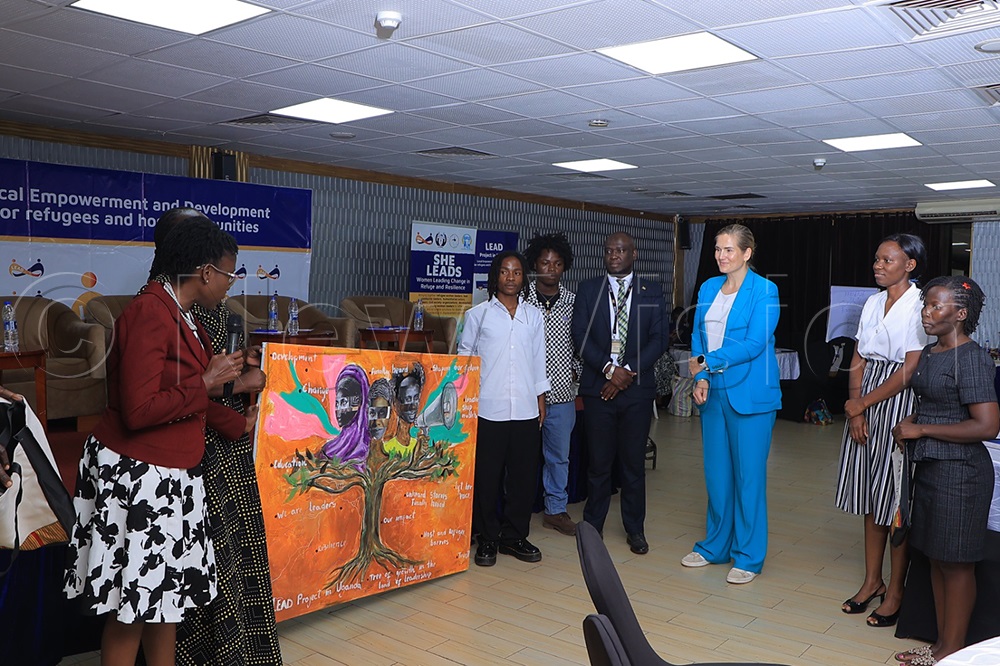
Quispel listens as refugee Congolese boys explain an art piece depicting women in leadership. (Credit: Prossy Nandudu)
Situation in refugee camps
According to her, 77% of the refugee community are women and children. Uganda has a population of about 2 million refugees, mostly from neighbouring countries such as Rwanda, South Sudan, Burundi and DR Congo.
“That is why it's right to focus on women leadership in general, for safety as well. When you look at the world, I personally feel it's becoming less and less safe. What we need is to strive for safety and security for all. And that means that we need to empower the vulnerable to lead. And in my view, if we allow women to lead their families that thrive,” Quispel noted.
She, however, added that for the leadership to be meaningful, hardships experienced by refugee women should be addressed, citing hardships in acquiring land, which makes having their own livelihood hard.
“When you talk about having your own livelihood, I fully agree. People don't want aid for the rest of their lives. They don't want handouts. They want to be able to spend for themselves, but then we have to help to make that possible,” Quispel explained.
Support to refugee women
Pastor Julius Onen, the country representative of Woods en Daad, explained that although displacement is one of the most destabilising forces a human being can experience, women across Uganda’s 13 refugee settlements including Bidibidi, Nakivale, Kyaka II, Imvepi, and Kiryandongo, continue to thrive in both leadership and economic generating activities to have a better living environment for themselves.
He said some women have established refugee-led organisations that advocate for service delivery in their communities, while others have taken seats on local councils and Refugee Welfare Committees to continue advocating for the rights of refugee women.
“They have built savings and credit cooperatives from scratch, creating financial lifelines that have kept families solvent through dry spells, economic shock and dwindling international support, which has led to peace-building dialogues that cross cultural and language divides to ensure safety and support to survivors of gender-based violence, among others,” Onen explained.
To ensure that women excel in their leadership positions, Onen said they have been using methods that bring together families to appreciate the role of everyone in the household. “In so doing, we empower girls and ladies with skills that can create lasting solutions to their challenges,” he said.
Officiating at the same event, the Permanent Secretary in the Ministry of Gender, Labour, and Social Development, Aggrey Kibenge, commended the initiatives of development partners in ensuring that refugees can thrive in Uganda.
Kibenge highlighted initiatives in the ministry that they are working on to ensure that there is a national self-reliance measurement framework for refugees and host communities. He added that the ministry is currently spearheading the implementation process, and the pilot has so far benefited 800 elderly refugees, among other initiatives that the ministry has lined up to support refugees in Uganda.
Support to refugee women
Pastor Julius Onen, the country representative of Woods en Daad, explained that although displacement is one of the most destabilising forces a human being can experience, women across Uganda’s 13 refugee settlements including Bidibidi, Nakivale, Kyaka II, Imvepi, and Kiryandongo, continue to thrive in both leadership and economic generating activities to have a better living environment for themselves.
He said some women have established refugee-led organisations that advocate for service delivery in their communities, while others have taken seats on local councils and Refugee Welfare Committees to continue advocating for the rights of refugee women.
“They have built savings and credit cooperatives from scratch, creating financial lifelines that have kept families solvent through dry spells, economic shock and dwindling international support, which has led to peace-building dialogues that cross cultural and language divides to ensure safety and support to survivors of gender-based violence, among others,” Onen explained.
To ensure that women excel in their leadership positions, Onen said they have been using methods that bring together families to appreciate the role of everyone in the household. “In so doing, we empower girls and ladies with skills that can create lasting solutions to their challenges,” he said.
Officiating at the same event, the Permanent Secretary in the Ministry of Gender, Labour, and Social Development, Aggrey Kibenge, commended the initiatives of development partners in ensuring that refugees can thrive in Uganda.
Kibenge highlighted initiatives in the ministry that they are working on to ensure that there is a national self-reliance measurement framework for refugees and host communities. He added that the ministry is currently spearheading the implementation process, and the pilot has so far benefited 800 elderly refugees, among other initiatives that the ministry has lined up to support refugees in Uganda.