
Courts begin one-month vacation
“I would like to inform the public that the annual court vacation for the High Court and the Magistrates' Courts starts today (Wednesday) and will run until August 15. The judicial officers will use this period to write pending judgments and rulings and also weed out idle cases,” Alum said.
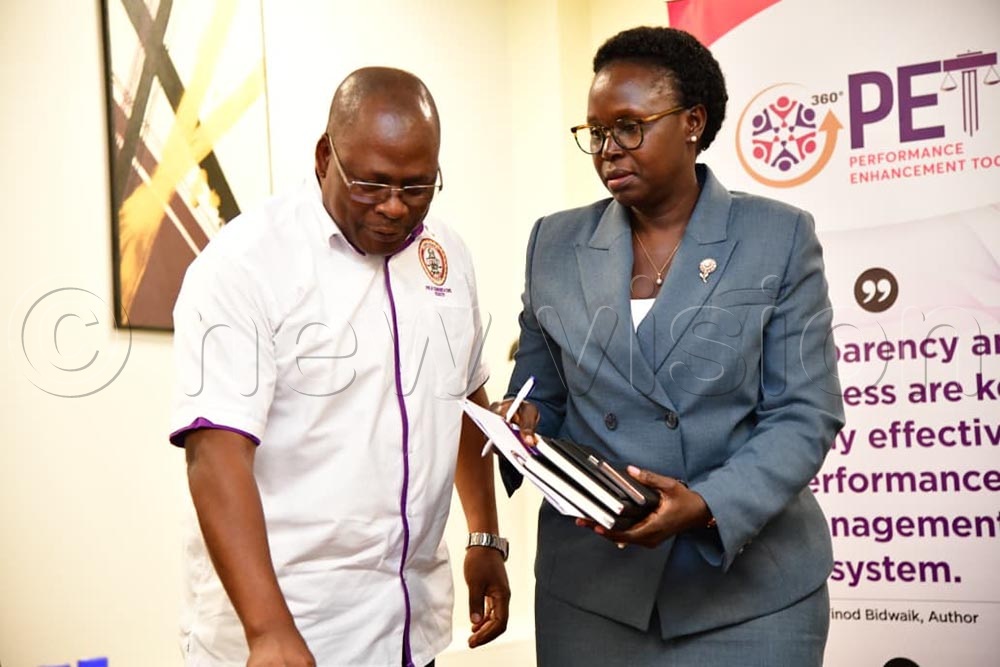
Chief Registrar Agnes Alum made the announcement during a media discourse at the Supreme Court boardroom in Kampala on Wednesday (July 15). (Credit: Mpalanyi Ssentongo)
KAMPALA - The Judiciary has announced the commencement of the annual one-month court vacation for the High Court and Magistrates’ Courts across the country.
Chief Registrar Agnes Alum made the announcement during a media discourse at the Supreme Court boardroom in Kampala on Wednesday (July 15).
“I would like to inform the public that the annual court vacation for the High Court and the Magistrates' Courts starts today (Wednesday) and will run until August 15. The judicial officers will use this period to write pending judgments and rulings and also weed out idle cases,” Alum said.
Alum explained that during this period, civil matters before the courts will not be heard, while criminal matters will proceed as usual.
Judiciary spokesperson James Ereemye Mawanda explained that during this period, civil matters before the courts can only be heard after obtaining a certificate of urgency from the parties.
Alum said the court vacation for the Court of Appeal and Supreme Court will start on August 1 and run until August 31.
Court vacation is mandatory and is provided for under the Judicature (Court Vacation) Rules, S.I 13-20.
What is court vacation
During vacation, judicial officers mainly concentrate on desk work, including writing judgments, weeding out inactive cases from the system, reviewing work from the previous period and planning for the next period.
During the two vacation periods, courts do not handle civil cases except where a party obtains a certificate of urgency through an application.
However, there is always a judicial officer on duty to handle urgent civil matters.
The concept of court vacation was inherited from the British colonial era. Historically, English judges and legal practitioners halted routine business to travel back to the United Kingdom to visit their families or attend religious festivals.
However, judicial officers now use the period mainly to write pending judgments.
New reforms
During the media briefing, Alum also unveiled an ambitious reform agenda that includes the use of artificial intelligence (AI) in court operations, expansion of electronic case management, new media accreditation and court reporting guidelines, recruitment of more judicial officers and a renewed focus on accountability and staff welfare.
Alum said the reforms are intended to build a more accessible, efficient, transparent and people-centred justice system while strengthening the Judiciary’s partnership with the media.
“The media remains a critical partner in our work. You are the bridge between the judiciary and the public and your role in informing, educating and shaping public perception of justice cannot be overstated,” she said.
She acknowledged that some journalists had experienced inconveniences during the transition and apologised for the challenges.
However, she expressed confidence that once fully implemented, the accreditation framework would improve the working relationship between the Judiciary and the media while creating a more efficient reporting environment.
She also announced that the Judiciary is developing media and court reporting guidelines to provide clarity on court reporting procedures, strengthen coordination between court officials and journalists, and promote professional, accurate and responsible reporting.
“The purpose of these guidelines is not to limit media freedom but to establish a clear and predictable framework that enables both the Judiciary and the media to effectively discharge their constitutional mandates,” she explained.
Regarding digital transformation, Alum said the Judiciary remains committed to consolidating reforms undertaken in previous years while accelerating its transformation agenda.
She said priority will be given to expanding the rollout of the Electronic Court Case Management Information System (ECCMIS) and increasing the use of virtual court hearings as the Judiciary works towards becoming a paperless institution.
She described the recent launch of the judgment writing tool by the Chief Justice as a major milestone in improving efficiency and consistency in judicial work.
Alum said the Judiciary is exploring the use of artificial intelligence (AI) to support court transcription services and judgment writing, adding that safeguards will be put in place to ensure the technology is used responsibly.
Alum appealed to members of the public to always raise their complaints so that they can be resolved.
“I call upon any member of the public with any complaint to bring it to our attention so that they are effectively handled,” Alum said.