
Chief Justice rallies public to embrace ADR mechanisms for timely justice
By embracing ADR at community, corporate and national levels, Zeija said the country would move towards a stronger culture of peace and ensure that justice is not only served but also achieved timeously, amicably, inexpensively and efficiently.
Justice Andrew Khaukha, the Executive Director of Judicial Training Institute (JTI) in a suit posing for a photo moment with graduates and their lecturers during the inaugural graduation of participants in the Gerontological Alternative Dispute Resolution (GADR) Training at St. Francis Chapel, Makerere University. (Photos by Simon Peter Tumwine)
________________
The Chief Justice, Dr Flavian Zeija, has urged members of the public to embrace Alternative Dispute Resolution (ADR) mechanisms in resolving disputes, saying they are not only speedy but also produce outcomes that are communally acceptable, unlike the adversarial justice system.
By embracing ADR at community, corporate and national levels, Zeija said the country would move towards a stronger culture of peace and ensure that justice is not only served but also achieved timeously, amicably, inexpensively and efficiently.
Citing the 2024 report by the Hague Institute for Innovation of Law (HILL), which revealed that the number of people seeking justice services through formal courts in Uganda increased from 4% in 2020 to 10% in 2024, Zeija said this shows that the majority still rely on informal justice systems such as mediation and negotiation.
He added that the Judiciary has since embarked on re-engineering ADR, including introducing new mediation rules, which he approved last week.
“We have started piloting the alternative justice strategy in Acholi and Lango with a view of rolling it in other parts of the country. We would like to reach a point where the courts can refer the matter to the Alternative Justice Strategy (AJS) practitioners. This is in line with administration of justice in the African context before colonialism,” Zeija noted.
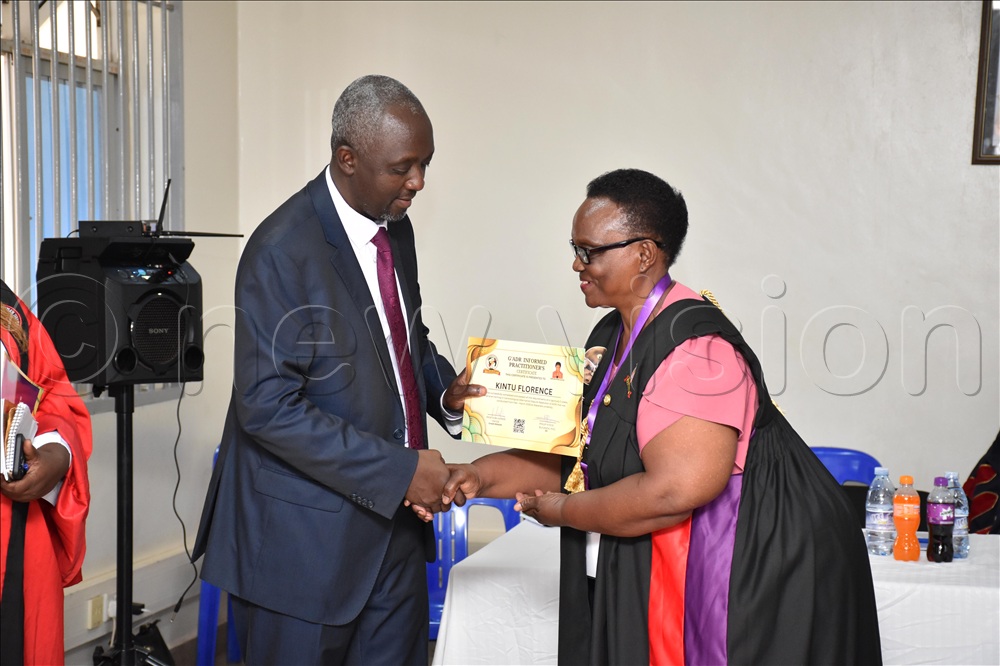
Justice Andrew Khaukha, Executive Director of Judicial Training Institute (JTI) awarding certificate to Kintu Florence during the inaugural graduation of participants in the Gerontological Alternative Dispute Resolution (GADR) Training at St. Francis Chapel, Makerere University.
Zeija made the call in a speech delivered on his behalf by Justice Prof. Andrew Khaukha, the executive director of the Judicial Training Institute, during the graduation ceremony of the first cohort of 21 participants in Gerontological Alternative Dispute Resolution (GADR) at St Francis Chapel, Makerere University, on April 18, 2026.
Courts closed the previous financial year with a pending caseload of 161,838 cases, of which 42,588 were backlogged.
“I take this opportunity to thank the organisers of this activity, which is contributing to the growth of professional mediators who are going to support the process of amicable dispute resolution. The efforts by the organisers are in line with the Government of Uganda National ADR policy that was approved by Cabinet in February 2025,” Zeija noted.
The National ADR policy enjoins government agencies, ministries and departments to promote ADR as the preferred mode of dispute resolution.
Zeija said colonisation introduced a legal regime that disrupted justice systems rooted in the social norms, traditions and customs of African societies.
“This has grave ramifications on the administration of justice in our various African jurisdictions,” he noted.
He urged members of the public and the Judiciary to continue on the path of innovation and scale up the use of ADR and AJS in communities.
“Together, we can build stronger and more resilient formal and informal judicial systems that uphold the rule of law and promote social harmony,” Zeija said.
Drawing from Article 126 of the Constitution, Zeija said ADR is a real game changer in the administration of justice because it is relevant, cost-effective, time-saving and a more effective means of access to justice that preserves social harmony in any community.
Amos Magezi of North West Ankole Diocese and Philip Ntege of Buganda, one of the trainers, commended the Judiciary for reintroducing the ADR system, saying it will help senior citizens remain relevant in society, promote peace, and, in the long run, reduce case backlog as fewer matters go to court for adjudication.
Prof. Khaukha said the Chief Justice is ready to accredit the graduates to join the list of court-accredited mediators. The graduates included former MPs such as Florence Kintu, among others.