
Chief Justice, BoU Governor hail progress of Uganda’s oil projects
The Chief Justice and the central bank governor expressed satisfaction that major infrastructure works are nearing completion.
Chief Justice Dr Flavian Zeija (left), Bank of Uganda (BoU) Governor Michael Atingi-Ego (2nd left) during a visit to Uganda's oil and gas region on Thursday, August 6, 2026. (Courtesy photos)
________________
Chief Justice Dr Flavian Zeija and Bank of Uganda (BoU) Governor Michael Atingi-Ego have hailed the progress of Uganda's oil and gas projects in the Albertine region.
Speaking at the conclusion of a four-day visit to Uganda's oil and gas region on Thursday, August 6, 2026, after a comprehensive tour of the Tilenga Project in Buliisa district, the Chief Justice and the central bank governor expressed satisfaction that major infrastructure works are nearing completion.
Organised by the Judicial Training Institute (JTI) in partnership with the Bank of Uganda (BoU), Uganda Revenue Authority (URA), Petroleum Authority of Uganda (PAU) and Uganda National Oil Company (UNOC), the study visit brought together officials from the partner institutions and the Judiciary to deepen their understanding of Uganda's petroleum sector and its legal, economic, environmental and social dimensions.
During the tour, judicial officers and senior central bank officials gained first-hand insight into upstream oil production, environmental restoration and community resettlement initiatives in the Albertine Graben.
Travelling through Murchison Falls National Park to the project sites, the Chief Justice said they gained a greater appreciation of the environmental considerations and conservation measures underpinning petroleum development within one of Uganda's most ecologically significant landscapes.
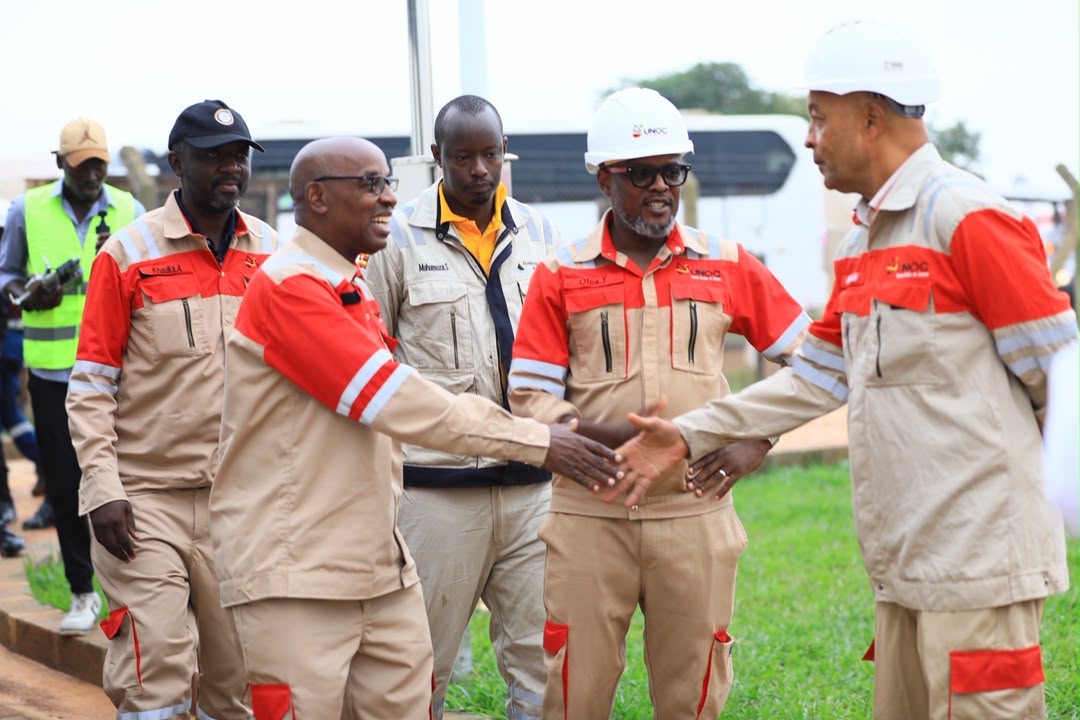
The delegation also toured key project infrastructure, including the Contractor Support Base (CSB), Central Processing Facility (CPF), Drilling Support Base (DSB), solar power plant and Construction Camp Area (CCA).
They also visited a replacement house built for a Project Affected Person (PAP), providing valuable insight into the land acquisition, compensation and resettlement processes undertaken as part of the project.
The field study also included visits to the rehabilitated JBR2 exploration well, rehabilitated trunk line sections, the fully developed JBR5 well pad and the Process Support Node (PSN), where participants gained practical knowledge of crude oil production, gathering, transportation and processing.
The Chief Justice underscored the importance of the tour, saying it exposed judicial officers to the realities of Uganda's oil and gas industry.
The Chief Justice said the visit dispelled misconceptions that Uganda's oil reserves had already been exhausted.
“Many people on social media claim there is no oil left, but what we have witnessed tells a completely different story. There is enormous work taking place here, and it is encouraging to see the progress being made,” the Chief Justice said.
He also commended the sector's commitment to promoting local content, noting that the increasing participation of Ugandans in specialised technical roles demonstrated the country's growing capacity to sustain its petroleum industry.
At Kabalega International Airport, the delegation toured one of Uganda's most significant infrastructure investments supporting the oil and gas sector.
The Chief Justice described the airport as a strategic national asset that will facilitate petroleum operations while contributing to Uganda's broader economic transformation.
He noted that the facility demonstrates Uganda's capacity to accommodate some of the world's largest heavy-lift cargo aircraft required to transport oversized equipment for oil and gas development.
Amos Muriisa, the public relations officer at SBC Uganda, an engineering construction firm, explained that the airport features a 3.5-kilometre runway within a five-kilometre airfield to accommodate turning pads and safety areas.
He added that construction is now 98.8% complete and that the airport was specifically developed to support Uganda's emerging petroleum industry.
Welcoming the delegation at the Kingfisher Oil Waste Management Facility, Lt Gen. James Mugira, the managing director of the National Enterprise Corporation (NEC), explained that the facility was commissioned by President Yoweri Museveni on January 24, 2023, and has since been safely managing hazardous waste generated from petroleum operations.
He said the facility was established to ensure environmentally sound treatment and disposal of oil waste in accordance with international standards, thereby safeguarding communities, wildlife and the environment.
Lt Gen. Mugira revealed that approximately US$6 million had been invested in the facility through internally generated resources and support from development partners.
He noted that NEC's contribution to the petroleum sector extends beyond waste management.
Through its subsidiaries, the corporation is constructing 86 kilometres of internal roads under a contract with the Uganda National Oil Company, building Pump Station One for the East African Crude Oil Pipeline and providing security for pipeline construction.
The delegation also observed the facility's waste treatment process, where oil-contaminated waste is received, sorted, treated, recycled where possible and safely disposed of in compliance with environmental standards.
Zeija praised the professionalism displayed by the engineers, particularly those from the Uganda People's Defence Forces (UPDF), saying their expertise demonstrated the value of investing in technical education and professionalising the armed forces.
He noted that the increasing number of national infrastructure projects entrusted to UPDF engineering units reflected the Government's confidence in their capabilities, citing ongoing security infrastructure within the Judiciary as one example.
Atingi-Ego commended the progress made in Uganda's petroleum sector, observing that the country's macroeconomic outlook is closely linked to the successful commencement of commercial oil production.
He said the Government's projected oil revenue of sh1.4 trillion for the 2026/2027 financial year, together with anticipated export growth, depended on the successful implementation of the ongoing petroleum projects.
“The visit has given me confidence that these projections are supported by visible progress on the ground,” he said.
He applauded the Government's deliberate investment in building local technical expertise.
Innocent Kihika, a board member of the Petroleum Authority of Uganda, said the visit provided an invaluable opportunity for leaders to witness first-hand the significant progress being made towards commercial oil production.
John Bosco Habumugisha, the deputy managing director and general manager of the Uganda branch of the East African Crude Oil Pipeline (EACOP), said the project is designed not only to deliver first oil but also to establish a sustainable petroleum industry that will benefit generations of Ugandans.
He noted that Uganda's commercially recoverable oil reserves are expected to sustain production for approximately 25 years, while the pipeline itself has a design life exceeding 50 years with proper maintenance.
He added that Uganda, through the Uganda National Oil Company, holds a 15% equity stake in EACOP, ensuring long-term national benefits from the strategic infrastructure.
The visit reaffirmed the value of continued collaboration between the Judiciary and institutions involved in Uganda's petroleum sector.
By gaining practical exposure to petroleum operations, environmental safeguards and the country's supporting infrastructure, judicial officers are better equipped to appreciate the complex legal, commercial and environmental issues that may arise as Uganda moves closer to first oil.