
Judiciary hopes for increased public trust in new justice strategy
According to the stakeholders, public trust in the justice system currently stands at 70.3%, and they want it to increase to 73.5% by 2030.
Chief Justice Dr Flavian Zeija appending his signature on the dummy during the launch of the Administration of Justice Programme (AJP) strategy for the 2026/27-2029/30 financial years. (Photo by Mpalanyi Ssentongo)
________________
The Administration of Justice Programme (AJP), formerly the Justice Law and Order Sector (JLOS), a national development framework that coordinates 13 justice sector institutions in the country, has unveiled its strategy for the 2026/27-2029/30 financial years, with the aim of increasing public trust in the justice system.
Other programme results that stakeholders hope to achieve include an improved accessibility and affordability index for civil justice, reduced average case turnaround time, a reduced case backlog, a reduced proportion of the prison population on remand, an improved corruption perception index in the justice system, and an increased proportion of the population with access to a frontline justice service point within a 15-kilometre radius.
According to the stakeholders, public trust in the justice system currently stands at 70.3%, and they want it to increase to 73.5% by 2030.
Regarding the case backlog, the stakeholders noted that it stands at 27.23%, and they want it reduced to at least 15.20% by 2030.
They also want the proportion of the prison population on remand, which stands at 47.3%, to be reduced to 41.3% by the end of the strategy period.
Launching the strategy at the Supreme Court Conference Hall on July 31, 2026, Chief Justice Dr Flavian Zeija said the strategy marks a significant milestone in efforts to build a more people-centred, efficient and accountable justice system.
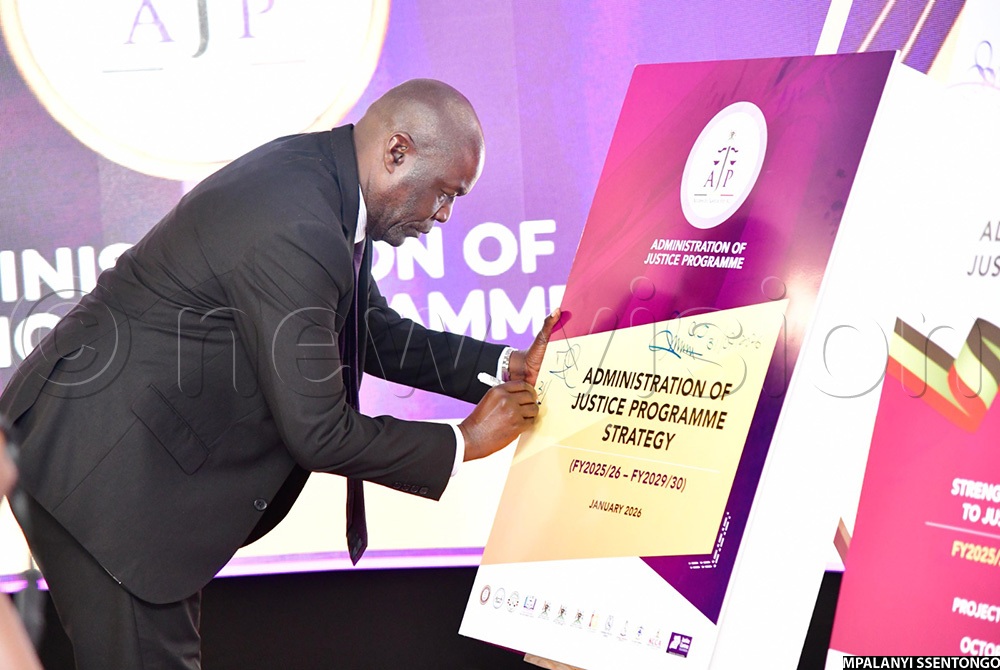
Zeija said the strategy builds on the gains made under the National Development Plan (NDP III) and aligns with the objectives of the National Development Plan (NDP IV).
He observed that the Administration of Justice Programme, now the 17th programme under NDP IV, is intended to strengthen the rule of law, protect individual and corporate rights, promote fair competition and enhance public trust in state institutions.
Among its priorities are expanding the use of Alternative Dispute Resolution (ADR), increasing access to legal aid, strengthening case management, improving enforcement of court orders and accelerating automation across justice institutions to enhance efficiency.
The strategy sets several measurable targets to be achieved by the end of the 2029/30 financial year.
Participating institutions include the Office of the Director of Public Prosecutions, the Judicial Service Commission, the Law Development Centre, the Uganda Police Force, the Uganda Prisons Service, the Inspectorate of Government, the Ministries of Gender, Labour and Social Development, Internal Affairs, and Local Government, the Directorate of Government Analytical Laboratory, the Tax Appeals Tribunal and Kampala Capital City Authority.
Justice Centres Uganda will collaborate in the provision of legal aid services.
Zeija said effective coordination among the institutions will be critical to delivering timely, affordable and accessible justice services.

A project management team will oversee planning, implementation, monitoring and performance reporting.
Officials said successful implementation is expected to contribute to social stability, economic growth and national development by making justice services more accessible, efficient and responsive.
Before the launch, justice sector leaders held a closed-door meeting to review priorities for the 2026/27 financial year and discuss reforms aimed at strengthening the administration of justice.
The meeting reviewed the status of key pending legislation, including the Legal Aid Bill, the Constitutional Affairs Bill, the Witness Protection Bill and the Mutual Legal Assistance Bill.

Participants also discussed strategies to reduce prison congestion and strengthen Local Council Courts and the juvenile justice system.
The Chief Justice also launched the programme project and the official logo for the entity. The programme project is aimed at mobilising resources to implement unique interventions that have a greater multiplier effect across all programme result areas.