
Uganda’s nutrition crisis is now a financing crisis, experts warn
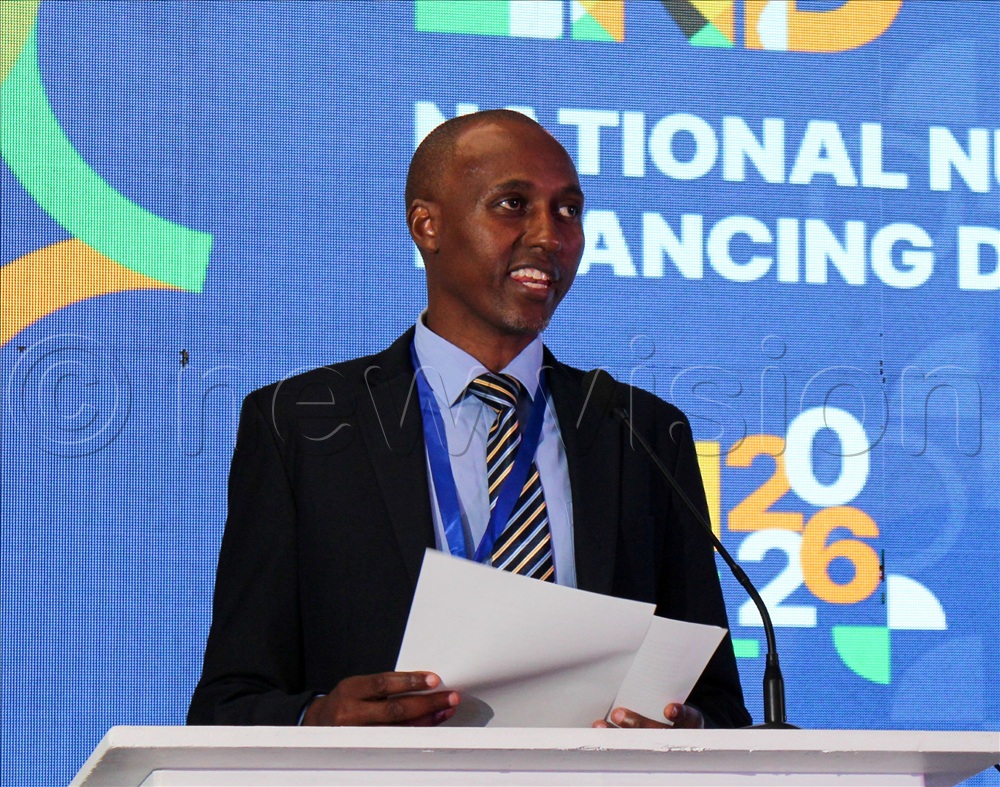
Dr Robin Nandy, the UNICEF country representative, speaking on behalf of development partners, described nutrition as one of the most powerful investments Uganda can make, yet one of the least financed.
Dr Robin Nandy, the UNICEF country representative making his remarks during the event. ( Photos by Bridget Ahurira)
_______________
Uganda is facing a growing challenge in the fight against malnutrition, driven not by a lack of policies or food but by a shortage of funding to turn solutions into action, as development partners scale back support and pressure mounts on the government to step up investment and protect the gains already made.
This was the key message from experts and government officials at the 2nd National Nutrition Financing Dialogue held at the Sheraton Kampala Hotel on April 17, 2026, where stakeholders warned that the country’s nutrition crisis is increasingly becoming a financing crisis.
Dr Robin Nandy, the UNICEF country representative, speaking on behalf of development partners, described nutrition as one of the most powerful investments Uganda can make, yet one of the least financed.
“Nutrition underpins child survival, cognitive development, education outcomes and long-term productivity. But financing remains a major bottleneck; investments are fragmented, insufficient, and still dependent on external funding,” he said.
Nandy warned that the global funding landscape has changed dramatically over the past year, forcing countries like Uganda to rethink how they finance essential services.
He called for a decisive shift towards domestically driven solutions, including increased government allocations, better integration of nutrition into sector budgets, and innovative financing mechanisms.
He also stressed the urgency of investing in the first 1,000 days of life, describing it as a critical window that determines a child’s future health, learning capacity and productivity.
“Every missed opportunity affects a child’s lifelong potential,” he said.
The crisis is not only about limited resources, but also about how those resources are prioritised and used. For years, Uganda has built a strong policy framework to tackle malnutrition, aligning national strategies with global targets such as the Sustainable Development Goals. However, behind those commitments lies a growing funding gap, and according to health experts, nutrition programmes remain underfunded, fragmented and heavily reliant on external donors whose support is steadily declining.
Jeremiah Nyagah, the National Director for World Vision Uganda, speaking during the event.
Undernourishment has more than tripled over the past two decades, rising from 4.7 million people in 2006 to 14.5 million in 2022. Severe food insecurity now affects over 11 million Ugandans, while nearly 300,000 children under five suffer from wasting. Undernutrition is linked to about 45% of child deaths.
At the heart of the discussion was a shift in tone from diagnosing the problem to confronting the system behind it. According to experts, there has been a rise in malnutrition in refugee settlements in Uganda, largely due to funding cuts.
Jeremiah Nyagah, the national director for World Vision Uganda, highlighted a striking contradiction, where a country like Uganda has visible and available food, yet malnutrition persists.
“You go to restaurants and see more food than you can finish, yet we are still struggling with malnutrition,” he said.
Nyagah acknowledged progress, noting that child stunting has declined from 29% to 26% and wasting remains below the African average. However, he warned that these gains are fragile and risk being reversed without sustained financing.
Today, about 2.2 million Ugandan children, roughly one in four, are chronically malnourished. He pointed to a shrinking pool of donors and the closure of many non-governmental organisations as a sign that the old funding model is no longer viable.
Civil society leaders pushed the conversation further, arguing that Uganda’s challenge is no longer about identifying solutions but implementing them. Ritah Kabanyoro, the country director for Action Against Hunger, criticised what she described as an overreliance on meetings and dialogue without tangible results.
“We have too many boardroom discussions, but we are not seeing enough change on the ground. We need clear, actionable plans,” she said.
Kabanyoro framed nutrition not just as a health issue but as a foundation for economic growth and human capital development.
She also challenged the country’s dependence on external funding, urging stakeholders to rethink domestic solutions, from increasing government investment to addressing knowledge gaps in communities where food is available but diets remain poor.
“We say Uganda has enough food. So why are we still malnourished? Maybe the issue is not just money; it is also knowledge and systems,” she asked.
The dialogue also exposed deeper structural challenges, including weak coordination across sectors, gaps in accountability, and delays in implementing key policies such as the updated food and nutrition framework.
Professor Pamela Kasabiiti Mbabazi, from the National Planning Authority, who was represented as the chief guest, reinforced the economic case for investing in nutrition, describing it as one of the highest-return investments a country can make. Citing global estimates, he noted that every dollar invested in nutrition can generate up to $34 in economic returns.
He challenged stakeholders to ensure that nutrition is reflected not just in policy statements but also in budgets, implementation plans and measurable outcomes.
“Nutrition financing must be supported by strong governance, policy clarity, coordination, and accountability,” he said.