
Omoro passes out 130 community extension health workers to boost care
While passing out the 130 CHEWs on April 15, 2026, at Omoro town council, Stephen Oringtho, the district health officer for Omoro district, said the CHEWs were selected with the help of community members, with two elected from each parish.
Mary Borgman, the acting director of the Department of State and Diplomacy giving a certificate to Verlaine Nimaro, one of the CHEWs, during the passing out. (Photo by Jackson Kitara)
_______________
Omoro district has passed out a total of 130 community health extension workers (CHEWs) to provide health care services at the community level.
This follows a programme by the Ministry of Health, in partnership with the Joint Clinical Research Centre (JCRC) and funded by the United States government, which identified and trained the 130 CHEWs for six months in health care.
They were also equipped with buffalo bicycles, a pair of gumboots, digital thermometers for measuring temperature, equipment for screening high blood pressure and diabetes, mid-upper arm circumference tapes for screening acute malnutrition, t-shirts, jackets, medical boxes and tablet phones for data collection.
While passing out the 130 CHEWs on April 15, 2026, at Omoro town council, Stephen Oringtho, the district health officer for Omoro district, said the CHEWs were selected with the help of community members, with two elected from each parish.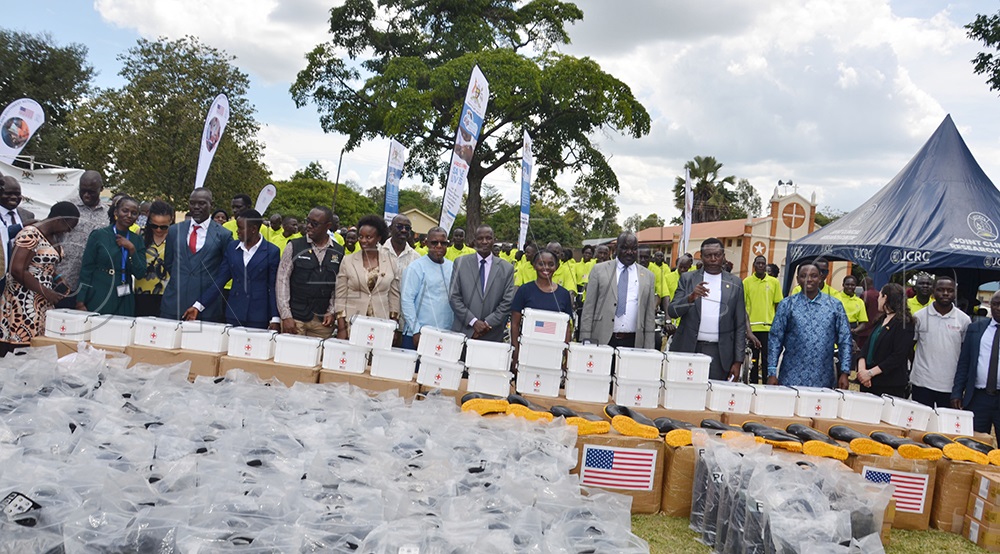
Ministry of Health staff, Omoro district staff and staff from the Joint Clinical Research Centre and the US government pose for photos with the equipment to be given to CHEWs to carry out primary health care in the community. (Photo by Jackson Kitara)
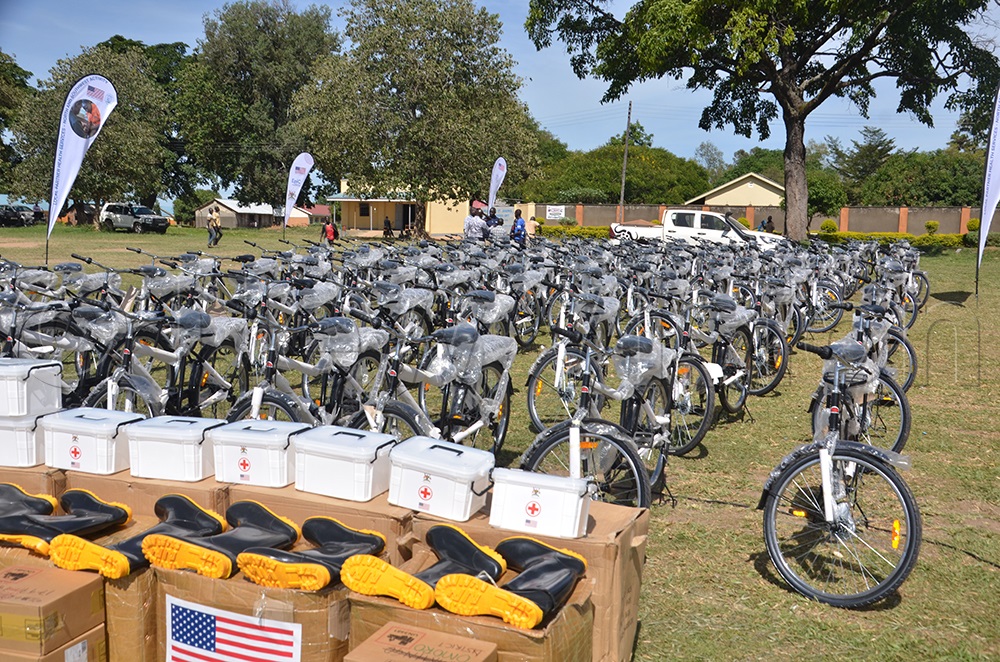
Bufallo bicycles and other equipment displayed that were given to CHEWs in Omoro district. (Photo by Jackson Kitara)
Oringtho noted that the CHEWs will help link the health system and communities, as they serve as the first point of contact for families in prevention, early detection and surveillance of health-related cases.
He added that they had already deployed the CHEWs in the distribution of treated mosquito nets for five days, which proved successful.
Oringtho said CHEWs will support village health teams in carrying out sensitisation and promoting health interventions such as vaccination against malaria, TB and measles, among others.
Dr Charles Olaro, the director general of health services, urged the CHEWs to serve the community with integrity and professionalism.
”You are now fully equipped with knowledge and are now health workers, use the skills and tools given to you to strengthen primary health care and bring services closer to the people”,
He said the Government of Uganda, through the Ministry of Health, recognises that a strong health system begins at the community level, noting that a large proportion of cases such as malaria, cough, pneumonia and diarrhoea are preventable.
Olaro said since CHEWs were trained, people should not be going to health facilities to get treatment, but be able to manage it at home, so that those who go to health facilities, go to get treatment and go back home.
“You (CHEWs) should act as a prevention arm and ensure that every household gets access to timely, accurate information. I would like to see the number of people reaching health facilities for preventable cases has gone down, but the number of children immunised, the number of women attending antenatal and delivering in the health facilities increase,” he said.
Richard Kabanda, Commissioner for Health Services, said the decision to train CHEWs in Omoro was informed by its sparse population, with the aim of strengthening the community health system.
He said CHEWs must conduct door-to-door engagement and early screening of hypertension and diabetes at the household level.
“We are taking the CHEWs program as a source of employment to our young people, and it’s the reason we are recruiting and investing in your people who are between 18 and 35 years,” Kabanda said.
Kabanda said the target is to have CHEWs across the entire country by 2028. He added that 38 districts are now fully covered, while 30 districts are currently undergoing training, with more districts set to begin training between June and July 2026.