
People living with HIV/AIDS seek sh10b for permanent headquarters
"We are currently operating from temporary offices at the Uganda AIDS Commission in Ntinda, but the space is too small to accommodate our staff and equipment," Kyomukama said.
The Patron and Chairperson of the fundraising task force of National Forum of People with HIV/AIDS Network in Uganda (NAFOPHANU), Prof Vinand Nantulya (left) looks on as the fundraising brand face of NAFOPHANU building, Prof Dr. Maggie Kigozi speaks during the launch of NAFOPHANU strategic plan and fundraising drive for the construction their home at Mbuya Kampala on 23 Sept 2026. (Credit: Ronnie Kijjambu)
KAMPALA - People living with HIV/AIDS, under their umbrella body, the National Forum of People Living with HIV/AIDS Networks in Uganda (NAFOPHANU), have launched a campaign to raise more than sh10b to construct a permanent headquarters and secretariat.
The appeal was made by NAFOPHANU executive director Flavia Kyomukama during the unveiling of the organisation's Strategic Plan 2026-2031 on September 28, 2026, at the UNAIDS offices in Mbuya, Kampala.
Founded on May 23, 2003, NAFOPHANU is the national umbrella body for networks and associations of people living with HIV. It coordinates 135 district forums across the country and supports networks, associations and support groups of people living with HIV.
Kyomukama said the organisation has faced significant challenges since the suspension of United States government funding, which affected its operations and forced it to vacate its long-time premises
“For the past 22 years, NAFOPHANU had been accommodated by the Church of Uganda, but the organisation was recently required to hand over the property," she said.
She said NAFOPHANU is currently operating from temporary offices at the Uganda AIDS Commission in Ntinda, but that the space is too small to accommodate its staff and equipment.
"We are currently operating from temporary offices at the Uganda AIDS Commission in Ntinda, but the space is too small to accommodate our staff and equipment," Kyomukama said.
Kyomukama said about sh3b of the sh10b target will be used to acquire 1.5 acres of land, while the balance will fund construction of a three-storey building.
“The proposed facility will house administrative offices, accommodation facilities, training and conference halls, counselling rooms, childcare facilities and indoor recreation spaces,” she explained.
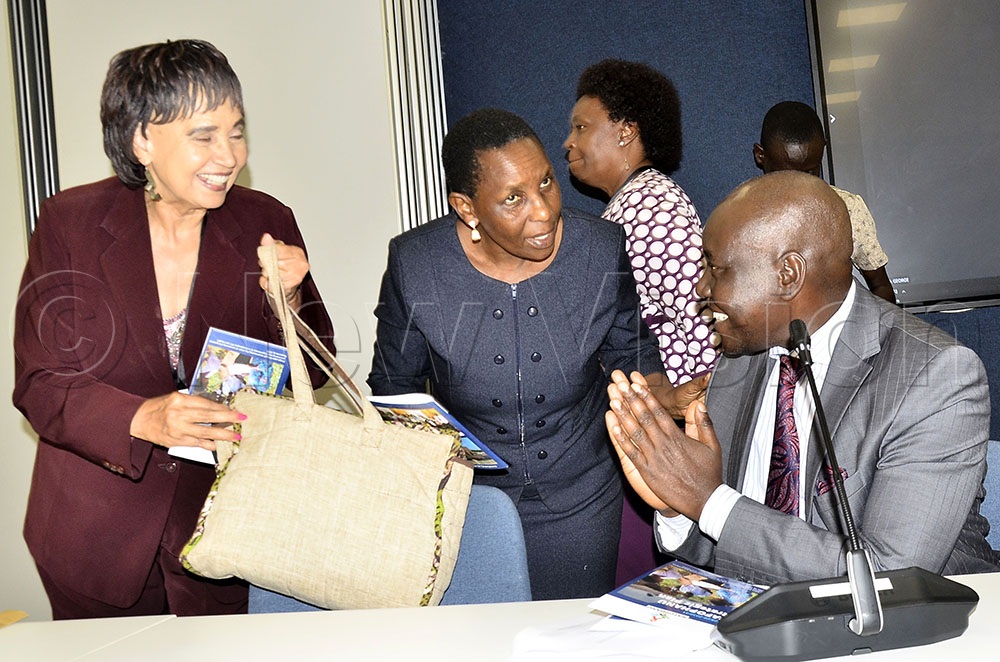
The fundraising brand face of National Forum of People with HIV/AIDS Network in Uganda (NAFOPHANU) home, Prof Dr. Maggie Kigozi (left) chat with the chairperson of the Parliamentary Committee on HIV/AIDS, and MP for Bugiri Municipality, John Bosco Oketho (right) during the launch of National Forum of People with HIV/AIDS Network in Uganda (NAFOPHANU) strategic plan and fundraising drive for the construction their home at Mbuya Kampala on 23 Sept 2026. Center is the Executive director of NOFUPHANU, Jane Mwiribi. (Credit: Ronnie Kijjambu)
She said the funding crisis has also strained the organisation's ability to support staff and HIV support groups across the country.
Kyomukama also raised concerns about the Government's integrated healthcare approach, which phased out many stand-alone HIV and tuberculosis clinics and merged services into general healthcare facilities
“While the policy aims to improve efficiency, some people living with HIV remain uncomfortable accessing treatment in open clinical settings,” she said.
"A section of people cannot comfortably access medication through open clinics. Some fear stigma, while others end up paying high costs to obtain treatment elsewhere," she said.
Kigozi leads fundraising effort
The organisation has appointed former Uganda Investment Authority executive director Maggie Kigozi as the face of the fundraising campaign and chairperson of the fundraising task force.
Kigozi said she accepted the role because ending HIV/AIDS requires collective effort from people living with HIV and the wider community.
"To end AIDS, we need both HIV-positive people and those who are not affected by the virus to work together. Ending the epidemic is not the responsibility of one group; it requires a united national effort," she said.
Kigozi noted that HIV/AIDS has affected nearly every Ugandan family in one way or another.
"Whether through relatives, friends, parents or siblings, almost every family has been affected by HIV/AIDS," she said.
UNAIDS director speaks out
UNAIDS country director Jacqueline Makhoka said Ministry of Health HIV estimates show that about 94 new HIV infections occur every day. She said the figures are particularly concerning because they affect young people aged between 14 and 26
Makhoka said stigma reduction was central to the HIV response because it affects access to testing, treatment, retention in care, viral suppression and prevention
"Stigma continues to undermine access to prevention, testing, treatment and care. If we are to end AIDS, we must also end the stigma and discrimination that continue to drive inequalities," she noted.
She said, according to reports, “By the end of 2025, Uganda had an estimated 1.55m people living with HIV, with approximately 1.3m people receiving antiretroviral therapy.
The country has also made remarkable progress, reducing annual new HIV infections by 65% since 2010, from about 96,000 to 34,000, while AIDS-related deaths have also declined by 65%.”
Makhoka said about 230,000 people living with HIV are not yet on treatment, attributing this to stigma and discrimination. "Nearly 100,000 remain unaware of their HIV status, because they have not bothered to go for HIV testing.”
NAFOPHANU patron Prof. Vinand Nantulya described the proposed headquarters as part of a broader domestic resource mobilisation strategy aimed at ensuring the sustainability of HIV/AIDS interventions.