
Malaria fight: How 25 million mosquito nets are being distributed to Ugandans
“Under this whole distribution, we are targeting 130 districts across the country where we are expected to distribute about 25 million nets as part of our effort to eliminate malaria by 2030.”
The campaign was officially flagged off in parts of northern Uganda, including Kitgum, Nwoya and Gulu, where Ministry of Health spokesperson Emmanuel Ainebyoona said the rollout has been carefully sequenced to avoid the logistical challenges experienced in earlier rounds. (Credit: John Musenze)
KAMPALA - The Government of Uganda, through the Ministry of Health, has launched a nationwide campaign to distribute 25.8 million long-lasting insecticide-treated mosquito nets (LLINs), in one of the country’s largest public health interventions aimed at reducing malaria-related illness and deaths.
The distribution is part of the five-phase format of the Universal Coverage Campaign and is designed to push national mosquito net coverage beyond 60 percent, in line with Uganda’s Malaria Elimination Strategy (2025–2030).
The exercise targets 130 districts across the country and is being implemented in five structured waves, prioritising high-burden areas.
The campaign was officially flagged off in parts of northern Uganda, including Kitgum, Nwoya and Gulu, where Ministry of Health spokesperson Emmanuel Ainebyoona said the rollout has been carefully sequenced to avoid the logistical challenges experienced in earlier rounds.
“This is the fifth round of the second phase of the distribution of the universal coverage campaign, where we are distributing long-lasting insecticide-treated mosquito nets,” Ainebyoona said.
“Under this whole distribution, we are targeting 130 districts across the country where we are expected to distribute about 25 million nets as part of our effort to eliminate malaria by 2030.”
He explained that the campaign is being implemented in five waves, beginning in January with 20 high-burden districts under wave one. Wave two is now underway, targeting 32 districts and reaching more than 8.3 million people.
Among the districts in the current phase are Agago, Amuru, Gulu, Gulu City, Kitgum, Lamwo, Nwoya, Omoro, Pader, Mayuge, and several others across eastern, northern, and western Uganda.
Ainebyoona said the programme is funded by the Government of Uganda with support from partners including the US President’s Malaria Initiative and the Global Fund.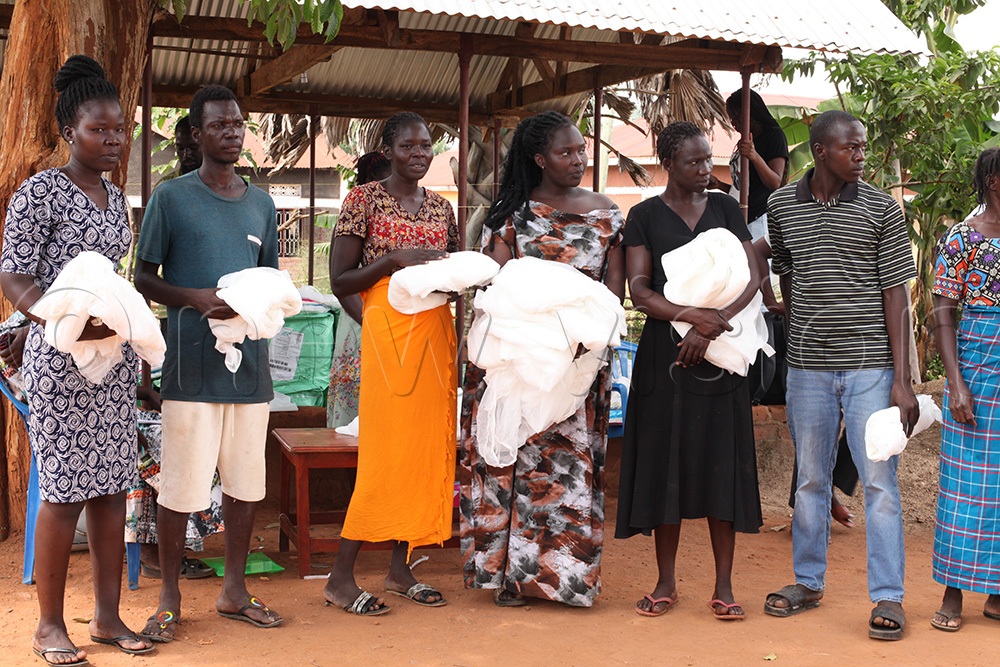
The distribution is part of the five-phase format of the Universal Coverage Campaign and is designed to push national mosquito net coverage beyond 60 percent, in line with Uganda’s Malaria Elimination Strategy (2025–2030). (Credit: John Musenze)
“So, this is under wave two. Earlier, we had done a number of districts under wave one, and we expect this exercise to be done in five waves,” he said, adding that high-burden districts remain the priority, while areas under indoor residual spraying have been excluded from this cycle.
In Kitgum District, one of the areas with persistently high malaria cases in the Acholi sub-region, the launch attracted strong community participation, with residents turning up to receive nets in large numbers.
Kitgum District Assistant Resident District Commissioner Joseph Okidi said mobilisation efforts played a key role in ensuring a smooth rollout.
“Mobilisation was done through radio, community structures, health teams, and local leaders. So far, people are receiving the nets without any cost and in good time,” Okidi said.
Kitgum continues to rank among Uganda’s districts with the highest malaria burden, often recording high outpatient attendance linked to the disease.
However, health officials have also raised concerns over the misuse of mosquito nets in some communities, including their use for fishing and other non-health purposes, a practice they say undermines malaria control efforts.
Dr Charles Olaro in a presser released on April 15, cautioned households to use the nets strictly for their intended purpose, stressing proper handling before use.
“When received, the nets should be used consistently by sleeping under them every night. They should be aired in the shade for 24 hours before use and must not be used for fishing, fencing, or gardening,” he said in a public advisory.
The Ministry of Health noted the campaign will continue across five waves, with each phase targeting specific high-risk districts as Uganda works toward its goal of eliminating malaria by 2030.
Ainebyoona have also urged parents not to neglect other malaria prevention measures, including vaccination where available, alongside consistent use of mosquito nets and noted that success will depend not only on coverage numbers, but also on whether households use the nets correctly and consistently in the fight against malaria.