
Japan gives sh1.83 billion to boost Uganda's fight against Ebola
In a joint statement released by the Government of Japan, IFRC and the Uganda Red Cross Society, the funds will strengthen community-based response activities that are considered critical in breaking chains of transmission and detecting cases early.
the Government of Japan, IFRC and the Uganda Red Cross Society staff in a group photo. (Courtesy photos)
________________
The Government of Japan has provided an emergency grant of $500,000 (sh1.83 billion) to strengthen Uganda's Ebola response, with the funding expected to support community surveillance, contact tracing, public awareness campaigns and frontline health interventions in areas at risk of the disease.
The funding, channelled through the International Federation of Red Cross and Red Crescent Societies (IFRC), will enable the Uganda Red Cross Society to scale up efforts aimed at containing the ongoing Ebola outbreak and preventing further transmission, particularly in high-risk communities.
The support comes at a time when Uganda continues to remain on high alert following Ebola cases linked to neighboring Democratic Republic of Congo (DRC), with health authorities intensifying surveillance and preparedness measures along border districts.
According to the latest situation report, Uganda currently has only four Ebola patients receiving treatment, while 817 contacts have successfully completed follow-up. Only nine contacts remained under active monitoring as of Monday, June 22, bringing the country closer to ending one of its most challenging outbreaks in recent years.
15 of Uganda's 20 confirmed Ebola cases have been imported from the DRC, which calls for more cross-border nature of the outbreak and the challenge facing health authorities.
In a joint statement released by the Government of Japan, IFRC and the Uganda Red Cross Society, the funds will strengthen community-based response activities that are considered critical in breaking chains of transmission and detecting cases early.
The funding will also support psychosocial services for affected individuals and families while strengthening surveillance and early warning systems designed to quickly identify and respond to new infections.
The ministry if health have repeatedly emphasised that community engagement remains one of the most effective tools in controlling Ebola outbreaks, especially in regions where misinformation, fear and stigma can undermine public health interventions.
Uganda Red Cross Secretary General Robert Kwesiga welcomed the support, describing it as timely and critical in strengthening frontline response efforts.
He noted that the contribution demonstrates the strength of the partnership between Japan, the Uganda Red Cross Society and IFRC in responding to public health emergencies.
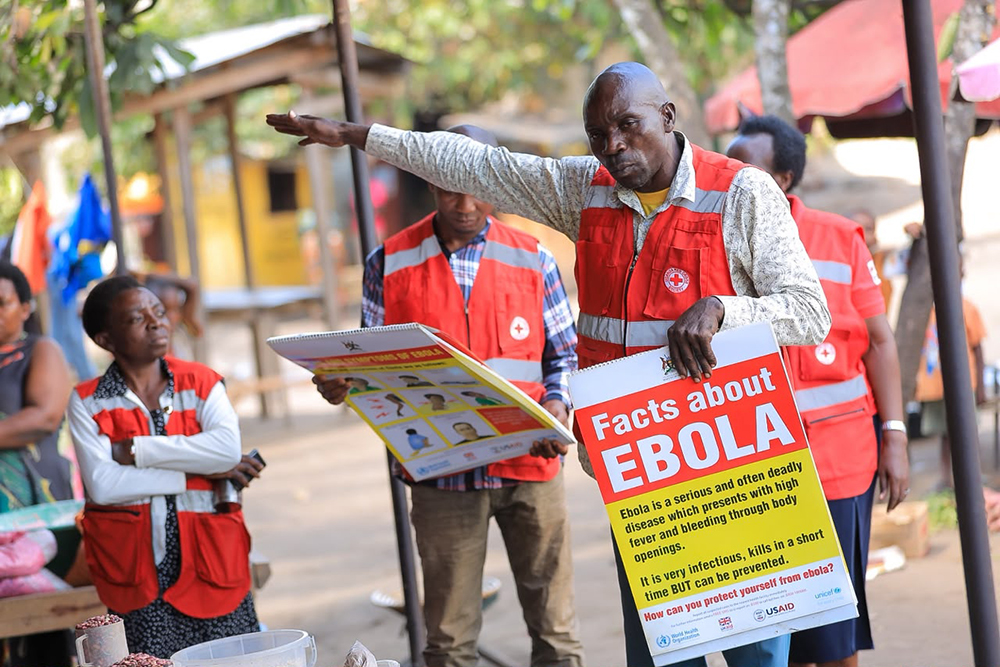
Red Cross volunteers have already been deployed in several communities where they are conducting awareness campaigns, promoting early reporting of symptoms and helping counter misinformation that often emerges during disease outbreaks.
Louise Daintrey-Hall, the IFRC Head of Country Office in Uganda, said communities remain central to controlling Ebola outbreaks and praised the role played by volunteers in the response.
"Ebola outbreaks begin and end in communities, and it is Red Cross volunteers who stand at the heart of this response. Japan's contribution will strengthen the Uganda Red Cross to scale up lifesaving work, helping communities protect themselves and stop the spread of Ebola," she said.
Last week, through the Japan International Cooperation Agency, Japan donated more than 9,000 litres of hand sanitiser to support infection prevention and control measures in public health facilities across the country.
The Japanese government said the new grant underscores the importance of international cooperation in addressing public health emergencies and strengthening health security in vulnerable regions.
IFRC said it is also mobilising additional resources and technical support to ensure that response operations remain adequately funded and capable of responding to any new developments in the outbreak.