
Ebola: Japan donates 9,000 litres of hand sanitiser to Uganda
The handover was made on June 19 at the Ministry of Health headquarters, with officials saying the supplies will support frontline health workers and help prevent transmission of the virus within health facilities.
Prof. Charles Olaro (in the middle, front row) poses for a photo with a Japanese delegation led by JICA Country Representative Osaki Mitsuhiro. (Photo by John Musenze)
__________________
The Government of Japan, through the Japan International Cooperation Agency (JICA), has donated more than 9,000 litres of hand sanitiser to Uganda to strengthen infection prevention and control measures amid the ongoing Ebola Virus Disease outbreak threat from the neighbouring Democratic Republic of Congo (DRC).
The handover was made on June 19 at the Ministry of Health headquarters, with officials saying the supplies will support frontline health workers and help prevent transmission of the virus within health facilities.
The donation follows an Ebola outbreak declared in eastern DRC on May 15, 2026, which prompted heightened surveillance and preparedness measures in Uganda due to the risk of cross-border transmission.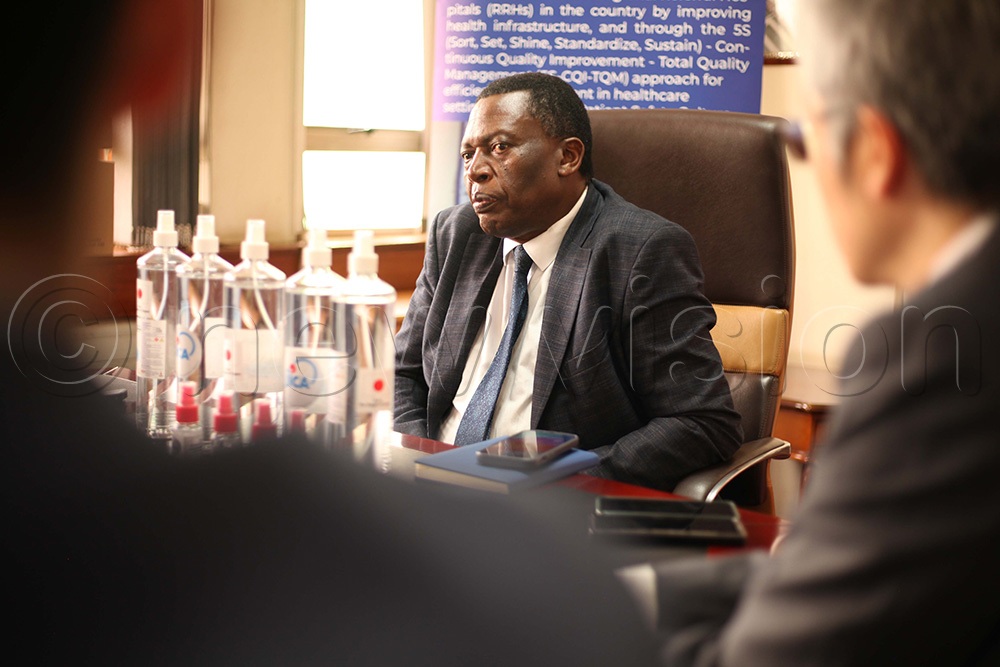
Director General of Health Services Prof. Charles Olaro said the sanitisers would play a critical role in protecting health workers and patients from infection. (Photo by John Musenze)
Speaking during the handover ceremony, JICA Country Representative Osaki Mitsuhiro said the sanitisers were procured under the agency's Project on Patient Safety Establishment in response to a request from the Ministry of Health.
"Today, we hand over more than 9,000 litres of hand sanitisers, which is expected to cover approximately two weeks of demand for all public hospitals across Uganda," Mitsuhiro said.
The supplies will be distributed to health facilities in high-risk areas, including regional referral hospitals participating in JICA's patient safety programme.
Japan's Ambassador to Uganda, Takuya Sasayama, praised Uganda's response to the Ebola threat and described the donation as a timely intervention to support healthcare workers.
"This is to protect the frontline workers, who are in the frontlines of the danger. We are very proud of these people protecting our society, the borders, the patients and our lives," the ambassador said.
He added that Uganda's health authorities had demonstrated strong capacity in managing Ebola outbreaks, noting that no new cases had been reported in the previous two weeks.
Receiving the donation on behalf of the Ministry of Health, Director General of Health Services Prof. Charles Olaro said the sanitiser would play a critical role in protecting health workers and patients from infection.
"The sanitiser denatures the virus capsule and has the same effect as handwashing. If you are not able to wash your hands with water and soap, then you can use a sanitiser," Olaro explained.
He revealed that four of Uganda's Ebola cases were health workers, underscoring the need for enhanced infection prevention measures within health facilities.
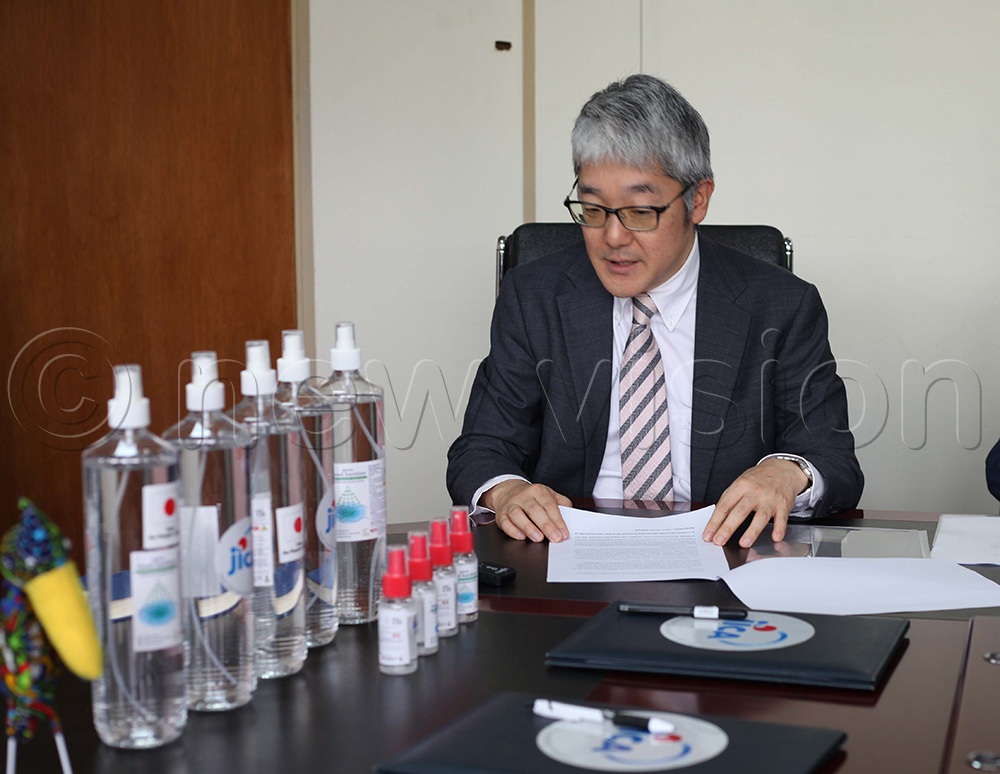
JICA Country Representative Osaki Mitsuhiro said the sanitisers were procured under the agency's project on Patient Safety Establishment in response to a request from the Ministry of Health. (Photo by John Musenze)
"When health workers become infected, they can easily pass the infection to patients. Therefore, these sanitisers contribute to protecting health workers, patients, their families and the wider community," he said.
Olaro thanked the Government of Japan and JICA for the support and disclosed that Uganda had requested additional personal protective equipment to complement ongoing Ebola-preparedness efforts.
He said Uganda had so far recorded 19 Ebola cases, of whom 10 have recovered and have been discharged, while two died. Three more patients are expected to be discharged, bringing the total number of recoveries to 13.
Despite the improving situation, Olaro said the country remains vulnerable to new infections because of the continuing outbreak in eastern DRC.
"Having no case or reducing the number of cases does not reduce the risk in the country. The risk remains. As long as there are cases in DRC, Uganda remains vulnerable. We still have porous borders and a very high risk of importation," he said.
He urged the public to remain vigilant and report suspected cases early, emphasising that prompt identification and supportive treatment have contributed to improved patient outcomes during the outbreak response.
The Ministry of Health is also working with authorities in DRC to strengthen cross-border collaboration and surveillance measures aimed at preventing further spread of the disease.