
Four hospitals declare sh8.6b in unspent wage allocations
Byaruhanga challenged the Ministry of Health and the Health Service Commission to explain why the money allocated for recruiting and remunerating health workers was not being fully utilised.
A panel for discussion during the first National Medical Internship Completion Health workforce leadership summit at School of Public Health Makerere University on 24 Nov 2026. (Photos by Ronnie Kijjambu)
________________
Government has been challenged to address recruitment bottlenecks in public hospitals after four regional referral hospitals returned a combined sh8.6b in unspent wage allocations in the 2025/26 financial year, even as newly qualified doctors struggle to secure employment.
Moses Byaruhanga, the Senior Presidential Advisor on Political Mobilisation, questioned why public health facilities were returning billions of shillings meant for paying health workers while medical graduates remained unemployed.
He cited figures showing that Arua Regional Referral Hospital returned sh2.9b in unspent wage allocations, Hoima Regional Referral Hospital returned sh2.6b, Fort Portal Regional Referral Hospital sh2.1b and Gulu Regional Referral Hospital sh1b.
Byaruhanga challenged the Ministry of Health and the Health Service Commission to explain why the money allocated for recruiting and remunerating health workers was not being fully utilised.
He argued that the unspent funds pointed to possible administrative and recruitment challenges that were preventing hospitals from filling available positions, despite the country's need for more medical personnel.
The senior presidential advisor made the remarks on Tuesday during the National Medical Internship Completion and Health Workforce Summit, held at Makerere University School of Public Health, where newly qualified doctors raised concerns about unemployment and uncertainty over their professional future.
He said the government had made provisions for wage allocations to enable health facilities to recruit personnel, questioning why such resources were being returned instead of translating into employment opportunities.
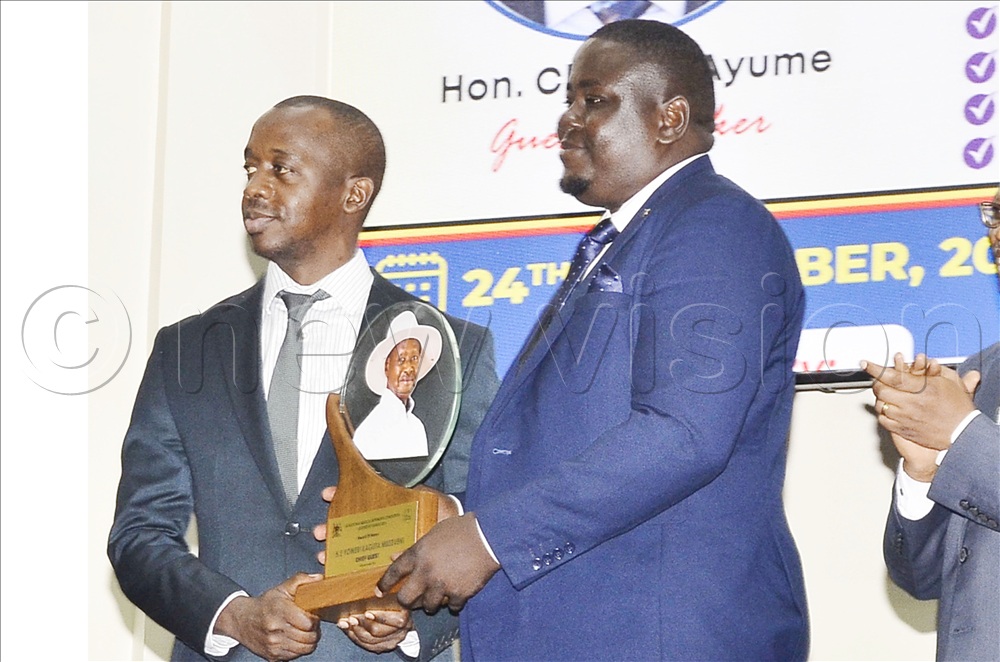
The state minister for Primary Health, Dr Charles Ayume (left) receive plaque for President Museveni from the chairperson of the Federation of Uganda Medical Interns (FUMI), Dr. Jacob Mwondha during the first National Medical Internship Completion Health workforce leadership summit at School of Public Health Makerere University on 24 Nov 2026.
“Finally, know that Uganda needs more health workers. Uganda needs you. Stay and serve Uganda for the socio-economic transformation and prosperity of us all,” Museveni said.
The President acknowledged the difficult working conditions faced by health workers and said the government would continue advocating for better remuneration, depending on available resources.
“Government will continue to advocate for better remuneration of health workers as long as the resource envelope allows, so that you work under the best conditions and support the health of our people,” he said.
Museveni also urged the professionals to uphold ethics, discipline, humility and compassion, while pursuing further learning, research and mentorship.
Byaruhanga's remarks come at a time when Uganda faces growing concerns over the retention and utilisation of its trained medical workforce.
According to September 2026 figures from the World Health Organisation, 29% of Uganda's health workers plan to leave the country or quit their jobs to work elsewhere.
The report also indicated that 35% of doctors and specialists in Uganda were unemployed, highlighting the contradiction between the demand for health workers and the difficulties medical professionals face in finding jobs.
Byaruhanga's concerns, raised during his presentation titled institutional support, workforce governance and professional development, reflect those raised by newly qualified doctors, who say they are ready to serve but lack clear pathways into government employment.
Dr Jacob Muwadha, the president of the Federation for Uganda Medical Interns (FUMI), said many young doctors were anxious about their future after completing internship.
“Today we gather not just to celebrate this chapter completed, but to ask what's next for us. We are now feeling the reality of unemployment,” Muwadha said.
He said the situation was frustrating because interns had spent a year working long hours in hospitals, sometimes under difficult conditions, helping deliver health services.
He called for a clear pathway for employment, postgraduate training, professional development and improved welfare.
Muwadha also said the federation had invited the Health Service Commission to explain why its latest recruitment advertisement did not include positions for doctors.
Beyond public sector employment, Byaruhanga proposed exploring financial support for groups of young doctors interested in establishing private health facilities.
He argued that supporting young medical professionals to set up health facilities could create employment opportunities while complementing government efforts to expand access to healthcare.
The proposal offers an alternative avenue for doctors who may not immediately secure government jobs, while potentially increasing the availability of health services.
Awards
During the summit, FUMI awarded President Museveni for his outstanding support to improving the plight of medical interns in Uganda.
The others who were awarded accolades and souvenirs include Dr Chris Baryomunsi, the Minister of Health, Dr. Ayume, Dr Jacob Mwadha, the outgoing FUMI president, Moses Byaruhanga and also received awards in various categories.
Dr Florence Namutebi, the FUMI outgoing vice president, was recognised by the interns, while Dr Angella Nduhura was acknowledged for being the most supportive intern in regard to clinical excellence.
Guests at the Makerere summit also included; Dr Henry Gatyanga Mwebesa, the chairperson of the Health Service Commission (HSC) and other government entities, including the Uganda People's Defence Forces (UPDF).
The event was supported by the Association of Graduate Nurses and Midwives of Uganda,State House ,the Ministry of Health, Marie Stopes and Makerere University School of Medicine,