
Districts in Busoga with highest sickle cell carrier rates revealed
Findings from a one-month community sickle cell testing drive show that out of 14,082 people tested, 3,276 were identified as carriers, representing 23.26%.
The executive director of Joint Clinical Research Centre (JCRC), Dr Cissy Kityo Mutuluuza addressing guests at Jinja Sity Square. (Photos by Agnes Kyotalengerire)
________________
A new survey has revealed that the prevalence of the sickle cell trait in some districts of the Busoga sub-region stands at 23%, significantly higher than the national average of 13%.
Findings from a one-month community sickle cell testing drive show that out of 14,082 people tested, 3,276 were identified as carriers, representing 23.26%.
A sickle cell carrier is a person who has the sickle cell trait. This means an individual inherits one normal haemoglobin gene and one sickle cell gene. Carriers do not develop sickle cell disease, but they can pass the trait to their children if their partner is also a carrier, explained the national coordinator of test initiatives, Annet Nabaggala.
The testing exercise was conducted in Kamuli, Iganga and Jinja districts, targeting schools, medical camps and markets.
The survey further found that 205 people had sickle cell disease, while 14 were identified with the C-trait. The remaining 10,587 tested normal.
The screening exercise, which began on May 18, 2026 and ended on June 18, 2026, was conducted by the Ministry of Health in collaboration with the Joint Clinical Research Centre (JCRC), Terumo Blood and Cell Technologies.
The findings were released during the national commemoration of World Sickle Cell Day held at Jinja City Square under the theme “Building and Streng thening Sickle Cell Communities in Uganda through Nationwide Newborn Screening and Knowing Your Sickle Cell Status,” on June 19, 2026.
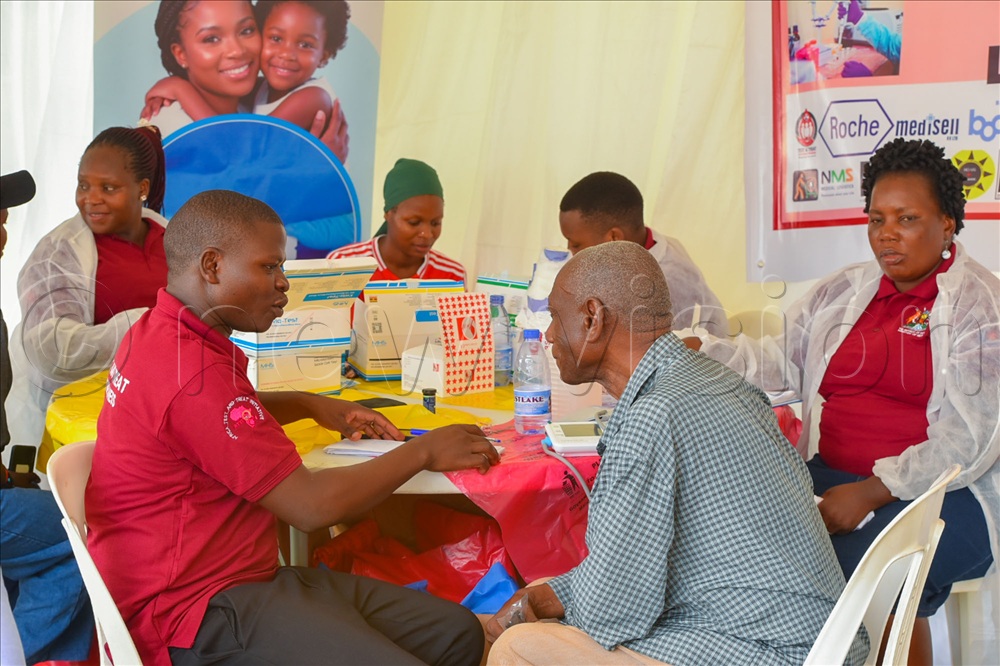
Health officials conducting sickle cell screening at Jinja City Square during the national commemoration.
The national coordinator for sickle cell disease at the Ministry of Health, Dr Miriam Ajambo, said the indicators are unacceptably high compared to the national prevalence, which ranges between 13% and 15%.
Dr Ajambo encouraged couples to undergo sickle cell testing before starting families.
The executive director of the Joint Clinical Research Centre (JCRC), Dr Cissy Kityo Mutuluuza, said the programme aims to procure specialised equipment to support treatment and management of the condition, reducing the need for patients to seek treatment abroad.
She said the institution is seeking approximately sh14.54 billion (US$4 million) to establish a unit for bone marrow transplants for eligible patients. The same facility will also be used for gene therapy, Dr. Kityo said.
Busoga remains one of the regions with the highest burden of sickle cell trait and disease in Uganda.
Nationally, an estimated 25,000 babies are born with the disease each year, indicating a high number of carriers in the population, given that affected children are born to carrier parents.
Without proper treatment and management, about 80% of children born with sickle cell disease do not survive beyond their fifth birthday.
The Imara programme project coordinator, Dr. Francis Kanyike, said the programme will implement comprehensive sickle cell management, including general testing, newborn screening and management of complications in advanced cases. The team will also sensitise communities about the disease and encourage couples to test before marriage and childbirth, Dr Kanyike said.