
Only 28% of Ugandan women access pregnancy ultrasound scans, ministry warns
According to the health ministry, only 28% of the estimated two million annual deliveries in the country currently receive obstetric ultrasound scans. Officials say this low coverage is contributing to missed diagnoses of high-risk conditions that could otherwise be detected early and managed.
The Director General of Health Services Dr Charles Olaro said Uganda must expand ultrasound coverage to reach all pregnant women, in line with World Health Organization recommendations. (Credit: John Musenze)
_________________
The Ministry of Health has warned that most pregnant women in Uganda are still missing out on essential ultrasound scans during pregnancy, a gap officials say is leading to late detection of complications and contributing to preventable maternal and newborn deaths.
According to the health ministry, only 28% of the estimated two million annual deliveries in the country currently receive obstetric ultrasound scans. Officials say this low coverage is contributing to missed diagnoses of high-risk conditions that could otherwise be detected early and managed.
The ministry attributes the gap to persistent shortages of trained personnel and equipment across public health facilities, particularly in rural and hard-to-reach districts where most women rely on government health services.
The figure was highlighted during a graduation ceremony at the Ministry of Health headquarters in Kampala, where 10 health workers completed specialised training in obstetric ultrasound scanning under a programme supported by Enabel and implemented in partnership with Albert Cook University.
10 health workers completed specialised training in obstetric ultrasound scanning under a programme supported by Enabel. (Credit: John Musezne)
Officials said the new cohort forms part of wider efforts to expand diagnostic services at lower-level health facilities, where many expectant mothers currently arrive without access to basic imaging services.
Commissioner for Maternal and Child Health at the health ministry, Dr PB Bagaala, said the lack of ultrasound access is a critical gap in maternal healthcare, particularly in identifying complications such as placenta previa and abnormal placental implantation.
He warned that without early diagnosis, women with high-risk pregnancies often present late to health facilities in critical condition, sometimes already in shock or facing life-threatening bleeding.
Dr Bagaala said government and partners are now focusing on expanding access to point-of-care ultrasound services at health centre III and IV levels, where most rural women first seek care.
He also cautioned against the misuse of skills by some trained personnel, saying cases had been reported where sonographers operate private services outside public facilities, undermining access for poorer patients.
“Don’t leave our people to suffer. Use your skills to serve humanity,” he said during the ceremony.
The new graduates were trained under the WeCare project, a maternal and newborn health programme implemented by Enabel in partnership with the Ministry of Health in the Busoga and Rwenzori regions.
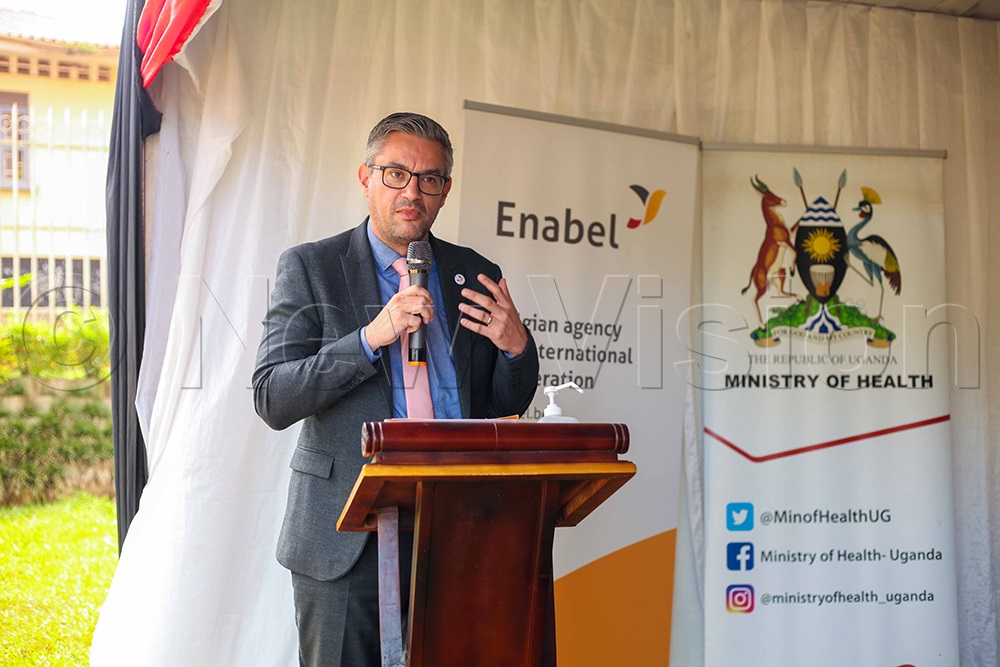
Enabel Country Director Nicolas Oebel said the programme is designed not only to train health workers but also to strengthen health systems through equipment supply and district supervision. (Credit: John Musezne)
Enabel country director Nicolas Oebel said the programme is designed not only to train health workers but also to strengthen health systems through equipment supply, district supervision and improved referral systems.
He said ultrasound training is part of a broader package that includes emergency care, maternal health services, leadership strengthening and community engagement.
The programme has so far equipped 20 health facilities and trained midwives and other health workers to provide ultrasound services closer to communities, reducing the need for referrals to private clinics.
Richard Imakit, the quality assurance officer at Enabel, said the trainees have conducted more than 10,000 scans in recent months, helping detect pregnancy complications earlier and reduce unnecessary referrals.
Undersecretary at the health ministry, Kenneth Akiiri, said while government is committed to improving access to diagnostic services, limited budgets and competing priorities continue to slow expansion.
He said Uganda’s health system is still constrained by shortages of essential supplies and human resources, but noted that gradual improvements are being made.
“We are a growing economy. A lot of interventions are being made to grow our economy so that we raise sufficient resources to meet all our needs,” he said.
Officiating the graduation, director general of health services Dr Charles Olaro said Uganda must expand ultrasound coverage to reach all pregnant women, in line with World Health Organisation recommendations of at least one scan per pregnancy.
He added that training already-employed health workers is a more sustainable approach than recruiting new specialists, as it strengthens existing health systems.
Experts at the event also warned that inadequate ultrasound access contributes to undetected complications, late referrals, and avoidable maternal deaths, particularly in underserved regions.
The Ministry of Health said it will continue expanding training programmes and equipment distribution, but acknowledged that significant gaps remain in achieving universal access to obstetric ultrasound services across the country.