
Data gaps leave Uganda’s motor neuron disease patients undiagnosed
MND is a rare progressive disease that affects the nerves controlling voluntary movement leading to weakness and stiffness in the muscles of both arms and legs. This also leads to paralysis, mobility challenges, and speech difficulties. However, Amyotrophic Lateral Sclerosis (ALS) is the most commonly diagnosed form.
For Joseph Sentamu, a resident of Lutungu village in Lwanda-sub-county, Rakai district, nearly three decades passed without knowing what he was suffering from due to delayed detection and wrong diagnosis.(Credit: Davis Buyondo)
In Uganda and other developing countries, many patients with motor neuron disease (MND) remain largely invisible and wrongly diagnosed. They struggle to afford or access specialised drugs/treatment that could enable them live longer.
In the absence of national data systems with inadequate care, MND and other rare diseases/conditions are often left out of the healthcare planning, making it harder for many patients, especially in rural communities, to survive.
For Joseph Sentamu, a resident of Lutungu village in Lwanda-sub-county, Rakai district, nearly three decades passed without knowing what he was suffering from due to delayed detection and wrong diagnosis.
The 39-year-old single father first showed signs of the strange illness at only five-years-old, stumbling frequently, losing grip on things and dropping objects.
However, the doctors at Rakai government hospital repeatedly misdiagnosed him, suspecting sickle cell disease until the disease (MND) had already crippled and left him bedridden for 16 years.
He depends entirely on his children for almost everything, including feeding, bathing, dressing, making his bed and pushing his wheelchair.
“Sometimes I miss medication and physiotherapy due to a lack of money. For now, I am really stuck,” he says quietly.
His experience reflects the wider struggles faced by patients with rare neurological disorders across Uganda. These include delayed diagnosis, incorrect diagnosis and the high cost of the only known treatment. This has made the management of rare conditions quite harder especially in rural communities.
MND, unseen rare condition
MND is a rare progressive disease that affects the nerves controlling voluntary movement leading to weakness and stiffness in the muscles of both arms and legs. This also leads to paralysis, mobility challenges, and speech difficulties. However, Amyotrophic Lateral Sclerosis (ALS) is the most commonly diagnosed form.
Doctors don’t know exactly what is causing MND. However, it is believed that MND can develop due to a combination of environmental, lifestyle and genetic factors.
According to the World Health Organisation (WHO), a rare disease is often described as a specific health condition affecting one in 2,000 individuals or fewer in the general population.
Currently, there are more than 7,000 known rare diseases worldwide affecting more than 300 million people, with 70% of these conditions starting in childhood. While most rare diseases are measured by prevalence, some are better described more precisely by incidence.
Health experts add that the number of MND patients in Uganda is unknown, and a few known patients are often misdiagnosed or underdiagnosed, not necessarily because it is rare but because it is difficult to detect and poorly documented.
As a result, it is frequently mistaken for other conditions, delaying proper treatment. In addition, the country does not have a national registry for rare neurological conditions.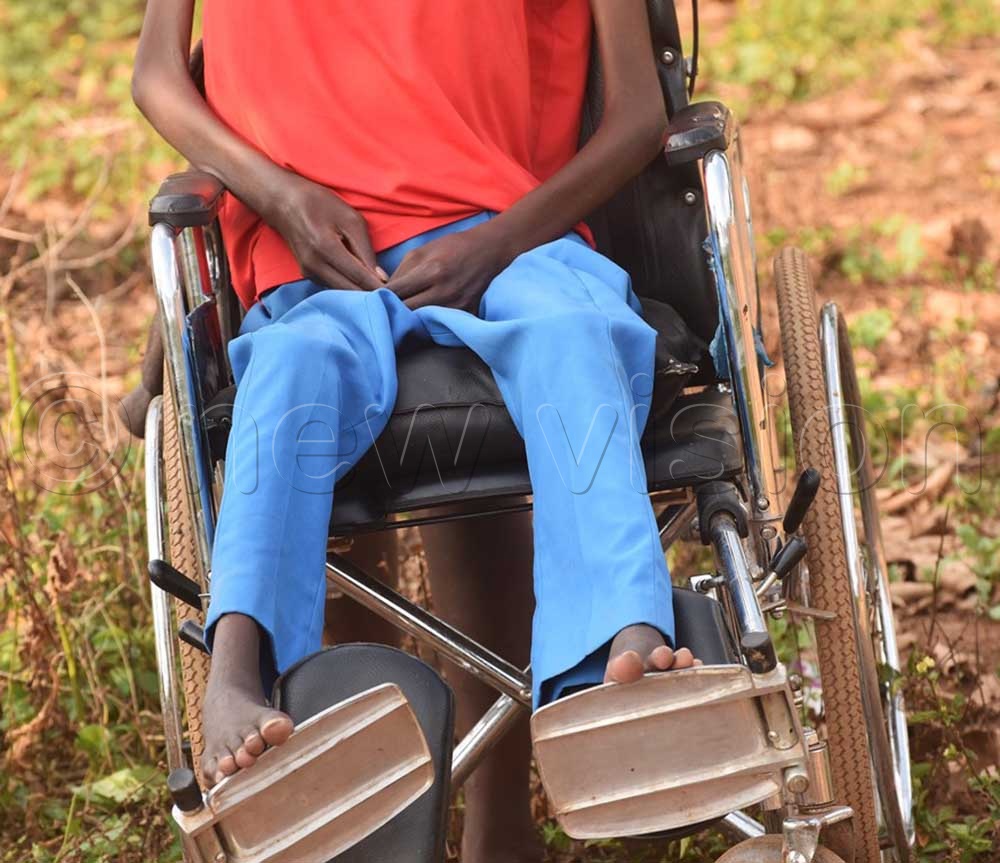
Joseph Sentamu was crippled by motor neuron disease (MND). (Credit: Davis Buyondo)
Years of misdiagnosis
For Ssentamu, the disease was already progressing quietly until it manifested when he was a child. He recalls that his struggles began after a severe malaria episode that left him in a coma for two weeks.
Shortly after, the weakness in his arms, legs and feet. “I would struggle with everyday tasks that others found easy,” he recounts. Little did he know that these were early signs of a rare condition that would later be diagnosed as MND.
Ssentamu has been visiting Rakai Government Hospital, where the doctors could not detect or treat the condition all this time. Over the years, he would only receive painkillers and immune booster,s which could not do much about the condition.
It wasn’t until 2018, when he was referred to Masaka Regional Referral Hospital for further attention. The doctors diagnosed MND. By then, the disease had taken much of his strength. “They said that my condition might not have deteriorated severely if it had been detected,” he recounts.
By his early 20s, he could no longer sit or stand unaided. He dropped out of school in Senior Five (S.5) in 2009. “My dreams of becoming a lawyer and a successful businessman were shuttered,” he says.
Cost of living with MND
Currently, there is no cure for MND. But the treatment focuses more on symptom control, slowing progression and palliative care for those in late stages of the condition, like Ssentamu.
The only drug known for extending survival by slowing progression is Riluzole. But in Uganda, it is not only scarce but also too expensive for underprivileged families.
At least each month, Ssentamu needs above Sh1,000,000 (approx. USD300) for his medication, more than what many households earn.
“Each tablet costs sh18,000. I have to take one in the morning and another in the evening,” he says, adding that the condition is becoming too expensive to manage alongside his family.
New Vision has established that Riluzole is not stocked in Ssentamu's nearby health centres or even at the Regional Referral Hospital in Masaka district. His nearest and most reliable access point is Kampala, more than 165km away.
“I can only afford drugs (Riluzole) through social mobilisation,” he says. “When I get money, I stock medicine for three months to avoid frequent travels,” he adds.
Ssentamu further says he also attends physiotherapy to help reduce pain and stiffness but he has to cater for his helper in all these visits. “As a result, everything from transport, lodging and food doubles,” he recounts.
With medication, Ssentamu's pain from stiffness of the muscles and pain or discomfort significantly reduces. But when he misses a dose, his condition worsens. “My body aches, the weakness spreads faster, and speaking becomes harder,” he explains.
Clare Naluze, a pharmacist in Masaka, who works closely with patients with neurological conditions, confirmed that the drugs that treat rare diseases are not always stocked because they are imported in small quantities, unlike those treating common diseases and conditions.
“These drugs are not procured in large quantities, yet there is no government subsidy to help lower the cost,” she says.
However, Uganda lacks a national health insurance policy that could help make treatment affordable and improve access to healthcare, leaving most patients to cover medical bills out of pocket.
Impact on family, Children
Ssentamu cannot work, yet he has a family, including orphaned dependents to look after. He relies on handouts from well-wishers. Still, his eldest son was forced to leave school to take care of him and his siblings.
“My children are psychologically stressed because they have never seen me walking,” he says. They are also stigmatised as the community members believe that he was bewitched and the condition is a curse punishing the family.
For Ssentamu, he has lost his privacy since it is his children who bathe and dress him. “To avoid being overwhelmed, they take turns. I know I am a burden to them, but they do not show it,” he explains.
Experts speak
Experts have explained that MND can affect multiple parts of the nervous system and becomes common with age, rising around 40 and peaking in the 80s. They say that the risk factors include cigarette smoking and pesticides being spread on crops.
According to Dr. Martin Kaddumukasa, a Consultant Neurologist and Physician at Mulago National Referral Hospital, there is no data for MDN patients in Uganda and there is no specific treatment currently available.
MND Diagnosing Challenges
Dr. Kaddumukasa explains that MND is difficult to diagnose because it does not follow a clear and straightforward pattern. It also takes a long time before the symptoms appear.
Usually, he adds, patients often start with weakness in the hands, legs and feet, and muscle wasting (shrinking), signs common in malaria and many other diseases or conditions. "This makes it hard to screen for MND among thousands of other possible diseases," he says.
Kaddumukasa says that diagnosing MND requires specialised expertise and not all doctors are trained to do it. While some patients receive care, the treatment is so complex and comprehensive.
It involves neurologists who treat the brain and nerves, physiotherapists when weak muscles need exercises, speech therapists as the muscles that lift the tongue become weak, respiratory physicians because the diaphragm also becomes weak, dieticians, nurses and social workers. "Palliative care is a good.
"To reduce the chances of developing MND, we must avoid smoking, prevent exposure to pesticides by wearing a mask, limit exposure to metals such as Lead and excessive copper, manganese and others," he advises.
While there is no cure, he says, palliative care would play a great role in easing symptoms, improving the quality of life, providing emotional and psychological support, supporting family and caregivers, and other symptoms, improving comfort and dignity.
Dr. Iddi Matovu is a public health specialist at Kitovu Mobile, a not-for-profit, faith- based organisation under the Diocese of Masaka, where he works with people with rare diseases in need of palliative care.
He explains that electrolytes like calcium, magnesium, sodium, and potassium help muscles to move and relax normally. Without these minerals, he adds, the muscles can become stiff and weak. “In some serious cases, they may shrink or even become paralysed,” he says.
A system not built for shortage
Uganda’s health system has made significant gains in infectious diseases and maternal health, but rare diseases remain largely invisible in policy planning.
“Currently, we (Uganda) don’t have a formal classification of rare diseases,” says Dr. Diana Atwine, the Permanent Secretary of the Ministry of Health (MoH).
This means that rare neurological conditions are not clearly identified, recorded, or given priority within the country’s healthcare system. As a result, diseases such as MND are often grouped with other illnesses, making it difficult to measure how many people have them to support planning for specific services for them.
Health experts further explain that since rare disease patients do not show up in statistics, they are not planned for. This gap makes it harder to carry out early diagnosis, secure funds, procure specialised drugs and policy development.
Therefore, without official classification, these rare conditions remain largely invisible during national healthcare planning, leading to delayed diagnosis, delayed treatment, misdiagnosis and limited access to specialised care.
Palliative Care in Uganda
The government does not provide home-based care services for people with rare diseases, especially those with progressive neurological conditions like MND. A few palliative care services that exist are disproportionately distributed and mostly focus on cancer and HIV patients.
Palliative Care Association of Uganda (PCAU) supports the work of MOH that aligns with its strategic objectives. PCAU works with the ministry to formulate policies and guidelines to enhance the scale-up of palliative care service provision and integration in the health care system.
In partnership with the Ministry of Health, PCAU conducts periodic and on-schedule visits to districts for mentorship and support supervision for palliative care providers.
The visits held jointly with the Ministry of Health are intended to address the knowledge, skills, and attitude needs for continued quality improvement of palliative care services.
“I have not been able to access these services. I wish there could be an opportunity,” he states.
New drug brings hope
A groundbreaking drug, Tofersen is giving renewed hope to people living with MND, not only in the United Kingdom but around the world. The drug, developed by Biogen, has been shown to slow and, in some cases, even stop the worsening of MND in people with Superoxide Dismutase 1 (SOD1).
Patients like Ssentamu remain optimistic that the ongoing research is helping patients to get closer to the life-extending treatment and nearing a cure. “Accessibility and affordability remain the biggest challenges, especially for patients in developing countries like Uganda,” he says.
Global contrasts
In developed countries, people with MND normally access specialised clinics under the supervision of teams of medical experts and physiotherapists in addition to specialised medication. However, in Uganda, and many parts of Sub-Saharan Africa, very little research has been done on MND.
The patients here are rarely part of international medical trials. Therefore, doctors often use treatment guidelines from other countries yet they may not fit local conditions.
Recent global research is giving much hope for a better understanding and treatment of MND. However, scientists are working on new tests that may help to detect the condition/disease much earlier. One study found that a simple blood test could identify people with MND with about 97% accuracy.
This raises hope for quicker and less invasive diagnosis in the future.
In addition, researchers are also studying blood tests that look for proteins and other signs that change years before symptoms start, which could help detect MND much earlier.
This story was published with the support the National Press Foundation (NPA) under the 2025 Covering Rare Disease Media Fellowship.