
Community health workers lead frontline Ebola response in West Nile
Armed with megaphones, posters and health education materials, Village Health Teams (VHTs) and other community health workers are reaching residents directly through community meetings, church gatherings, markets and door-to-door sensitisation campaigns.
Residents of Ofua seven Uriama Sub-county in Rhino Camp Refugee Settlement in Terego district being sensitised about Ebola in a community meeting. This was on June 6, 2026. (Credit: Lawrence Mulondo)
WEST NILE - As Uganda intensifies efforts to contain the Ebola outbreak, community health workers across the West Nile sub-region have emerged as key frontline defenders in the fight against the disease.
Armed with megaphones, posters and health education materials, Village Health Teams (VHTs) and other community health workers are reaching residents directly through community meetings, church gatherings, markets and door-to-door sensitisation campaigns.
Their work is helping to bridge the gap between health facilities and communities by ensuring that residents receive accurate information on prevention measures and the importance of early reporting of suspected cases.
At Wandi Market in Wandi trading centre, Onzoro parish in Katrini subcounty, Terego district, New Vision found 34-year-old VHT member Winnie Munduru and her colleague Omar Adaku moving from stall to stall, educating vendors and shoppers about Ebola.
Using Ministry of Health-approved posters and a megaphone, Munduru explained the causes of Ebola, its signs and symptoms, prevention measures and the importance of reporting suspected cases to health authorities.
Despite the busy market environment, many traders and customers paused to listen. Some asked questions, which Munduru responded to.
“When the Ebola outbreak was announced, many people in our area were frightened because they did not know how to protect themselves. Others were worried about possible lockdowns like those experienced during COVID-19,” Munduru said.
“We took it upon ourselves as VHTs to move from house to house, visit churches and markets, and provide communities with the right information. We had previously received training on disease outbreaks, so we are now using that knowledge to protect our communities.”
However, she noted that community health workers face several challenges, including inadequate transport, limited information materials and a shortage of megaphones for wider outreach.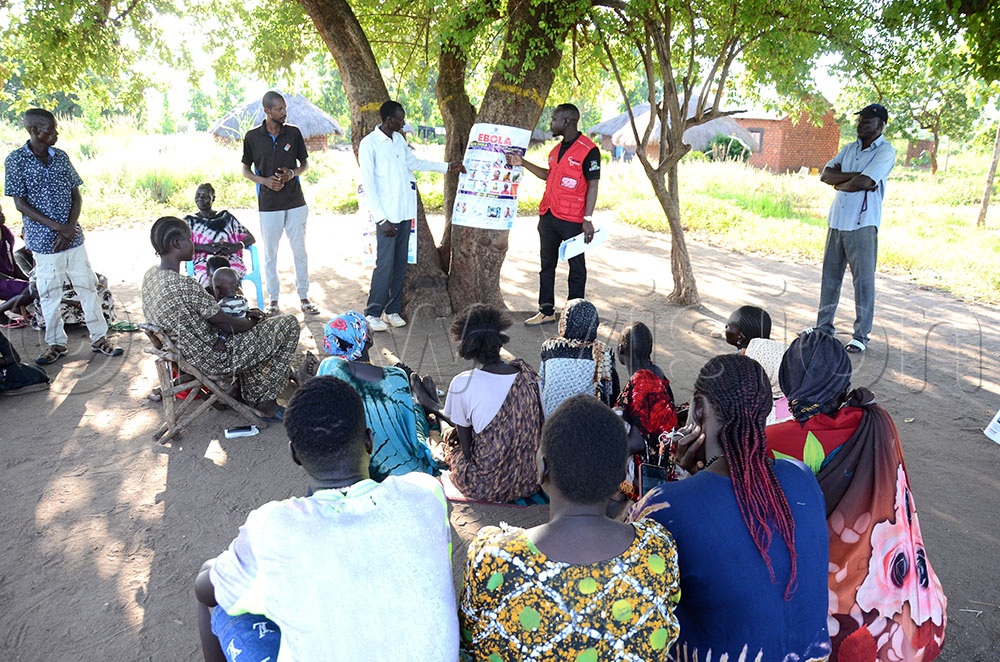
Residents of Ofua seven Uriama Subcounty in Rhino Camp Refugee Settlement in Terego district being sensitized about Ebola in a community meeting. This was on June 6, 2026. (Credit: Lawrence Mulondo)
Further north in Rhino Camp Refugee Settlement, another team of health workers is carrying out similar sensitisation efforts.
The discussion was highly interactive, with residents sharing concerns and suggestions. To ensure inclusivity, translators provided interpretation in Kakwa, Nuer, French and Lingala, allowing refugees and host community members to participate fully.
“The moment you experience symptoms such as fever, vomiting or bleeding, report immediately to the health authorities so that you can receive help and protect others in the community,” Erima told the gathering.
He advised residents to avoid handshakes and hugs, maintain proper hygiene and wash hands regularly with soap and water. He also urged vigilance, avoidance of unnecessary crowding and reporting of new arrivals to local authorities.
“I encourage you to share this information with your neighbours and families so that everyone remains alert,” he said.
Erima was accompanied by midwife Maureen Moseka, who highlighted the risks Ebola poses to breastfeeding mothers and infants.
“Once a mother is diagnosed with Ebola, she must stop breastfeeding immediately and seek medical attention,” Moseka explained. “Even when the virus is no longer detectable in the blood, it may still be present in breast milk and can infect the child. In such situations, health workers guide families on alternative feeding methods.”
In Ofua Seven Village, health assistant Perez Elionzi from Uriama Health Centre III conducted door-to-door sensitisation visits, speaking to families in their homes.
Elionzi emphasised adherence to health guidelines in schools, churches and markets. He also urged residents not to discriminate against Congolese nationals, noting that the disease was first reported in the Democratic Republic of Congo.
“Ebola does not choose nationality,” he said. “We must work together as communities and support one another in preventing the disease.”
He warned against unsafe burials and encouraged reporting of deaths with unknown causes so that trained personnel can manage them safely.
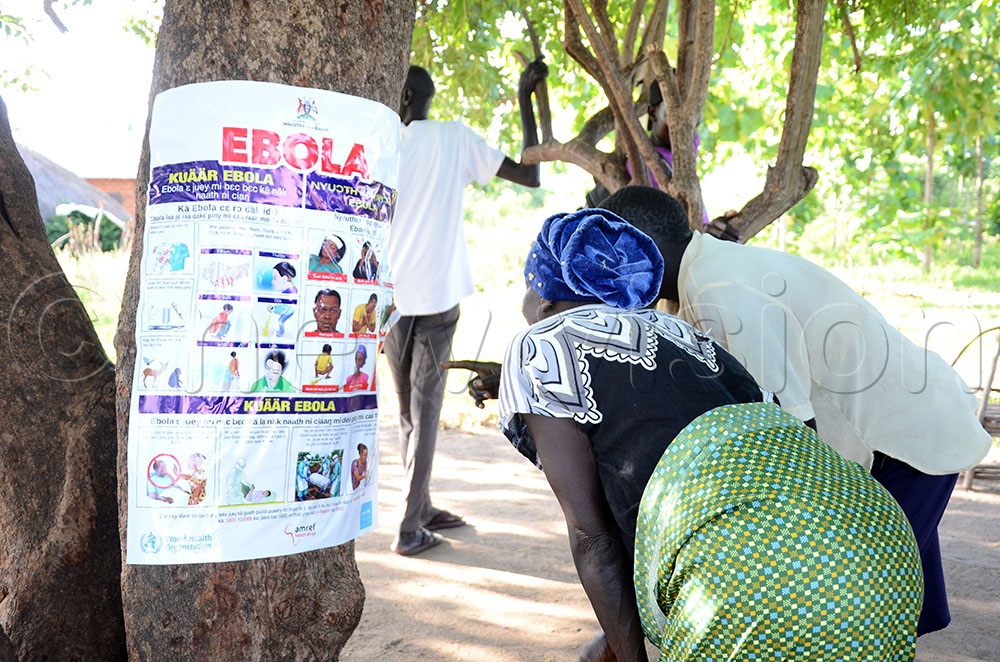
Some of the refugees in Ofua seven Uriama Subcounty in Rhino Camp Refugee Settlement in Terego district reading about Ebola on a ministry of health approved information material. This was during a sensitization community meeting on Ebola that was organized by Amref Health Africa on June 6, 2026. (Credit: Lawrence Mulondo)
According to project manager Emmanuel Ebitu, the organisation is supporting district authorities in coordination, surveillance, risk communication and community engagement.
“We are working closely with district health teams to provide strategic direction, supervision and monitoring of Ebola response activities,” Ebitu said.
He explained that a significant portion of support is directed towards community engagement, where VHTs and health assistants deliver lifesaving messages directly to residents.
The organisation has also printed Ministry of Health-approved materials in multiple languages commonly spoken in border communities.
At border points, Amref has supplied personal protective equipment, including masks, gloves, face shields, disinfectant sprayers and protective suits.
Importantly, community health workers have also been equipped with megaphones to improve public awareness campaigns.
“We have been working with about 40 VHTs who were previously involved in managing childhood illnesses such as malaria, diarrhoea and pneumonia. We have now engaged them in Ebola risk communication and community mobilisation because they are trusted members of the communities they serve,” Ebitu said.
Residents have acknowledged the importance of the interventions. Serena Aya from Ofua Six Village said limited access to water remains a challenge, with many families relying on a single borehole.
“We need people to be patient and avoid crowding at water sources because that can increase the risk of disease transmission,” she said.
At the Vurra border point, trader Gloria Alesi said business has slowed since the Ebola outbreak was declared, but remains hopeful.
“We are confident that if communities cooperate with health workers and continue following the guidance provided, things will return to normal,” she said.