
Cervical cancer screening up in Kampala and Mbarara — Study finds
Dr. Frank Mugabe, the principal medical officer in the Ministry of Health's Department of Non-Communicable Diseases, said the project began in 2023 and targeted 20 health facilities across the three areas, including Kisenyi Health Centre IV and facilities supported by the Uganda Cancer Institute.
The state minister for Primary Health Care Dr. Charles Ayume; the director UCI, Jackson Erem; the country representative, KOFIH Uganda, Juwang Baik, during the dissemination of the findings of the National Cancer Management and Capacity Building Project in Uganda (CANCAP-UG) at the Fairway Hotel on Tuesday. (Credit: Juliet Waiswa)
KAMPALA - A cervical cancer screening project in Kampala and western Uganda has reached more than 70,000 women since 2023, exceeding its initial target and highlighting growing efforts to improve early detection of the disease, according to findings released by the Uganda Cancer Institute (UCI) and the Korea Foundation for International Healthcare (KOFIH).
The study found that 70,547 women had been screened in Kampala, Mbarara City and Mbarara District. Kampala recorded the highest number, with 33,134 women screened, followed by Mbarara City with 24,718 and Mbarara District with 12,695
The findings were presented during a dissemination meeting attended by health officials and project partners
Dr. Frank Mugabe, the principal medical officer in the Ministry of Health's Department of Non-Communicable Diseases, said the project began in 2023 and targeted 20 health facilities across the three areas, including Kisenyi Health Centre IV and facilities supported by the Uganda Cancer Institute.
In Mbarara, participating health facilities included Rubaya, Kashare, Kagoni, Rubindi, Bwizibwera, Bukiro and Bubaare, among others.
The project targeted women aged 25 and older seeking cervical cancer screening services at five selected sites under the National Cancer Management and Capacity Building Project (CANCAP-UH). Its beneficiaries included health workers, local and national authorities, communities in the project areas and women at risk of cervical cancer.
Initially, the project aimed to screen 40,000 women, but the number screened exceeded 50,000, according to the study.
The study also sampled 4,000 women, with 800 drawn from each facility.
Cervical cancer remains one of the leading causes of cancer-related deaths among women in Uganda, with an estimated 6,959 new cases and 4,607 deaths annually. Despite the disease's burden, screening uptake remains low.
Dr. Charles Ayume, the State Minister for Primary Health Care, called for greater collaboration and the integration of cancer screening into routine services at health facilities.
"Most mothers come to your facilities for HIV testing, family planning and immunization of their children. Request them to have cancer screening among other services," Dr. Ayume said.
He urged health workers to use existing contact with women seeking other medical services to encourage them to undergo cervical cancer screening
UCI seeks continuity of project
The executive director of the Uganda Cancer Institute, Dr. Jackson Erem, described the initiative as a pilot project that had demonstrated the potential for Uganda to work effectively with international partners.
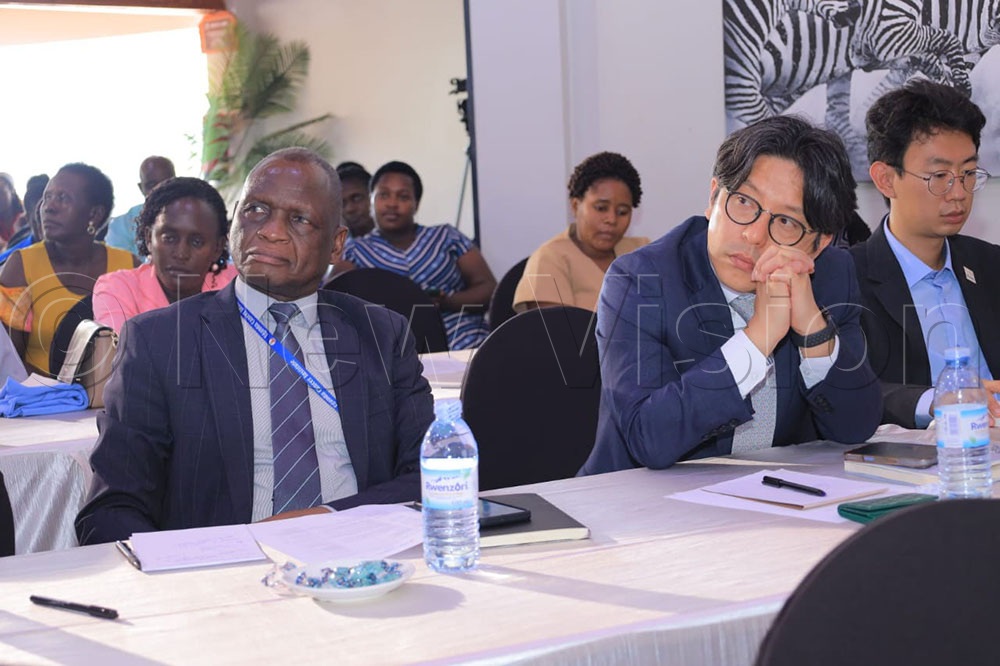
The director of UCI, Jackson Erem, and Juwang Baik, Country Representative, KOFIH and Minwoong Park, Country Program Coordinator, KOFIH, during the dissemination of the findings of the National Cancer Management and Capacity Building Project in Uganda (CANCAP-UG) at the Fairway Hotel in Kampala on Tuesday. (Credit: Juliet Waiswa)
He called for the project's continuation and stronger collaboration with KOFIH
"If we stop this project, we would not have achieved our aim of managing cervical cancer. All UCI needs is support from our leaders. We plead that the community, with collaboration and support from leadership, will be sustained," Dr. Erem said
KOFIH pledges continued cooperation
Juwang Baik, the KOFIH country representative in Uganda, said the partnership had focused on strengthening cancer screening, improving health services and building the capacity of health professionals.
"Through strengthening cancer screening, improving healthcare services, and building the capacity of health professionals, we have worked together to give more people the opportunity to protect their health and their future," Baik said.
He said the project had recorded meaningful achievements over the years, crediting the Ministry of Health, the Uganda Cancer Institute, local governments, health professionals and other partners for their cooperation.
"Over the years, this project has achieved meaningful results. These achievements would not have been possible without the strong leadership, cooperation, and commitment of the MoH, the UCI, local governments, healthcare professionals, and all our partners," he said.
Baik said KOFIH intended to explore further opportunities for cooperation with the Embassy of the Republic of Korea, the Export-Import Bank of Korea, the Korean Ministry of Health and Welfare and its affiliated specialised institutions.
He said the organisation hoped to see Uganda develop into a regional centre of excellence in cancer prevention, diagnosis, treatment and professional training in East Africa.
"From the beginning, KOFIH Uganda Office has hoped to see Uganda develop into a regional centre of excellence in cancer prevention, diagnosis, treatment, and professional training in East Africa
"We believe that the UCI has the potential not only to improve cancer care for the people of Uganda, but also to share its expertise and experience with neighbouring countries across the region," Baik said.