
25 sickle cell disease patients receive free hip replacement surgery
Twenty-five patients with sickle cell disease have undergone hip replacement surgery at Mulago National Referral Hospital during a two-week medical camp aimed at restoring mobility and improving their quality of life.
The State Minister for Primary Health Care, Dr Charles Ayume, chats with a sickle cell patient recovering from hip replacement surgery. (Credit: Agnes Kyotalenegerire)
_________________
Twenty-eight-year-old Isha Kabahweza lies in Ward 3B at Mulago National Referral Hospital, recovering from hip replacement surgery. She describes the operation as a turning point in her life, saying it will enable her to walk again with greater ease and return to her daily activities.
“I feel good and hope to walk again with ease,” says Kabahweza, beaming with a smile.
She recalls that her hip problems began with a painful crisis in her back and hip. To her surprise, the pain persisted. She sought medical attention at the sickle cell clinic at Mulago National Referral Hospital, where she was given painkillers, but they did not relieve her pain.
She was later referred to consultant orthopaedic surgeon Dr Geoffrey Madewo, who examined her and discovered that her hip had been damaged.
Kabahweza learnt about the opportunity to undergo hip replacement surgery through messages circulated on social media by the RareMark Foundation.
She is among 25 patients with sickle cell disease who have undergone hip replacement surgery at Mulago National Referral Hospital during a two-week medical camp that started on October 5, 2026, and ends on Friday, October 16, 2026.
Dubbed the “Hope for Warriors Hip Replacement Medical Camp”, the initiative was organised by Mulago National Referral Hospital in partnership with the RareMark Foundation, Hips for Africa and Gigimark Communications.
The artificial hip implants were donated by Hips for Africa, a Spain-based organisation, to patients with sickle cell disease suffering from avascular necrosis (AVN) of the hip.
AVN is a condition in which bone tissue dies because of a temporary or permanent loss of blood supply. When the blood supply to the femoral head, the ball-shaped upper part of the thigh bone that forms the hip joint, is interrupted, the bone cells begin to die.
Over time, the affected bone weakens and may develop small fractures or collapse, damaging the joint and potentially leading to severe osteoarthritis.
Medical camp brings hope to patients
The coordinator of the Hope for Warriors Hip Replacement Medical Camp, Dr Alexandra Bangirana, described the camp as successful.
RareMark Foundation co-founder Steven Byamugisha said the medical camp targeted patients with sickle cell disease suffering from avascular necrosis of the hip who could not afford the implants.
He said the initiative was dedicated to patients with sickle cell disease because it gives them a second chance to walk.
Byamugisha added that the main objective of the camp was to demonstrate what organisations can achieve when they work together to address community needs.
He called for more collaborations to support similar initiatives.
“We need to create more awareness about sickle cell disease, and the campaigns have to be strong so as to have a generation free of the disease,” he said.
He made the remarks during a press conference on the sickle cell disease hip replacement camp held in the boardroom of Mulago National Referral Hospital on Tuesday, October 13, 2026.
Those in attendance included State Minister for Primary Health Care Dr Charles Ayume; Mulago National Referral Hospital Executive Director Dr Rosemary Byanyima; the Ministry of Health's National Coordinator for Sickle Cell Disease, Dr Miriam Ajambo; World Health Organisation country team adviser for non-communicable diseases Dr Hafisa Kasule; RareMark Foundation officials; and hospital staff.
Dr Kasule said the medical camp demonstrated the power of partnerships.
“When government hospitals, specialists, civil society organisations, development partners and patient advocates come together, lives can be transformed,” she said.
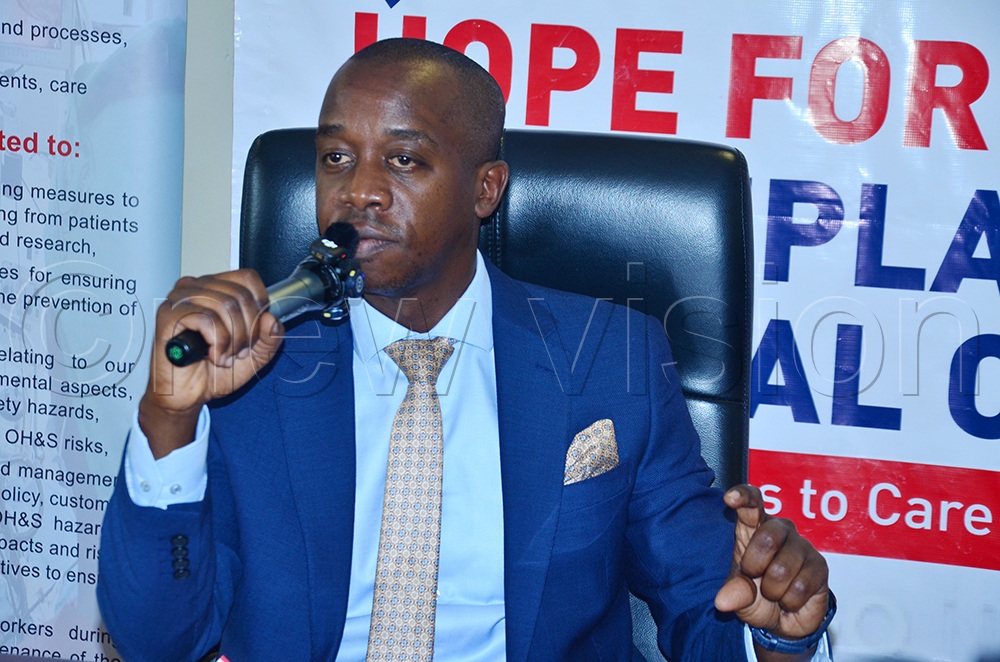
State Minister in charge of primary health care, Dr Charles Ayume, addressing guests during a press conference on hip replacement surgery. (Credit: Agnes Kyotalengerire)
Dr Ayume called for greater awareness of sickle cell disease prevention through trusted community structures, including religious and cultural leaders.
“As long as we do not turn the taps off, we are just holding water in the basket,” he said, emphasising the need to strengthen prevention efforts.
Dr Bangirana estimated that a total hip replacement procedure costs about Sh25 million in private hospitals in Uganda, including the implants and other charges.
At Mulago National Referral Hospital, the cost is estimated at about Sh10 million, excluding accommodation, meals and consultation fees, which are provided free of charge, according to Dr Bangirana.
He said similar medical camps could only be organised when an individual or organisation donated the artificial hip implants.
Mulago National Referral Hospital also performs hip replacement surgeries for patients with sickle cell disease suffering from avascular necrosis when they can afford the implants, he added.
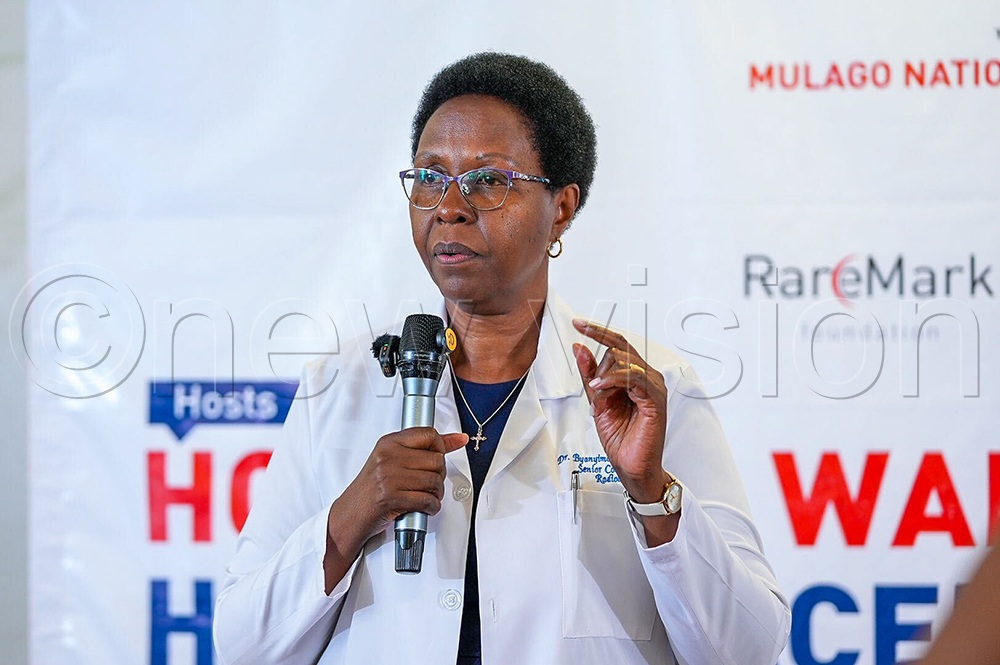
Mulago National Referral Hospital Executive Director Dr Rosemary Byanyima. (Credit: Agnes Kyotalengerire)
The hospital's Executive Director, Dr Byanyima, urged the Government, through the Ministry of Health, to engage manufacturers to negotiate lower prices for the implants.
She said Mulago National Referral Hospital was committed to providing hip replacement surgery, but funding remained the main constraint.
Sickle cell disease burden
Sickle cell disease (SCD) is an inherited blood disorder that affects haemoglobin, the protein in red blood cells responsible for carrying oxygen around the body.
The condition occurs when a child inherits abnormal haemoglobin genes from both parents. This causes red blood cells to become hard and sickle-shaped, potentially blocking blood flow and causing painful episodes and other serious health complications.
Sickle cell disease remains a major public health concern in Uganda. Recent data indicate that about 20,000 babies are born with the disease in the country every year. Approximately 1.3% of Uganda's population lives with sickle cell disease, while 13.3% carry the sickle cell trait.
At Mulago National Referral Hospital, the sickle cell clinic operates from Monday to Friday and registers an average of 150 patients daily.
Dr Phillip Kasirye, a health professional at the sickle cell clinic, said about 5% to 10% of patients with sickle cell disease develop bone complications that require surgery.