
Resilience: Conslate walked 20km for a chance at university
With the family struggling to survive, Conslate began burning and selling charcoal to raise money for her siblings’ school fees.
Natasha Conslate
From burning charcoal to pay school fees to walking 20km to submit a scholarship application, Natasha Conslate from Sebei Sub-region has fought against the odds to stay in school. Today, she is pursuing a degree in agriculture, while championing rights of young people and persons with disabilities. She shared her journey with Ritah Mukasa
At 24, Natasha Conslate has experienced many of the hardships poverty can throw at a child — more so a child living with disability. She has scavenged for survival, nursed a diabetic father and taken on the responsibility of keeping her younger siblings in school.
“Life has been a constant struggle fraught with endless problems,” she says. Conslate is the third of six children born and raised in Kakwere, a remote village in Soi sub-county, Kween district.
During the rainy season, reaching the village can be difficult, further isolating families already grappling with extreme poverty. “We were raised single-handedly by our father, a peasant farmer,” she says, describing him as a strong man who loves his children unconditionally.
“We have been through tough times, but dad has never forsaken us.” Food and other necessities were often hard to come by, but their father was determined to keep his children in school. He believed education was their best chance at a better life.
That belief would become deeply ingrained in Conslate and fuel her determination to overcome poverty; stigma, and the odds stacked against her. Growing up, Conslate dreamed of becoming a doctor so she could treat her father, who was battling diabetes.
She excelled in science subjects, but the constant struggle to raise school fees made it difficult for her to concentrate on her studies. She also grew up without female role models or mentors to guide her.
Most of the women she knew were illiterate and struggling to make ends meet. Early marriage was common and, in some cases, seen as the natural path for girls.
Conslate chose a different path
She was determined to become a change-maker in her community. After completing primary school, she joined Sebei College Tegeres for her O’level education and later attended Jeresar High School in Soroti for A’level.
Walking 20 kilometres for a scholarship
Conslate was a brilliant and disciplined student. During A’level, she set her sights on a government scholarship that would enable her to attend university. But her results dashed those hopes. She scored six points.
“I saw my dream fade. Dad was disappointed. I was devastated,” she recalls. A tertiary institution seemed like the more affordable option, but even that was beyond what her father could manage. Conslate returned home, where another difficult chapter awaited her — finding ways to keep her siblings in school while resisting pressure to get married early. Then her father’s health deteriorated.
He was diagnosed with diabetes, and whatever little the family earned from their garden went towards his medical treatment. With the family struggling to survive, Conslate began burning and selling charcoal to raise money for her siblings’ school fees. Yet, despite everything, she refused to let go of her university dream.
“Deep inside, I had hope that one day, I would join university. It was a matter of time,” she says. She grabbed every opportunity that came her way. One of those opportunities was translating for visitors who came to the community.
Whenever visitors arrived, the local council chairperson would recommend Conslate because of her command of English. She translated for months. Then, during a health camp organised by a non-governmental organisation, her life took an unexpected turn.
The organisation’s driver was impressed by the young woman translating for the visitors. He wondered what someone with her abilities was doing in such a remote village and began asking questions about her. Conslate’s story moved him.
He encouraged her to apply for the Higher Education Access Programme (HEAP), a bridging initiative implemented by the Forum for African Women Educationalists (FAWE) in partnership with the Mastercard Foundation to help disadvantaged students access university. But even applying for the scholarship was a struggle.
Conslate needed to download and print the application form. She did not own a smartphone and the deadline was only two days away.
It took her an entire day to find someone in the village with a smartphone. Finding a printer proved even more difficult. She walked several miles to a trading centre to print the form. Then came the final leg of the journey: Submitting the application.
Conslate walked 20km to the Kween district education office, with a brown envelope in hand. She crossed two thick forests, climbed steep hills and descended into valleys, making the journey alone.
But somewhere along the way, her phone went off, cutting her off from the DEO. The DEO waited, but Conslate did not arrive on time. When she finally reached the office, she found the DEO leaving. Fortunately, she agreed to accept the application. Conslate asked about her chances.
“They told me they were slim because the bursaries are highly competitive. ‘There is no guarantee. Just go home and pray,’” she recalls.
Those words stayed with her. Back home, the family prayed every day for the bursary. Then came the long wait.
“We have a network problem at home,” Conslate explains. There was only one spot, near the kitchen entrance, where they could get a mobile network signal. She placed her button phone there and waited for the DEO’s call.
Nothing. Days turned into weeks. Following her father’s advice, Conslate eventually walked back to the DEO’s office to find out whether she had been selected. She was told the selection process was still ongoing. Then, finally, the call came. But Conslate’s phone was off. The opportunity that she had fought so hard for was once again at risk of slipping away.
“A mentor who had been assigned to me decided to call my father and unusually, his phone was on,” she says.
The family erupted in celebration. Conslate had won the bursary. For her, it was more than financial support. It was the fulfilment of a dream and an open door to opportunities she had spent years fighting for. “Dad prayed, asking God to bless FAWE, thinking it was an individual,” she says with a laugh.
In fact, her father had gone a step further. When Conslate travelled to Mbale city for orientation, he instructed her to buy a bunch of matooke and a chicken for FAWE. “I had received sh80,000 from a client booking for charcoal,” she says.
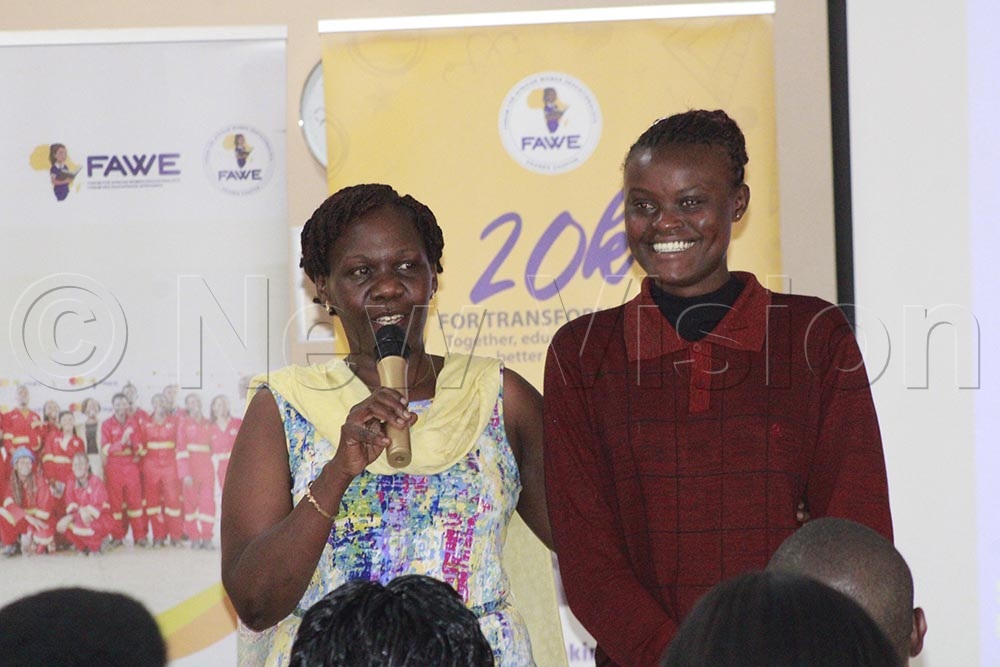
Conslate (right) with FAWE executive director Susan Opok Tumusiime at a TUSEME training recently. (Credit: Ritah Mukasa)
She used part of the money for transport and the food items. But when she arrived at the orientation venue in Mbale, she discovered that FAWE was not an individual who could receive her gift. It was an organisation.
“I was stuck with the matooke and chicken,” she recalls. It was an amusing misunderstanding born out of gratitude, but it also captured just how much the bursary meant to her family.
For years, university had seemed like an impossible dream. Now, the door was open. After completing the Higher Education Access Certificate (HEAC) at Kumi University, FAWE Uganda supported Conslate to transition into a degree programme.
For a young woman who once walked 20km through forests, hills and valleys to submit an application, the journey to university was never just about education. It was a journey of resilience, hope and an unwavering refusal to give up.
“HEAC helped me pursue my dream course, which my UACE results would not have allowed me to achieve,” she says.
The HEAC is a one-year bridging programme for students who do not meet the Uganda Advanced Certificate of Education (UACE) requirements for direct entry into university or diploma programmes.
Today, Conslate is in her second year, pursuing a Bachelor of Science in Agriculture at Muni University in Arua district. Beyond the classroom, she has emerged as a student leader and advocate.
She serves as clerk to council in Arua, deputy speaker in the 11th guild government and guild female representative for persons with disabilities.
Conslate has lived with a physical disability since childhood, when her hand and thigh were severely burnt. Rather than allow her disability to define her, she has turned her experience into a source of advocacy.
As a mentor and youth advocate, she has participated in several youth parliaments across West Nile. She also mentors girls in her community, helping them navigate some of the challenges she encountered growing up.
Her efforts have contributed to several adolescent mothers returning to school. But Conslate says she is not yet where she wants to be. She remains grateful for how far she has come and for the opportunities that have opened up along the way.
“I want to be a successful agriculture entrepreneur with businesses all over the world,” she says. Her journey, however, has also transformed the way she sees herself.
Giving other girls a chance
For Canon Calvin Okello, Programme Coordinator-Education and gender equality champion, Conslate is one of the 1,600 girls FAWE Uganda is supporting to access and complete higher education through the HEAP. But getting onto the programme is not automatic.
Applicants go through a rigorous selection process that begins with applications submitted through district education offices and partner learning institutions.
After applications are reviewed and deserving candidates shortlisted, FAWE teams visit applicants in their homes to understand their circumstances. It was during one of these visits that Okello first met Conslate and witnessed the difficult conditions in which she was living.
They met again at the orientation programme in Mbale in 2024, where Conslate shared her story.
Okello was particularly moved by her account of walking more than 20km to submit her application, as well as the hardships she had endured to put herself through secondary school.
“There are many Conslates in the programme who need this kind of boost,” he says. For many of the beneficiaries, receiving a bursary is only the beginning. Socioeconomic challenges do not disappear simply because a student has secured a place at university.
That is why FAWE Uganda complements the bursary with interventions such as the extended orientation programme, mentorship and the TUSEME model.
The orientation helps students prepare for the transition into higher education by equipping them with academic and life skills.
Through mentorship, psychosocial support and practical guidance, students build confidence, learn to navigate campus life, make informed decisions and develop the resilience needed to thrive.
TUSEME, a participatory and arts-based empowerment approach, gives young people a platform to speak openly about the social, cultural and educational challenges affecting them and work collectively towards solutions.
For Conslate, the TUSEME clubs have become an important space where students can raise issues affecting girls and explore lasting solutions to challenges such as sexual harassment and mental health. Her own story has come full circle.
The girl who once struggled to imagine a future beyond poverty, disability and family responsibilities is now helping other young people see possibilities beyond their circumstances.
And while her dream of becoming a doctor may have changed, her determination to transform lives has not.
Today, Conslate is pursuing agriculture, building her leadership skills and mentoring girls who, like her, need someone to tell them that their circumstances do not have to determine their future.
From shy girl to leader
When Natasha Conslate joined Muni University, she was timid and self conscious, according to Prof. Zami Atibuni, her mentor and a lecturer at the university.
“She confided in me that her physical disability had affected her confidence and that she had tried to conceal it,” Prof. Atibuni recalls.
With time, however, and through continued mentorship, Conslate’s confidence grew. She eventually rose to become deputy speaker of the university’s guild government — a transformation that, to Atibuni, demonstrates just how far mentorship and opportunity can take a young person.
“She has grown from a shy, timid girl into a highly capable leader who has shown incredible resilience along the way,” he says.
Prof. Atibuni has mentored Conslate and other young people through FAWE Uganda’s mentorship model at the university. The experience, he says, has given him a firsthand view of the power of mentorship.
“It is deeply rewarding because you get a front-row seat to the transformative power of education and the chance to serve as a guiding light for someone finding their way,” he says.