
Skills give Entebbe centre teenage mothers lifeline beyond pregnancy
“I'm now an expert at hairdressing. I can move offering services and earn money to survive. I hope the skills will enable me to support my child. I also plan to eventually return to school. I want to become a meteorologist.”
Some of the members of the Rotary Club of Entebbe pose for a group picture with some of the staff and teenage mothers at Wamukisa Youth Centre during their charity visit to the centre on September 30, 2026. (Credit: Lawrence Mulondo)
WAKISO - At Wamukisa Youth Centre in Kitala, Wakiso District, caregivers and Rotarians are championing skills training as a way of helping teenage mothers rebuild their lives and earn a living with dignity after leaving the centre.
The approach is based on a simple reality: providing temporary shelter, food and medical care can save a mother and her baby, but equipping her with a skill can help her survive long after the support ends.
The training includes hairdressing, soap making, baking, tailoring and financial literacy.
For teenage mothers, especially in Uganda and countries in the developing world, giving birth is only the beginning of another difficult journey.
After pregnancy and delivery, many must find ways to feed, clothe and educate their babies while confronting stigma, family rejection and the loss of opportunities that came with becoming mothers at a young age.
Arthur Byara, the president of the Rotary Club of Entebbe, says that supporting teenage mothers should go beyond donations because they will eventually return to their communities and need sustainable means of survival.
During a visit to the centre on Wednesday, September 30, a group of Rotarians led by Byara visited Wamukisa centre, where they delivered an assortment of items and interacted with teenage mothers.
A 19-year-old mother, who preferred anonymity, narrates that she arrived at the centre in n March when she was two months pregnant.
She narrates that after the death of her mother said in 2020, she left home and moved between relatives before returning to live with her father and stepmother while continuing her education.
As she was about to join Senior Six, she got into a relationship with her classmate. A few months later, she realised that she was pregnant.
“I decided against abortion despite fears about how her family would react. I was so scared and hid from my father, but at school a test was conducted, and he was subsequently informed,” she said.
“I'm now an expert at hairdressing. I can move offering services and earn money to survive. I hope the skills will enable me to support my child. I also plan to eventually return to school. I want to become a meteorologist.”
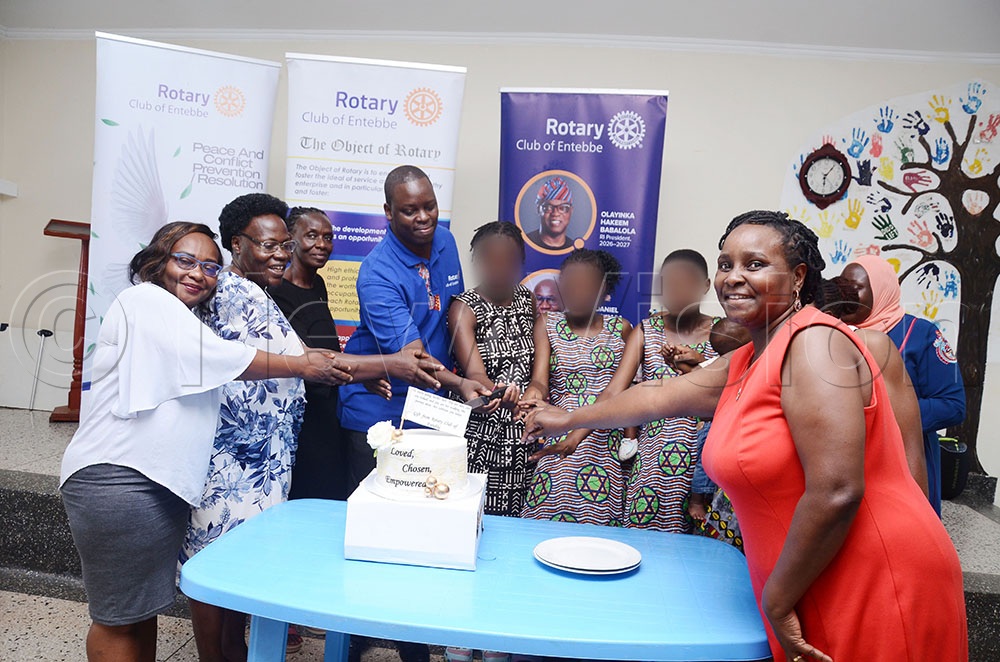
Some of the members of the Rotary Club of Entebbe led by Arthur Byara (blue t-shirt) the club president join some of the staff and teenage mothers at Wamukisa Youth Centre in Kitara Wakiso district to cut cake during their charity visit to the centre on September 30, 2026. (Credit: Lawrence Mulondo)
From survival to economic independence
“We believe skilling the mothers is more sustainable than giving them just donations because these are mothers who will be raising the next generation,” says Byara after his team handed over an assortment of materials to support the mothers.
Byara said the club was supporting training in different ways, including hairdressing, financial literacy and economic empowerment. The Rotary professionals, he said, were volunteering their expertise to equip the mothers with practical skills and mentorship.
He revealed that the club hopes to secure a global grant to expand the initiative, with the ambition of supporting the programme for up to 10 years.
The centre currently accommodates about 32 teenage mothers, although it receives more applications. Byara said expanding the programme would require additional accommodation, training space and equipment.
“Our first call to action is for anyone with a skill to come and pass it on to these teenage mothers who may be in need of it,” he said.
He also called for communities to change their attitudes towards teenage mothers, saying pregnancy should not be treated as the end of a girl's productive life.
Safe motherhood must include life after delivery
Esther Lugoloobi, the centre manager, said Wamukisa supports girls aged between 12 and 19 who have become pregnant, including those referred by community leaders and police after experiencing violence.
“The centre is a safe space where teenage mothers can seek refuge, grow their pregnancies and deliver safely before being reintroduced into their communities,” she said.
The centre ensures that the mothers attend antenatal care and deliver at Kisubi Hospital under professional medical supervision. They also receive counselling and vocational training in partnership with Rotary.
“We have seen mothers get out and become good tailors or hairdressers who are supporting their children well,” Lugoloobi said.
She said mothers remain at the centre for two to three months after delivery before being resettled with their families and communities.
However, some face difficulties returning home, particularly where the father of the baby is a relative or where family relationships have broken down. In such cases, the centre works with partner organisations to arrange alternative care for the baby while supporting the mother.
The centre currently has 32 mothers and 20 babies and is operating at full capacity, with 10 more teenage mothers awaiting admission.
Rebuilding confidence and futures
Rotarian Kezia Nalubega said teenage mothers also require emotional and psychosocial support as they adjust to motherhood.
She encouraged families to avoid stigmatising teenage mothers and instead support them to return to school or acquire skills that can help them pursue their ambitions.
Rotarian Marvin Nantaja, a club coordinator, commended Wamukisa for providing care that helps mothers avoid desperate decisions.