
Universities challenged to introduce AI programmes in all courses
‘‘Although basic computer literacy or general ICT (Information and Computer Technology) and basic digitalisation courses are mandatory as common courses in many undergraduate curricula, this is not enough knowledge for university students in ICT and AI compared to how advanced the world is moving in information technology presently,’’ Muhwezi noted.
Tourism Beauty Queens and Kings, facilitators and officials from MUBS during the ceremony. (Credit: Jovita Mirembe)
KAMPALA - All Universities across the country should consider introducing Artificial Intelligence (AI) programmes and systems across all the courses they offer to enable students to cope with the current academic trends, Prof. Moses Muhwezi, the principal of Makerere University Business School (MUBS), has advised.
According to Muhwezi, students should access AI as a tool that will help them ease their work during studies.
‘‘Although basic computer literacy or general ICT (Information and Computer Technology) and basic digitalisation courses are mandatory as common courses in many undergraduate curricula, this is not enough knowledge for university students in ICT and AI compared to how advanced the world is moving in information technology presently,’’ Muhwezi noted.
He observed that if anyone does not know how to use AI in the next five years, they will be counted among people who are not educated because "a person who knows AI usage will have a certain level of knowledge, which one who doesn’t know AI will not have."
Muhwezi was officiating at the opening of 'The World Tourism Day' students' conference at MUBS on September 18. The conference was organised under the theme "Digital Agenda and Artificial Intelligence: Preparing Future Tourism Professionals for an Intelligent and Innovative Industry.”
The conference was organised in commemoration of the World Tourism Day celebrated annually on September 27.
Dr. Celestine Katongole, the head of the tourism department at MUBS, said Africa is the largest part of the world where 70% of every tourist uses internet to get to their next destination.
Presently, Katongole said, the tourism industry is undergoing transformation driven by rapid advancements in digital technologies and AI across the world, destinations, hotels, airlines, tour operators, museums, and other tourism enterprises.
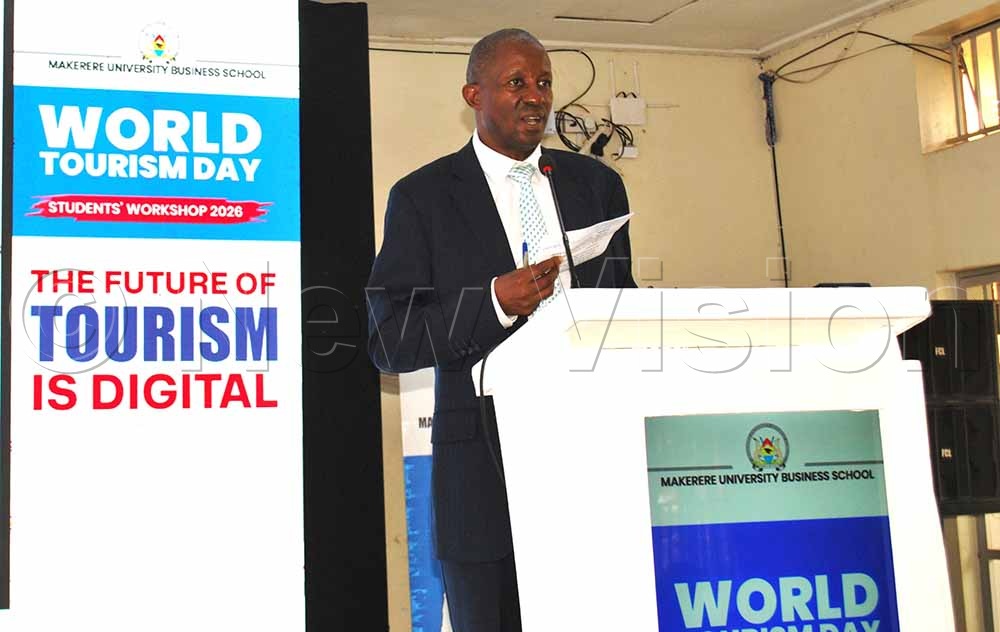
Muhwezi advised students to use the internet on their phones to develop innovative tourism business ideas and market them through the same channel to earn a living. (Credit: Jovita Mirembe)
These enterprises, he added, are increasingly integrating AI, data analytics, digital marketing, automation, and smart technologies to improve operational efficiency, personalise visitor experiences, strengthen destination competitiveness, and support sustainable tourism development.
‘‘Recent studies published in leading tourism papers prove that while digital transformation presents huge opportunities for innovation, productivity, and sustainable destination management, it also exposes a widening gap between the competencies required by the tourism industry and the skills possessed by many tourism graduates.
He noted that as Uganda continues to position tourism as a key driver of socio-economic transformation, it is confident that higher education institutions equip students with future-ready competencies that are in line with global industry trends and national development priorities.
Judith Ashelynne Mubiru, the Chief Executive Officer of Jaan Solution Uganda Limited, a human resource consultancy firm, while presenting a paper on the future of the tourism profession, told tourism students that during job interviews, employers look at only 30% of academic qualifications and the 70% goes to the skills and competence that a candidate has in that field.
‘‘Since we are in a digital competence world, digital confidence and technology skills of a tourism professional are key because you need to understand the challenges travellers are going through to get to their next destination and how they can manoeuvre through.
Tourism students must go to various communities and adopt the behaviour there so that in case they are asked by tourists about such communities, they can go to those places with confidence that they know a lot about them," Mubiru said.
Lyn Tukei, the communication manager at Capital Markets Authority, advised tourism students to use their emotional intelligence so that AI does not replace them in the coming years.
The conference was attended by over 500 tourism students from various universities and tourism training institutions, which included Makerere University, Avance International University, Mutesa Royal University, Metropolitan University, Kyambogo University, ISBAT University, Uganda Hotel and Tourism Training College and MUBS
Others were from Kampala International University, International University of East Africa, Ndejje University, Uganda Christian University, Victoria University, St Lawrence University, Islamic University in Uganda and Uganda Wildlife Research and Training College.