
Rotarians launch sh50m WASH project to improve sanitation at Entebbe School
“Many lessons under the new curriculum require learners to access online resources and conduct internet-based research. That is why we decided to donate 17 laptops to support teaching and learning,” he said. Sembeguya added that the school had been drawing water manually from a shallow well, prompting the club to procure a water pump to improve access to clean water.
(L-R) Samuel Katende the Projects Director Rotary Club of Entebbe Base, Roger Sembeguya the president of the Rotary Club of Entebbe Base, Ruth Obella the school head teacher and Daniel Ddamulira the District 9214 Governor appending signatures on the proposed plan for a water borne toilet at Entebbe Comprehensive Secondary School. This was during the ground-breaking ceremony for the construction of a water borne toilet at the school in Entebbe Municipality on August 4. (Credit: Lawrence Mulondo)
WAKISO - Hundreds of students at Entebbe Comprehensive Secondary School in Lugonjo-Nakiwogo, Entebbe Municipality, arrive each day eager to pursue their education despite a major challenge that has long undermined their learning environment: an acute shortage of sanitation facilities.
While the students' determination reflects resilience, the school's inadequate toilet infrastructure has continued to compromise hygiene, learners' concentration and overall well-being.
The government-aided school, which has an enrolment of 1,657 students, including 900 girls, currently relies on only two six-stance pit latrines for the students. One block is designated for boys and the other for girls, leaving each toilet stance to serve an average of about 80 learners daily.
School administrators say the shortage has made it difficult to maintain proper hygiene standards while forcing some learners to delay using the toilet until they return home, exposing them to health risks and poor sanitation practices.
In response, the Rotary Club of Entebbe Base has launched a sh50m Water, Sanitation and Hygiene (WASH) project aimed at improving sanitation and learning conditions at the school.
The project includes the construction of a sh40m six-stance water-borne toilet with two bathrooms, the donation of 17 laptop computers worth sh10m, and the installation of a sh3m water pump to improve access to water.
Once completed, the new toilet block will primarily serve the boys, easing pressure on the existing facilities and improving the pupil-to-toilet ratio across the school.
Speaking during the ground-breaking ceremony on Tuesday, the President of the Rotary Club of Entebbe Base, Roger Sembeguya, said the project was informed by a community needs assessment conducted two months ago.
He said local leaders identified inadequate sanitation at the school as one of the area's most pressing challenges before introducing the club to the school administration.
“We want to thank the head teacher for opening the doors for us to add our contribution to what others have already done,” Sembeguya said.
“Many lessons under the new curriculum require learners to access online resources and conduct internet-based research. That is why we decided to donate 17 laptops to support teaching and learning,” he said.
Sembeguya added that the school had been drawing water manually from a shallow well, prompting the club to procure a water pump to improve access to clean water.
He said the interventions were intended not only to improve learning conditions but also to inspire students to embrace community service.
“When you grow up, look for people in need and serve them. Improve lives in your communities just as others are doing for you today,” he told the learners.
To ensure sustainability of the projects, Sembeguya said the club would establish an Interact Club at the school to promote leadership, community service and proper management of the donated facilities.
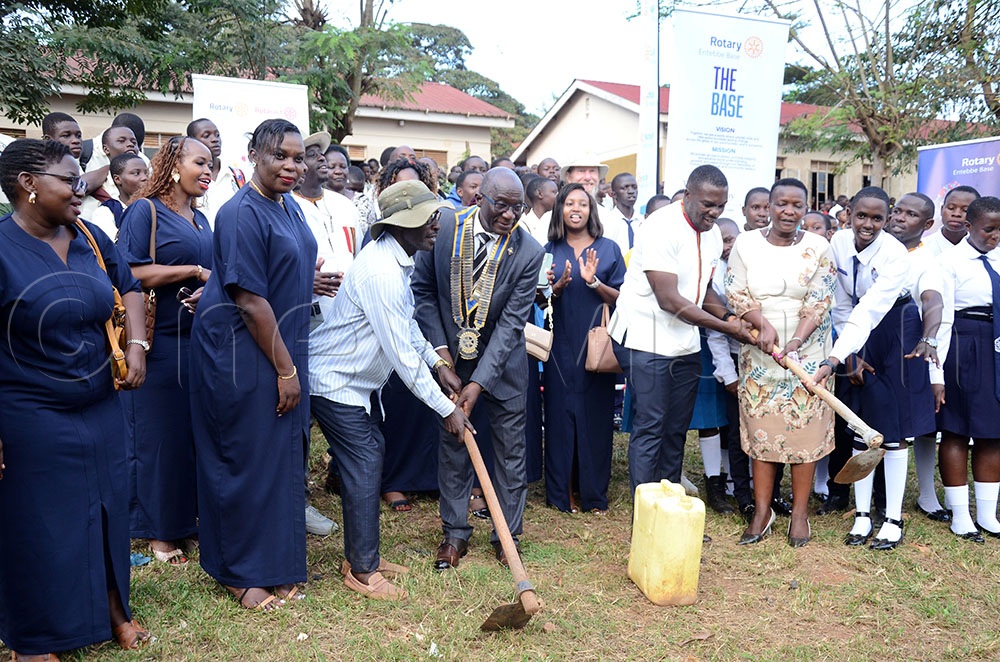
Rotarians led by Daniel Ddamulira (in suit with chain of office) the District 9214 Governor and Roger Sembeguya (white shirt front) the president of the Rotary Club of Entebbe Base join the students and staff of Entebbe Comprehensive Secondary School to break ground for the construction of a water borne toilet at the school in Entebbe municipality. This was on Tuesday. (Credit: Lawrence Mulondo)
District Governor lauds initiative
Rotary District 9214 Governor Daniel Ddamulira, who officiated at the ground-breaking ceremony during his official visit to the club, commended the Rotarians for identifying genuine community needs and responding with practical solutions.
“As governor, one of my responsibilities is to visit clubs, assess what they are doing, inspire them and guide them on best practices. I am happy that this club is representing Rotary very well in this community,” Ddamulira said.
“A toilet is one of those facilities whose importance is only fully appreciated when it is missing. Every school must have adequate sanitation facilities to ensure learners study in comfort and dignity,” he said.
Ddamulira also praised the donation of computers, noting that today's learners are growing up in a digital era and should use technology responsibly to enhance their education.
He urged the school community to use water sparingly and maintain the new toilet block properly once construction is completed.
School welcomes long-awaited relief
The school's head teacher, Ruth Obella, described the project as a dream come true, saying the sanitation challenge had persisted for years despite several attempts to address it.
“When the Rotarians first came with the LC1 chairperson and told us they wanted to build a toilet for the school, we were sceptical. Today, we are grateful because our dream is becoming a reality,” she said.
Obella revealed that parents had previously agreed to contribute sh5,000 per child each term to raise funds for a new toilet block, but the initiative struggled to meet the enormous need.
Village chairperson Paul Zikuliza commended the Rotary Club for consulting community members before implementing projects, saying the approach ensures interventions address the most pressing needs.
He urged the school administration and learners to safeguard the new facilities so they continue serving future generations.
“We believe this project will greatly improve sanitation, hygiene and the learning environment, ultimately helping learners achieve better academic outcomes,” Zikuliza said.