
Learners with disabilities to get alternative competence-based curriculum
Kazinda explained that the new subject developed for learners with disabilities is called Uganda Sign Language and targets learners with hearing and deaf impairments from Senior One to Senior Four.
A cross-section of participants during the closure of the national stakeholders disability inclusion meeting at Hotel Africana in Kampala. (Photo by Francis Emorut)
________________
The government has developed an alternative competence-based curriculum for learners with disabilities in lower secondary schools.
According to Generous Kazinda, acting manager for special needs education at the National Curriculum Development Centre (NCDC), learners with disabilities who are unable to participate in certain practical science activities will be provided with alternative approaches to demonstrate their understanding.
Kazinda explained that the new subject developed for learners with disabilities is called Uganda Sign Language and targets learners with hearing and deaf impairments from Senior One to Senior Four.
“Learners who are unable to participate in certain practical science activities are provided with alternatives which allow them to demonstrate their understanding through explanation and other appropriate approaches,” Kazinda told the audience.
Available data indicate that the enrolment of learners with disabilities remains extremely low, at less than 1% of the total secondary student population.
The Government introduced the competence-based curriculum for lower secondary schools in 2020, aimed at enabling learners to acquire hands-on practical skills during their studies rather than focusing mainly on theory.
“To ensure learners with disabilities participate in the competence-based curriculum, we are developing an alternative science subject for learners who cannot do practicals, called general science, to replace biology, chemistry and physics,” Kazinda, acting manager, special needs education at NCDC, said.
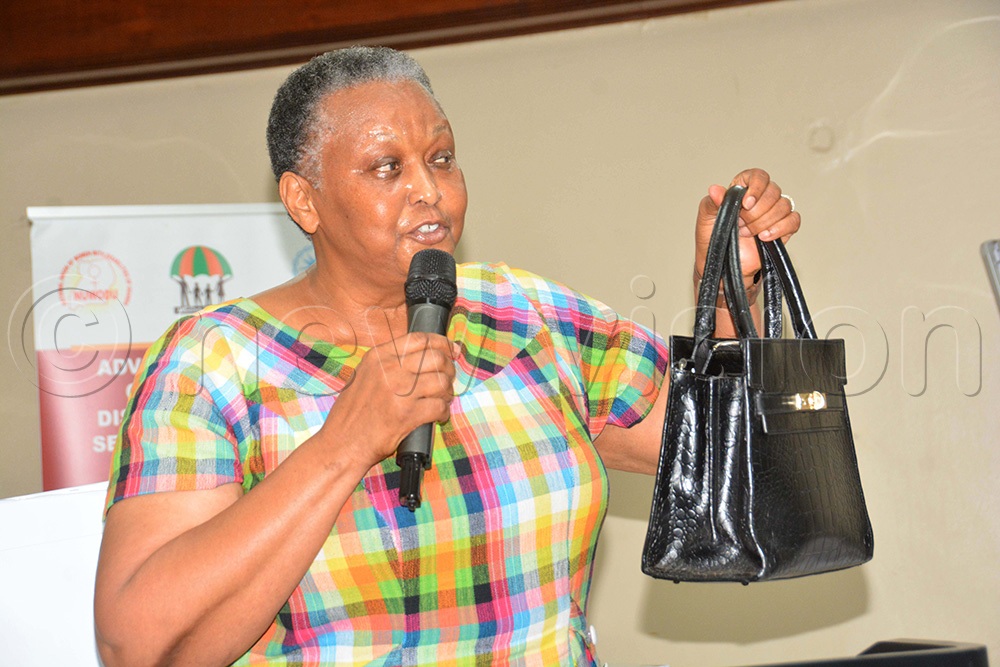
Dr Katana Mirembe, the special presidential advisor at the Presidential Initiative Skilling programme, displays a handbag made by the ghetto youth during the closure of the national stakeholders' disability inclusion meeting at Hotel Africana in Kampala. (Photo by Francis Emorut)
Kazinda made the remarks during the closure of a national stakeholders' disability inclusion meeting organised by the National Union of Disabled Persons of Uganda (NUDIPU) at Hotel Africana in Kampala on September 24, 2026.
She informed participants that her agency had adapted learning activities in 10 subjects for learners with disabilities and that teachers had been oriented to implement the competence-based curriculum.
On the employment of persons with disabilities, Henry Saaba, disability inclusion coordinator at the Federation of Uganda Employers, appealed to employers not to employ them as tea girls or boys, but to recruit them for positions that would help advance their careers.
“Don’t use disability as poster boys but should be on merit,” Saaba said.
He urged organisations working with persons with disabilities and the private sector to institutionalise disability inclusion to promote their rights.
Dr Faith Katana Mirembe, a special presidential adviser at the Presidential Initiative on Skilling programme, asked the ministries of trade, gender, labour and social development to embrace persons with disabilities because they have potential, citing trainees at skilling centres who make leather handbags.
Dr Katana displayed a handbag worth sh300,000 and the dress she was wearing, which had been made by the ghetto youth, to the amazement of participants.
“We are losing a lot of potential; they (ghetto youth) have the capability. We need to follow them up and give start-ups capital to change the mindset and realise their potential,” Dr Kazinda stated.
Lilian Kanushu, the Member of Parliament for the national female constituency for persons with disabilities, decried the exclusion of persons with disabilities from government programmes such as the Youth Livelihood Project, Women Empowerment Project and Parish Development Model.
She noted that whereas the Parish Development Model is the President’s “heartbeat”, few persons with disabilities have benefited from the programme and there is a need to increase the number of beneficiaries.
Lilian Namukasa, programme manager at the National Council for Persons with Disabilities, informed the audience that the council had visited 10 districts to assess access to health services and found physical infrastructure without ramps, as well as communication barriers between health workers and patients due to a lack of sign language interpreters.
She told participants that the council was grappling with low staffing levels, saying the recommended staffing level was three personnel, but she was the only employee running the council's activities.
Namukasa appealed to organisations working with persons with disabilities to produce reports and work as a team to promote the rights of persons with disabilities.
She threatened to report organisations that are non-compliant with report writing to the NGO Bureau so that it could take action against them.