
Remembering King Oyo’s journey to Margherita Peak
On August 3, 2022, Oyo arrived at Nyakalengijo Gate in Ibanda-Kyanya Town Council, Kasese District, where he was warmly welcomed by local residents and officials from Rwenzori Mountains National Park.
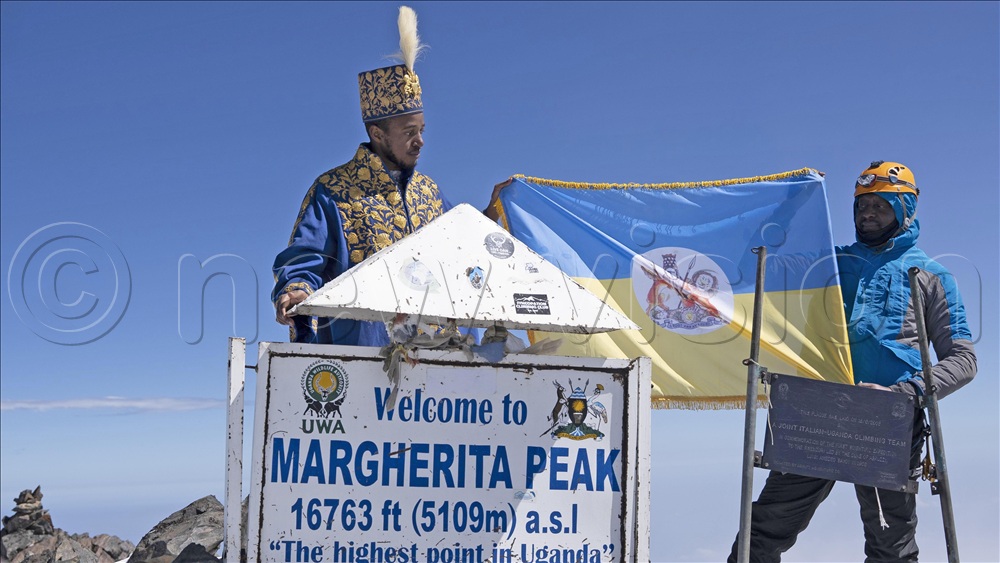
King Oyo Kabamba Iguru (left) and his executive assistant Jonathan Baala at the Margherita Peak upon conquering the 5,109 meters’ highest peak of Rwenzori mountains. (File photos)
________________
For 10 days, King Oyo Nyimba Kabamba Iguru Rukidi IV left behind the comfort and ceremony of the royal court and followed a difficult trail through the steep slopes, boggy valleys and cold terrain of the Rwenzori Mountains.
His destination was Margherita Peak, the highest point in the Rwenzori Mountains, standing at 5,109 metres above sea level.
However, the young King was not climbing the mountain simply to conquer one of Uganda’s most challenging peaks. He wanted to see the mountain for himself and draw attention to what was happening to its environment.
The expedition was also intended to promote tourism and encourage communities to take advantage of opportunities created by visitors to the Rwenzori.
The 10-day expedition, held in August 2022, was dubbed the Rwenzori Royal Expedition. It brought together officials from Tooro Kingdom, the Ministry of Tourism, Wildlife and Antiquities, the United Nations Development Programme and the Uganda Tourism Board.
On August 3, 2022, Oyo arrived at Nyakalengijo Gate in Ibanda-Kyanya Town Council, Kasese District, where he was warmly welcomed by local residents and officials from Rwenzori Mountains National Park.
For residents who witnessed his arrival, the sight of a King preparing to walk into the mountains like an ordinary climber was unusual.
Enosi Muhindo, a resident of Ibanda Village who listened to the King’s remarks, said Oyo used the opportunity to highlight some of the challenges faced by people climbing the mountain.
Muhindo said the King called for better infrastructure, including boardwalks and ladders, to improve the safety of climbers.
“He also talked about the need to ensure skilled rescue teams and first-aid services are employed,” Muhindo said.
But beneath the physical challenge of the climb was a much bigger concern: the mountain was changing.
In June 2021, while hosting visitors around a fireplace, the King announced that he would climb the Rwenzori and shoot a short documentary about the journey.
Joan Else Kantu, the Tooro Kingdom Minister of Tourism, later said the King wanted to move beyond simply talking about environmental conservation and instead experience the changes on the mountain himself.
“Our environment is very key; people are talking, dreaming, and dancing about it, but hey, our King decided to take action, and the action was to climb Rwenzori and see it himself if those glaciers are still there,” she said.
The resulting 20-minute documentary highlighted the Rwenzori and other tourism attractions in Tooro and Uganda. It was also intended to promote Uganda as a tourism destination beyond its borders.
Kantu said the Kingdom first premiered the film in the United States, where it attracted interest from potential tourists.
The Rwenzori provides a spectacular setting for such a campaign. Its slopes rise through grassland, montane forest, bamboo and heather before reaching the unusual afro-alpine vegetation near the summit.
The ecosystem is home to 54 Albertine Rift endemic species and more than 217 recorded bird species, including the Rwenzori Turaco, Bamboo Warbler and Golden-winged Sunbird.
The Rwenzori Mountains were designated a UNESCO World Heritage Site in 1994 and later became a Ramsar Site in 2008 because of their ecological importance.
However, Oyo’s message was not only about attracting tourists. He also wanted communities living around the mountain to benefit from the visitors it attracts.
Erick Mwesige, another resident who heard the King speak, said Oyo encouraged people along the route to invest in agriculture and tourism.
“He encouraged us to plant more food crops and fruits, but also rear birds, especially hens, and some animals. Then he advised those with enough money and land to construct up-to-standard hotels and guest houses,” Mwesige said.
The King’s message was that tourism and conservation should also create opportunities for surrounding communities.
Four years after the expedition, some of the infrastructure concerns raised during Oyo’s visit have seen progress.
George Busingye, the chief warden of Rwenzori Mountains National Park, recently said boardwalks and other critical infrastructure had been installed across boggy valley floors and steep sections of the mountain.
The improvements have coincided with an increase in visitors to the park.
Busingye said visitor numbers increased from 7,703 in the 2023–2024 financial year to 10,483 in the 2024–2025 financial year.
The increase underlines the tourism potential Oyo sought to showcase through his expedition and documentary.
Daniel Irumba of the Uganda Tourism Board said Uganda’s natural beauty can attract international visitors and generate much-needed foreign exchange.
In 2022, international visitor arrivals increased by 58.8 per cent, from 512,945 to 814,508. Tourism and visitor exports generated Sh2.718 trillion during the same year.
However, the shrinking glaciers remain a warning that some of the attractions Uganda hopes to sell to tourists could themselves be threatened by climate change.
Irumba said the documentary would show the retreating glaciers while calling for urgent action against the causes of climate change.
“When glaciers overheat, those are the floods; we see rivers bursting, yet we can control them,” he said.
The concern is particularly relevant in Kasese, where flooding has repeatedly destroyed roads, homes and crops and claimed lives.
River Nyamwamba, for instance, has frequently burst its banks, leaving communities counting their losses.
Prof Emeka Akaezuwa, the vice-chancellor of the International University of East Africa, said institutions of learning also have a role to play in finding solutions to climate change while supporting tourism.
“We are training experts; we are already leading by example in managing carbon emissions because we have electric bikes,” he said.
For the late King Oyo, the journey to Margherita Peak was more than a royal adventure. It was a journey into a changing landscape and a call to protect it.
He climbed the mountain to see the Rwenzori for himself, but he also wanted the world to see it.
The message he left after the climb was clear: Uganda can invite the world to experience the beauty of the Rwenzori, but it must also protect the environment that makes the mountain worth visiting.